Results of the Development of Guidelines and Mechanisms for Disease Prevention and Control Using the Concept of Mechanism of District Health Board in Area Health Region Number 7
Keywords:
Results of the development, Disease prevention and control, Mechanism of District Health BoardAbstract
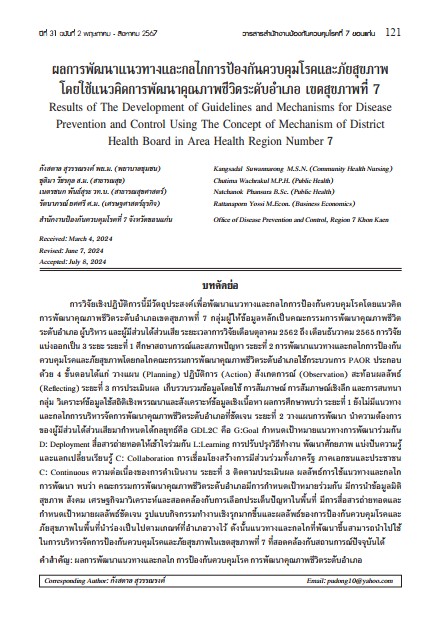
This action research aimed to develop guidelines and mechanisms for disease prevention and control, using the concept of improving quality of life at the district level in Area Health Region Number 7. The key informants included members of the District Health Board (DHB), administrators, and stakeholders. Research period was from October 2019 to December 2022. The research was divided into three phases. Phase I involved studying the situation and problem conditions. Phase II developed guidelines and mechanisms for disease prevention and control, addressing health hazards through the mechanism of the District Quality of Life Development Committee, using the PAOR process comprising four steps: planning, action, observation, and reflecting. Phase III involved evaluation, data were collected through interviews, focus group discussions, and in-depth interviews. The data were analyzed using descriptive statistics and content data synthesis. The results of the study found that Phase I did not have clear guidelines and management mechanisms for improving the quality of life at the district level. Phase II planned development by taking the needs of stakeholders into determination, resulting in the formulation of the GDL2C framework. This framework included Goal(G) strategy, goals, and development guidelines; Deployment (D) strategies to communicate and convey for mutual understanding; Learning (L) initiatives aimed at improving working methods, sharing knowledge, and developing potential; Collaboration (C) efforts to create participation among the public, private, and public sectors; and Continuous (C) measures to ensure the continuity of operations. Phase III involved follow-up and evaluation. The results of using development guidelines and mechanisms, along with lessons learned, were examined. It was found that the CSOs had shared goals. Data on health, social, and economic dimensions were used for analysis and were consistent with the selection of local issues. Communication was conveyed to stakeholders and goals were clearly defined. The activity format became more proactive and the results of disease and health hazard prevention and control in the pilot areas aligned with the criteria set by the district. Therefore, the developed guidelines and mechanisms could be used in the management, prevention, and control of diseases and health hazards in Public Health Region 7, consistent with the current situation.
Downloads
References
Tarimo E, Fowkes FGR. Strengthening the backbone of primary health care. World Health Forum 1989; 10(1): 74-9.
คณะกรรมการอำนวยการจัดทำแผนพัฒนาสุขภาพแห่งชาติ. แผนสุขภาพแห่งชาติฉบับที่ 12 พ.ศ.2560-2564. นนทบุรี: กระทรวงสาธารณสุข; 2560.
World Health Organization. WHO global strategy on people-centred and integrated health services. Geneva: World Health Organization; 2015.
ระเบียบสำนักนายกรัฐมนตรีว่าด้วยการพัฒนาคุณภาพชีวิตระดับพื้นที่ พ.ศ.2561. ราชกิจจานุเบกษา 2561; เล่ม 135 ตอนพิเศษ 54ง หน้า 1-7.
สำนักงานบริหารยุทธศาสตร์สุขภาพดีวิถีชีวิตไทย. บันทึกความร่วมมือคณะกรรมการพัฒนาคุณภาพชีวิตระดับอำเภอ [อินเทอร์เน็ต]. 2559 [เข้าถึงเมื่อ 2 มีนาคม 2561]. เข้าถึงได้จาก: https://shorturl-ddc.moph.go.th/KZTt9
Ministry of Health New Zealand. Guidelines for district health boards mental health quality monitoring and audit. Wellington: New Zealand; 2002.
สถาบันรับรองคุณภาพสถานพยาบาล (องค์การมหาชน). มาตรฐานระบบสุขภาพระดับอำเภอ ฉบับมิถุนายน 2563 [อินเทอร์เน็ต]. 2563 [เข้าถึงเมื่อ 12 กุมภาพันธ์ 2565]. เข้าถึงได้จาก: https://shorturl-ddc.moph.go.th/GgCKI
Kemmis S, McTaggart R. The action research planer. 3rd ed. Geelong, Australia: Deak in University Press; 1988.
คณะทำงานจัดทำแผนยุทธศาสตร์ 20 ปี เพื่อพัฒนาระบบป้องกันควบคุมโรคแห่งชาติ. แผนพัฒนาด้านการป้องกันควบคุมโรคและภัยสุขภาพของประเทศ ระยะ 20 ปี (2561-2680) ฉบับย่อ. นนทบุรี: กองแผนงาน กรมควบคุมโรค กระทรวงสาธารณสุข; 2560.
ดวงดาว สารัตน์, ประภัทรสร พิมพ์ดี, ดวงเดือน ศรีมาดี, ประชัน อาจนนลา, ฐิติกรณ์ ไชยรัตน์ . การพัฒนาระบบและกลไกการป้องกันและควบคุมโรคติดเชื้อไวรัสโคโรน่า 2019 (โควิด19) โดยการมีส่วนร่วมของคณะกรรมการพัฒนาคุณภาพชีวิตอำเภอเมืองสรวง จังหวัดร้อยเอ็ด. วารสารวิจัยและพัฒนานวัตกรรมทางสุขภาพ 2565; 3(2): 108-23.
กานต์ชัชพิสิฐ คงเสถียรพงษ์, ศิวิไลซ์ วนรัตน์วิจิตร. คณะกรรมการพัฒนาคุณภาพชีวิตระดับอำเภอ : ความท้าทายและการพัฒนา. วารสารวิทยาลัยพยาบาลบรมราชชนนีอุตรดิตถ์ 2564; 13(2): 275–86.
อดุลย์ บำรุง. ข้อเสนอแนะการพัฒนาสมรรถนะคณะกรรมการพัฒนาคุณภาพชีวิต (พชอ.). วารสารสำนักงานสาธารณสุขจังหวัดขอนแก่น 2562; 1(1): 87-101.
ถนัด ใบยา, ยุพิน แตงอ่อน. การประเมินผลรูปแบบการดำเนินงานพัฒนาคุณภาพชีวิตระดับอำเภอที่เชื่อมโยงกับการพัฒนาตำบลจัดการคุณภาพชีวิต จังหวัดน่าน. วารสารวิชาการกรมสนับสนุนบริการสุขภาพ 2565; 18(1): 59-68.
Downloads
Published
How to Cite
Issue
Section
License
Copyright (c) 2024 สำนักงานป้องกันควบคุมโรคที่7จังหวัดขอนแก่น

This work is licensed under a Creative Commons Attribution-NonCommercial-NoDerivatives 4.0 International License.
ความรับผิดชอบ
บทความที่ลงพิมพ์ในวารสารสำนักงานป้องกันควบคุมโรคที่ 7 ขอนแก่น ถือเป็นผลงานทางวิชาการหรือวิจัย และวิเคราะห์ตลอดจนเป็นความเห็นส่วนตัวของผู้เขียน ไม่ใช่ความเห็นของวารสารสำนักงาน ป้องกันควบคุมโรคที่ 7 จังหวัดขอนแก่น หรือ ของกองบรรณาธิการแต่ประการใด ผู้เขียนต้องรับผิดชอบต่อบทความของตนเอง
ลิขสิทธ์บทความ
บทความที่ได้รับการตีพิมพ์จะถือเป็นลิขสิทธิ์ของสำนักงานป้องกันตวบคุมโรคที่ 7 จังหวัดขอนแก่น