Results of The Development Model of Fermented Fish Establishments Free From Liver Flukes with Local Participation at Ubolratana District, Khon Kaen Province
Keywords:
Pickled and fermented fish products, Fluke-free productsAbstract
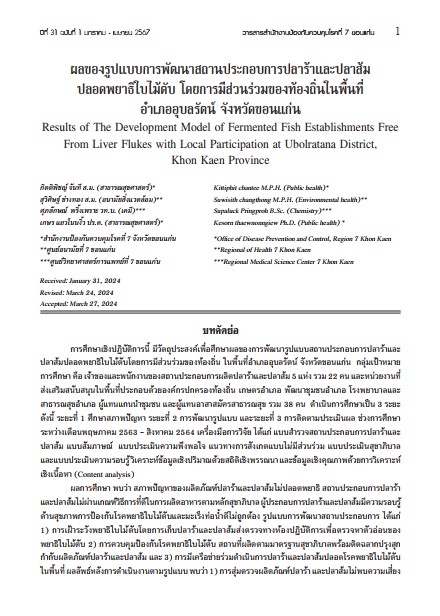
This action research aimed to develop a model to enhance the quality of fermented fish products to mitigate liver fluke contamination. The study was conducted at the Ubolratana District, Khon Kaen Province, with the participation of 60 personnel from relevant organizations, including the Ubolratana Municipality, the Administration Organization of Ubolratana sub-district, fermented fish producers, Ubolratana Hospital, the District Health Office, the District Agriculture Office, District community development office, community leaders, and health volunteers. The study proceeded through three phases: situational analysis, development of intervention strategies, and monitoring and evaluation. Data collection took place between May 2020 and August 2021. Various research instruments such as surveys of fish and fermented fish product establishments, interviews, satisfaction assessments, non-participant observation forms, food safety standard assessment forms, and health literacy assessment questionnaires were used. Data analysis involved descriptive statistics and content analysis.
The results of a study indicated that fermented fish and pickled fish products are often contaminated with liver fluke. Such products do not meet the food safety standards set by health regulations. The producers of these products lack accurate knowledge on how to prevent liver fluke and bile duct cancer. To address this issue, three establishment models were established: 1) Lab tests are conducted on fermented and pickled fish samples to detect liver fluke eggs; 2) Producers are supported in holding to health standards and labeling their products as "fluke-free" to control and prevent liver fluke disease; 3) A collaborative network is established to operate liver fluke-free fermented fish and pickled fish operations in the area. After the intervention, it was found that: 1) Random testing of fermented and pickled fish products did not detect any liver fluke contamination; 2) All fermented fish and pickled fish products were labeled as "fluke-free"; 3) Establishments that produce fermented and pickled fish now meet the standards for food production set by health regulations; 4) Producers of fermented and pickled fish now possess increased knowledge on preventing liver fluke and bile duct cancer; 5) Local enforcement efforts led to the regulation of hazardous business activities related to the production, accumulation, or packaging of fermented foods such as fermented fish, pickled fish, or similar products.
The study emphasizes the effectiveness of collaborative approaches among fermented fish producers to produce fluke-free products through community-supported initiatives, fostering collective progress toward shared objectives.
Downloads
References
กรมควบคุมโรค กระทรวงสาธารณสุข. แผนยุทธศาสตร์ทศวรรษกำจัดพยาธิใบไม้ตับและมะเร็งท่อน้ำดี ปี 2558-2568. นนทบุรี: สำนักงานกิจการโรงพิมพ์ องค์กรทหารผ่านศึกในพระบรมราชูปถัมภ์; 2559.
Shin HR, Oh JK, Masuyer E, Curado MP, Bouvard V, Fang Y, et al. Comparison of incidence of intrahepatic and extra hepatic cholangiocarcinoma-focus on East and South-Eastern Asia. Asian Pac J Cancer Prev 2010; 11(5): 1159 - 66.
สำนักโรคติดต่อทั่วไป กรมควบคุมโรค กระทรวงสาธารณสุข. แนวทางการปฏิบัติงาน โครงการควบคุมโรคหนอนพยาธิ ในโครงการตามพระราชดำริสมเด็จพระเทพรัตนราชสุดาฯ สยามบรมราชกุมารี. กรุงเทพฯ: พุมทอง; 2561.
Sadun EH. Studies on Opisthorchis viverrini in Thailand. Am J Hyg 1955; 62(2): 81–115.
กรมควบคุมโรค กระทรวงสาธารณสุข. แผนงานป้องกันควบคุมโรคพยาธิใบไม้ตับและมะเร็งท่อน้ำดี (โครงการรณรงค์กำจัดปัญหาโรคพยาธิใบไม้ตับและมะเร็งท่อน้ำดี ถวายเป็นพระราชกุศลฯ). ใน: ธนรักษ์ ผลิพัฒน์, บรรณาธิการ. แนวทางการดำเนินงานป้องกันควบคุมโรคและภัยสุขภาพสำหรับพื้นที่ ประจำปีงบประมาณ 2564 ภายใต้แผนพัฒนาด้านการป้องกันควบคุมโรคและภัยสุขภาพของประเทศ ระยะ 20 ปี พ.ศ.2561-2580. พิมพ์ครั้งที่ 2. กรุงเทพฯ: อักษรกราฟฟิคแอนด์ดีไซน์; 2561. หน้า 51-76.
ญาธิปวีร์ ปักแก้ว. ปกิณกะ ปลาร้า:ความเป็นมา และวัฒนธรรมการกิน “ปลาส้ม” ผลิตภัณฑ์พื้นบ้านไทยยอดนิยม. วารสารวิจัยและพัฒนาผลิตภัณฑ์อาหาร (Food journal) 2562; 49(2): 37 - 41.
Carr W, Kemmis S. Becoming Critical: Education, knowledge and action research. Lewes, Sussex: Fa1met; 1986.
ทิพย์กมล ภูมิพันธ์, อุไรวรรณ อินทร์ม่วง. สุขลักษณะของการประกอบกิจการผลิตปลาร้าและปลาส้มในอำเภอหนึ่งจังหวัดขอนแก่น. วารสารมหาวิทยาลัยขอนแก่น 2559; 16(2): 75 - 85.
สมคิด เลิศไพฑูรย์. หน้าที่และอำนาจขององค์กรปกครองส่วนท้องถิ่นตามระบบกฎหมายไทย. กรุงเทพฯ: เดือนตุลา; 2565.
สำนักงานกองทุนการสร้างเสริมสุขภาพ. ปรับการกิน ป้องกันพยาธิใบไม้ตับ [อินเทอร์เน็ต]. 2559 [เข้าถึงเมื่อ 20 มีนาคม 2563] เข้าถึงได้จาก: https://www.thaihealth.or.th/?p=257955
วิลาวัณย์ ภูมิดอนมิ่ง, ดุลยทรรศน์ กรฑ์แสง, คำพล แสงแก้ว, นันทพร ธรรมะตระกูล, ภานุมาศ โคตะนนท์. การส่งเสริมการบริโภคอาหารพื้นบ้านปลอดพยาธิใบไม้ตับ เพื่อลดอัตราการติดเชื้อและป้องกันการติดเชื้อและป้องกันการติดเชื้อซ้ำ ตำบลโคกปรง จังหวัดเพชรบูรณ์. วารสารวิจัยเพื่อการพัฒนาเชิงพื้นที่ 2563; 12(1): 22 – 40.
สรญา แก้วพิทูลย์, ณัฏฐวุฒิ แก้วพิทูลย์. รายงานการวิจัยเพื่อพัฒนาปลาร้า-ปลาส้มปลอดพยาธิใบไม้ตับ เพื่อลดปัจจัยเสี่ยงของมะเร็งท่อน้ำดี. (รายงานการวิจัย). นครราชสีมา: มหาวิทยาลัยเทคโนโลยีสุรนารี; 2559.
Onsurathum S, Pinlaor P, Haonon O, Chaidee A, Charoensuk L, Intuyod K, et al. Effects of fermentation time and low temperature during the production process of Thai pickled fish (pla-som) on the viability and infectivity of Opisthorchis viverrini metacercariae. Int J Food Microbiol 2016; 218: 1-5.
ฐิติมา วงศาโรจน์. กินปลาอย่างไร ไม่ให้ติดพยาธิใบไม้ตับ. จุลสารศูนย์ประสานงานพยาธิใบไม้ตับและมะเร็งท่อน้ำดี 2560; 2(7): 4 - 6.
Downloads
Published
How to Cite
Issue
Section
License
Copyright (c) 2024 สำนักงานป้องกันควบคุมโรคที่7จังหวัดขอนแก่น

This work is licensed under a Creative Commons Attribution-NonCommercial-NoDerivatives 4.0 International License.
ความรับผิดชอบ
บทความที่ลงพิมพ์ในวารสารสำนักงานป้องกันควบคุมโรคที่ 7 ขอนแก่น ถือเป็นผลงานทางวิชาการหรือวิจัย และวิเคราะห์ตลอดจนเป็นความเห็นส่วนตัวของผู้เขียน ไม่ใช่ความเห็นของวารสารสำนักงาน ป้องกันควบคุมโรคที่ 7 จังหวัดขอนแก่น หรือ ของกองบรรณาธิการแต่ประการใด ผู้เขียนต้องรับผิดชอบต่อบทความของตนเอง
ลิขสิทธ์บทความ
บทความที่ได้รับการตีพิมพ์จะถือเป็นลิขสิทธิ์ของสำนักงานป้องกันตวบคุมโรคที่ 7 จังหวัดขอนแก่น