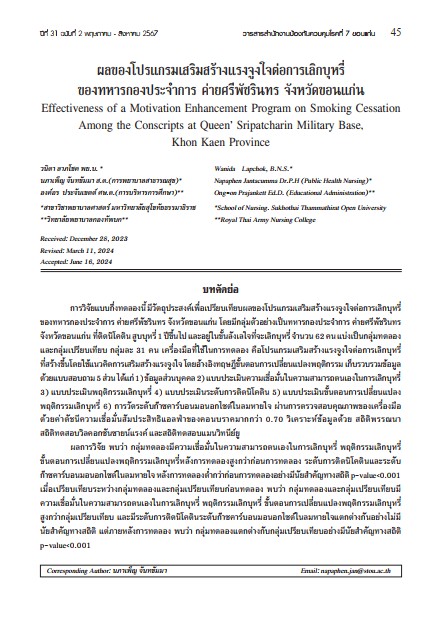
Effectiveness of a Motivation Enhancement Program on Smoking Cessation among the conscripts at Queen’ Sripatcharin Military Base, Khon Kaen Province
Keywords:
Motivation enhancement program, Stage of change, Quit smoking, ConscriptAbstract
The objective of this quasi-experimental research was to compare the effectiveness of a motivation-enhancing smoking cessation program among soldiers stationed at Sri Patcharinthra Camp, Khon Kaen Province. A sample group of soldiers from Sri Patcharinthra Camp, Khon Kaen Province, consisting of 62 individuals who had been smoking cigarettes for at least one year and were contemplating quitting smoking, was divided into an experimental group and a control group, each comprising 31 individuals. The tool utilized for the experiment was a motivation-enhancing smoking cessation program developed based on the principles of motivational enhancement theory, referencing the stages of behavior change. Data were collected through a questionnaire consisting of six parts 1) Personal information 2) Assessment of self-efficacy beliefs in smoking cessation 3) Assessment of smoking cessation behaviors 4) Assessment of nicotine dependence level 5) Assessment of stages of behavior change in smoking cessation 6) Measurement of exhaled carbon monoxide levels. Passed the quality check of the instrument with a Cronbrach alpha coefficient greater than 0.70. Data analysis employed descriptive statistics, Wilcoxon signed-rank test, Mann-Whitney U test.
Results found that, the experimental group exhibited significantly higher levels of self-efficacy beliefs in smoking cessation, smoking cessation behaviors, and stages of behavior change in smoking cessation post-experiment compared to pre-experiment levels. Additionally, post-experiment, the experimental group had significantly lower levels of nicotine dependence and exhaled carbon monoxide levels compared to pre-experiment levels, with statistical significance (p < 0.001). When comparing the experimental and control groups pre-experiment, no statistically significant differences were found in self-efficacy beliefs, smoking cessation behaviors, stages of behavior change, nicotine dependence levels, or exhaled carbon monoxide levels. However, post-experiment, statistically significant differences were observed between the experimental and control groups (p < 0.001).
Recommendations include implementing the motivation-enhancing smoking cessation program for new military personnel and conducting nicotine dependence assessments for all individuals.
Downloads
References
GBD 2019 Tobacco Collaborators. Spatial, temporal, and demographic patterns in prevalence of smoking tobacco use and attributable disease burden in 204 countries and territories, 1990–2019: a systematic analysis from the Global Burden of Disease Study 2019. Lancet 2021; 397(10292): 2337-60.
Ezzati M, Lopez AD. Estimates of Global Mortality attributable to smoking in 2000. Lancet 2003; 362(9387): 847-52.
Gajalakshmi CK, Jha P, Ranson K, Nguyen S. Global patterns of smoking and smoking-attributable mortality: tobacco control in developing countries. Oxford: Oxford University Press; 2000.
กองสถิติสังคม สำนักงานสถิติแห่งชาติ. การสำรวจพฤติกรรมด้านสุขภาพของประชากร พ.ศ. 2564. กรุงเทพฯ: กระทรวงดิจิทัลเพื่อเศรษฐกิจและสังคม; 2564.
กรมควบคุมโรค. รายงานสถานการณ์โรค NCDs เบาหวาน ความดันโลหิตสูงและปัจจัยเสี่ยงที่เกี่ยวข้อง พ.ศ.2562. กรุงเทพฯ: อักษรกราฟฟิคแอนด์ดีไซน์; 2562.
รณชัย คงสกนธ์. มุ่งมั่นตั้งใจเลิกบุหรี่ได้จริง. วารสารก้าวทันวิจัยกับ ศจย. 2564; 13 (2): 4-6.
Holder HD, Cisler RA, Longabaugh R, Stout RL, Treno AJ, Zweben A. Alcoholism treatment and medical care costs from Project MATCH. Addiction. 2000; 95(7): 999-1013.
จารุวรรณ ไชยบุบผา, ภรภัทร เฮงอุดมทรัพย์, ดวงใจ วัฒนสินธุ์. ผลของโปรแกรมเสริมสร้างแรงจูงใจต่อการสมรรถนะแห่งตนและพฤติกรรมการเลิกบุหรี่ในผู้รับบริการชาย. วารสารคณะพยาบาลศาสตร์ มหาวิทยาลัยบูรพา 2561; 26(4): 10-20.
Rolnick S, Miller WR. What is motivational interviewing? Behavioural and Cognitive Psychotherapy 1995; 23(4): 325–34.
Prochaska JO, DiClemente CC. Transtheoritical therapy: toward a more integrative model of change. Psychotherapy: theory, Research & Practice 1982; 19(3): 276-88.
สุกัญญา คำก้อน, แอนน์ จิระพงษ์สุวรรณ, สุรินธร กลัมพากร, สุคนธา ศิริ. โปรแกรมช่วยเลิกบุหรี่สำหรับผู้กลับมาสูบซ้ำของทหารกองประจำการในค่ายหลวงชุมพรเขตอุดมศักดิ์ จังหวัดชลบุรี. วารสารพยาบาล 2562; 69(1): 44-53.
กรองจิต วาทีสาธกกิจ. การส่งเสริมการเลิกบุหรี่ในงานประจำ. พิมพ์ครั้งที่ 2. กรุงเทพฯ: มูลนิธิรณรงค์เพื่อการไม่สูบบุหรี่; 2551.
ภาสกร เนตทิพย์วัลย์, สุนีย์ ละกำปั่น, สุรินธร กลัมพากร. ประสิทธิผลของโปรแกรมส่งเสริมการเลิกบุหรี่โดยประยุกต์ทฤษฎีขั้นตอนการเปลี่ยนแปลงสำหรับข้าราชการตำรวจ กรุงเทพมหานคร. วารสารพยาบาลตำรวจและวิทยาศาสตร์สุขภาพ 2560; 9(1): 82-93.
พยอม สุขเอนกนันท์ โอล์สัน. การเสพติดนิโคติน [อินเทอร์เน็ต]. 2563 [เข้าถึงเมื่อ 17 ธันวาคม 2566 ]. เข้าถึงได้จาก: https://ccpe.pharmacycouncil.org/index.php?option=article_detail&subpage=article_detail&id=928
Downloads
Published
How to Cite
Issue
Section
License
Copyright (c) 2024 สำนักงานป้องกันควบคุมโรคที่7จังหวัดขอนแก่น

This work is licensed under a Creative Commons Attribution-NonCommercial-NoDerivatives 4.0 International License.
ความรับผิดชอบ
บทความที่ลงพิมพ์ในวารสารสำนักงานป้องกันควบคุมโรคที่ 7 ขอนแก่น ถือเป็นผลงานทางวิชาการหรือวิจัย และวิเคราะห์ตลอดจนเป็นความเห็นส่วนตัวของผู้เขียน ไม่ใช่ความเห็นของวารสารสำนักงาน ป้องกันควบคุมโรคที่ 7 จังหวัดขอนแก่น หรือ ของกองบรรณาธิการแต่ประการใด ผู้เขียนต้องรับผิดชอบต่อบทความของตนเอง
ลิขสิทธ์บทความ
บทความที่ได้รับการตีพิมพ์จะถือเป็นลิขสิทธิ์ของสำนักงานป้องกันตวบคุมโรคที่ 7 จังหวัดขอนแก่น