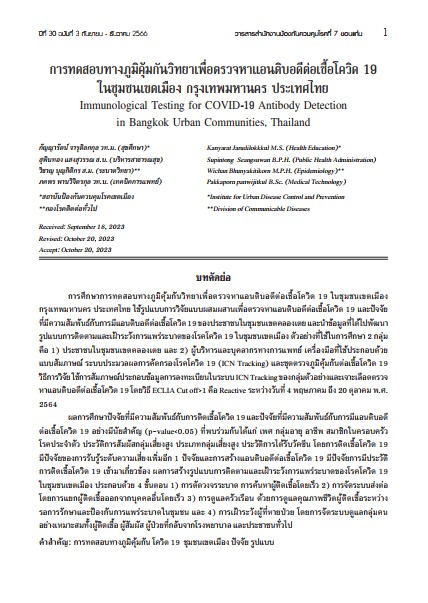
Immunological Testing for COVID-19 Antibody Detection in Bangkok Urban Communities, Thailand
Keywords:
Immunological testing, COVID-19, Urban communities, Factors, ModelAbstract
Immunological testing study to detect COVID-19 antibodies in urban communities in Bangkok, Thailand, used a mixed methods research design to detect antibodies against COVID-19 and factors related to the COVID-19 antibodies among people in the Khlong Toei District community and use the information to develop a model for tracking and monitoring the spread of COVID-19 in urban communities. The samples were 2 groups: 1) people in the Khlong Toei District community and 2) administrators and medical personnel. The research tools consisted of an interview form, a COVID-19 screening processing system (ICN Tracking), and Vitros Anti SARs-CoV-2 IgG Quantitative tests. The interview method along with the registration data in the ICN Tracking system of the samples were operated and whole blood samples were sent to the laboratory for detection of COVID-19 antibodies by ECLIA method; the cut off >1 means reactive result, between 4th May - 20th, October 2021.
The study reveals that the factors related to COVID-19 infection and the factors related to the SARS-CoV-2 antibodies that significantly (P-value<0.05) those found together include: gender, age group, occupation, number of family members, underlying disease, history of exposure to high-risk groups, type of high-risk groups, history of vaccination. Whereas COVID-19 infection had one additional factor of risk perception and the creation of antibodies against COVID-19 there was a factor of a history of COVID-19 infection involved. The results of creating a model for tracing and monitoring the spread of COVID-19 in urban communities consists of 4 steps: 1) breaking the cycle of the epidemic by early detection, 2) organizing a referral system for early isolating infected cases from other people, 3)household care by taking care the quality of life of infected case while waiting for hospital admission and preventing the spread in the community, and 4) monitoring those who have recoveries by organizing a system to take care of a group of people appropriately Including infected cases, contact cases, recovered cases and general public.
Downloads
References
World Health Organization. Impact of COVID-19 on people's livelihoods, their health and our food systems [Internet]. 2020 [cited 2023 Feb 20]. Available from: https://www.who.int/news/item/13-10-2020-impact-of-covid-19-on-people's-livelihoods-their-health-and-our-food-systems.
The world bank. Monitoring the impact of COVID-19 in Thailand, Impact of COVID-19 on Thailand's households [Internet]. 2021 [cited 2023 Feb, 20]. Available from: https://www.worldbank.org/en/country/thailand/publication/monitoring-the-impact-of-covid-19-in-thailand.
กรมควบคุมโรค. สถานการณ์ผู้ติดเชื้อโควิด 19 [อินเตอร์เน็ต]. 2566 [เข้าถึงเมื่อ 20 ก.พ. 2566]. เข้าถึงได้จาก: https://ddc.moph.go.th/viralpneumonia/
United Nation. Launch of policy brief on COVID-19 and cities COVID-19 in an Urban World [Internet]. 2020 [cited 2023 Feb, 20]. Available from: https://www.un.org/en/coronavirus/covid-19-urban-world.
Cod Satrusayang. Authorities warn that Khlong Toey could become a ‘disaster zone’[Internet]. 2021[cited 2023 Feb, 20]. Available from: https://www.thaienquirer.com/27079/authorities-warn-that-khlong-toey-could-become-a-disaster-zone/
The 101 world. คลัสเตอร์-คลองเตย-ความตาย [อินเทอร์เน็ต]. 2564 [เข้าถึงเมื่อ 20 ก.พ. 2566]. เข้าถึงได้จาก: https://www.the101.world/klong-toey-covid-19/
The active ThaiPBS. เดินหน้าขยาย “โมเดลคลองเตย” จัดการโรคระบาดในชุมชน. สรุปการสนทนา “โควิด-19 รุกคลองเตย: ช่วยชีวิต ปิดจุดเสี่ยง ครั้งที่ 2” ชู “ศูนย์พักคอยวัดสะพาน” จุดเด่นคุมโรคระบาดชุมชน เปิดแผนชุมชนจัดการตนเองกู้วิกฤต เร่งถอดบทเรียน ขยายต้นแบบสู่พื้นที่อื่น[อินเทอร์เน็ต]. 2564 [เข้าถึงเมื่อ 20 ก.พ. 2566]. เข้าถึงได้จาก: https://theactive.net/data/covid19-khlong-toei-model-ep2/
สถาบันพัฒนาองค์กรชุมชน. 2 ปีโควิด-19 (2) พอช. –ขบวนองค์กรชุมชนและภาคีเครือข่าย : ถอดบทเรียนการจัดการโควิดโดยชุมชน “ชุมชนจัดการได้ อยู่ร่วมกันได้” [อินเทอร์เน็ต]. 2564 [เข้าถึงเมื่อ 20 ก.พ. 2566]. เข้าถึงได้จาก: https://web.codi.or.th/20211126-28866/
อรุณ จิรวัฒน์กุล. สถิติในงานวิจัย:เลือกใช้อย่างไรให้เหมาะสม.พิมพ์ครั้งที่ 4. กรุงเทพฯ: วิทยพัฒน์; 2558.
Dupraz J, Butty A, Duperrex, Estoppey S, Faivre V, Thabard J, et al. Prevalence of SARS-CoV-2 in household members and other close contacts of COVID-19 cases: A serologic study in canton of Vaud, Switzerland. OFID 2021; 8(7): 1-11.
Hasan T, Pham TN, Nguyen TA, Le HTT, Le DV, Dang TT, et al. Sero-prevalence of SARS-CoV-2 antibodies in high-risk populations in Vietnam. Int J Environ Res Public Health 2021; 18(12): 6353.
Bogogiannidou Z, Speletas M, Vontas A, Nikoulis DJ, Dadouli K, Kyritsi MA, et al. Repeated leftover serosurvey of SARS-CoV-2 IgG antibodies in Greece, May to August 2020. Vaccines (Basel) 2021; 9(5): 504.
Sam IC, Chong YM, Tan CW, Chan YF. Low post pandemic wave SARS-CoV-2 seroprevalence in Kuala Lumpur and Selangor, Malaysia. J Med Virol 2021; 93(2): 647-8.
Gidding HF, Machalek DA, Hendry AJ, Quinn HE, Vette K, Beard FH. Seroprevalence of SARS-CoV-2-specific antibodies in Sydney, Australia following the first epidemic wave in 2020. Med J Aust 2020; 214(4): 179-85.
Tseng WP, Wu JL, Wu CC, Kuo KT, Lin CH, Chung MY, et al. Seroprevalence surveys for anti-SARS-CoV-2 antibody in different populations in Taiwan with low incidence of COVID-19 in 2020 and severe outbreaks of SARS in 2003. Front Immunol 2021; 12: 626609.
Stringhini S, Wisniak A, Piumatti G, Azman AS, Lauer SA, Baysson H, et al. Seroprevalence of anti-SARS-CoV-2 IgG antibodies in Geneva, Switzerland (SEROCoV-POP): a population-based study. Lancet 2020; 396(10247): 313-9.
Petersen MS, Kristiansen MF, Reinert HW, Fjallsbak JP, Christiansen DH, Gaini S, et al. Seroprevalence of SARS-CoV-2–specific antibodies among quarantined close contacts of COVID-19 patients, Faroe Islands, 2020. Emerg Infect Dis 2021; 27(11): 2795–2801.
Yang HS, Costa V, Racine-Brzostek SE, Acker KP, Yee J, Chen Z, et al. Association of age with SARS-CoV-2 antibody response. JAMA Netw Open 2021; 4(3). e214302.
Bonanni P, Canton R, Gill D, Halfon P, Liebert UG, Crespo KAN, et al. The role of serology testing to strengthen vaccination initiatives and policies for COVID-19 in Europe. MDPI 2021; 1(1): 20-38.
Soares P, Rocha JV, Moniz M, Gama A, Laires PA, Pedro AR, et al. Factors associated with COVID-19 vaccine hesitancy. MDPI 2021; 9(3): 300.
กองระบาดวิทยา สำนักงานปลัดกระทรวงสาธารณสุข กระทรวงสาธารณสุข. คู่มือการดำเนินงานทางระบาดวิทยา. กรุงเทพฯ: องค์การรับส่งสินค้าและพัสดุภัณฑ์; 2542.
Downloads
Published
How to Cite
Issue
Section
License
Copyright (c) 2024 สำนักงานป้องกันควบคุมโรคที่7จังหวัดขอนแก่น

This work is licensed under a Creative Commons Attribution-NonCommercial-NoDerivatives 4.0 International License.
ความรับผิดชอบ
บทความที่ลงพิมพ์ในวารสารสำนักงานป้องกันควบคุมโรคที่ 7 ขอนแก่น ถือเป็นผลงานทางวิชาการหรือวิจัย และวิเคราะห์ตลอดจนเป็นความเห็นส่วนตัวของผู้เขียน ไม่ใช่ความเห็นของวารสารสำนักงาน ป้องกันควบคุมโรคที่ 7 จังหวัดขอนแก่น หรือ ของกองบรรณาธิการแต่ประการใด ผู้เขียนต้องรับผิดชอบต่อบทความของตนเอง
ลิขสิทธ์บทความ
บทความที่ได้รับการตีพิมพ์จะถือเป็นลิขสิทธิ์ของสำนักงานป้องกันตวบคุมโรคที่ 7 จังหวัดขอนแก่น