Risk Assessment of Occupational Heat-Related Illness among outdoor farmers exposed to the sun on Northeastern region of Thailand
Keywords:
Outdoor farmer, Heat, Risk assessmentAbstract
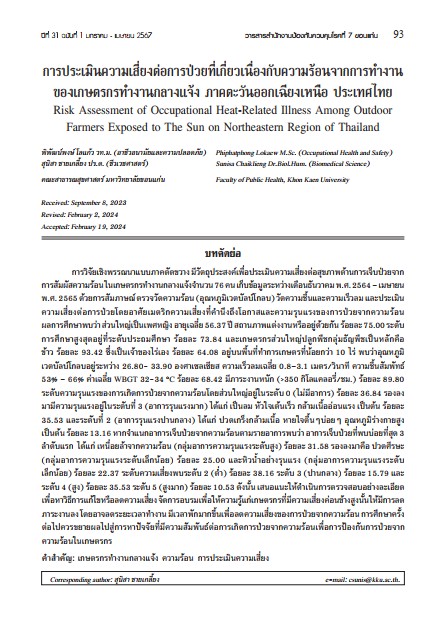
This cross- sectional descriptive study designed to assess risk of occupational heat-related illness of outdoor farmers Northeastern provincial group, Thailand. Data were collected from 76 farmers from December 2021 to April 2022 by the interviewed questionnaire and measurements of working conditions by Wet Bulb Globe Thermometer (WBGT), humidity meter and air velocity monitor. Risk was evaluated by the matrix of the combination of the likelihood and the severity levels of heat-related illness. Results show that most participants were female, average age were 56.37 years, marital status: married, divorced, and separated 75.00, educational background were primary school 73.84%, planting rice 93.42%, farm owner 64.08% on cultivating area less than 16,000 squares meters. The working condition had WBGT range at 26.80-33.90 °C, average wind speed at 0.8-3.1 m/s, average relative humidity at 53-66%, the average WBGT at 32-34 °C 68.42% with heavy workload (>350 kcal/hr.) 89.80%, most of the severity levels of heat symptom were level 0 (not have any symptom) 36.84% followed by level 3 (severe; syncope, tachycardia, muscular weakness etc.) 35.53% and level 2 (low; heat fatigue, shortness of breath, high body temperature etc.) 13.16%. When we classify each sign and symptom, we found that, Top three of the most common heat-related signs and symptoms were heat fatigue (high severity) 31.58% followed by headache (low severity) 25.00% and heavy thirsty (mild severity) 22.37% respectively. Agriculturist had risk level 2 (low risk) 38.16% followed by level 3 (moderate) 15.79%, level 4 (high) 35.53, and level 5 (very high) 10.53%. In conclusion, suggest farmers to have training on how to control heat stress and to recognize symptoms of heat illness. Farmers who had a high risk of heat-related-illness more must be decreased the workload to reduce the risk level of heat-related illness. Further investigations should be focused on the factors associated with heat-related illness to prevent of diseases.
Downloads
References
กรมอุตุนิยมวิทยา. ฤดูกาล ฤดูกาลของโลก ฤดูกาลของประเทศไทย [อินเทอร์เน็ต]. มปป [เข้าถึงเมื่อ 15 สิงหาคม 2564]. เข้าถึงได้จาก: https://tmd-dev.azurewebsites.net/info/%E0%B8%A4%E0%B8%94%E0%B8%81%E0%B8%B2%E0%B8%A5-%E0%B8%A4%E0%B8%94%E0%B8%81%E0%B8%B2%E0%B8%A5%E0%B8%82%E0%B8%AD%E0%B8%87%E0%B9%82%E0%B8%A5%E0%B8%81-%E0%B8%A4%E0%B8%94%E0%B8%81%E0%B8%B2%E0%B8%A5%E0%B8%82%E0%B8%AD%E0%B8%87%E0%B8%9B%E0%B8%A3%E0%B8%B0%E0%B9%80%E0%B8%97%E0%B8%A8%E0%B9%84%E0%B8%97%E0%B8%A2
ปฐมฤกษ์ มีสมบัติ, สุนิสา ชายเกลี้ยง, อนุชนรา ตาลกุล คัสเธอร์. การประเมินความเสี่ยงต่อการป่วยที่เกี่ยวเนื่องกับความร้อนจากการทำงานของเกษตรกรเพาะปลูก อำเภอน้ำพอง จังหวัดขอนแก่น. วารสารความปลอดภัยและสุขภาพ 2563; 13(2): 45-63.
Radir AF, Hashim Z, Phan K, Sao V, Hashim JH. The impact of heat on health and productivity among sugarcane workers in Kampong Cham, Cambodia. APEOHJ 2017; 3(1): 9-19.
Boonruksa P, Maturachon T, Kongtip P, Woskie S. Heat stress, physiological response, and heat-related symptoms among Thai sugarcane workers. Int J Environ Res Public Health 2020; 17(17): 6363.
สมจิต แดนสีแก้ว, รัตน์ดาวรรณ คลังกลาง, เกศินี สราญฤทธิชัย. ประสบการณ์ของชาวนาในการป้องกันการเจ็บป่วยที่เกี่ยวข้องกับการทำนา. วารสารการพยาบาลและการดูแลสุขภาพ 2558; 33(1): 134–44.
อุมา ลางคุลเสน, นันทวรรณ วิจิตรวาทการ. ผลกระทบของการเปลี่ยนแปลงสภาพภูมิอากาศและความร้อนที่มีต่อเกษตรกรและพนักงานในโรงงานอุตสาหกรรมในประเทศไทย. วารสารวิทยาศาสตร์และเทคโนโลยี 2561; 26(4): 680–93.
Xiang J, Bi P, Pisaniello D, Hansen A, Sullivan T. Association between high temperature and work-related injuries in Adelaide, South Australia, 2001–2010. Occup Environ Med 2014; 71 (4): 246–52.
Bethel JW, Harger R. Heat-Related Illness among Oregon Farmworkers. Int J Environ Res Public Health 2014; 11(9): 9273–85.
ชวพรพรรณ จันทร์ประสิทธิ์, วรันธรณ์ จงรุ่งโรจน์สกุล, ธานี แก้วธรรมานุกูล, อนนท์ วิสุทธิ์ธนานนท์, วิไลพรรณ ใจวิไล. สถานการณ์ด้านอาชีวอนามัยและสิ่งแวดล้อมของกลุ่มเกษตรกรปลูกข้าวโพด. พยาบาลสาร 2562; 46(1), 5-17.
กรกนก พลท้าว, อุไรวรรณ อินทร์ม่วง. การประเมินความเสี่ยงต่อสุขภาพของเกษตรกรจากการเพาะปลูกมะเขือเทศเก็บเมล็ดพันธุ์บ้านลาดนาเพียง ตำบลสาวะถี อำเภอเมือง จังหวัดขอนแก่น. วารสารวิจัยสาธารณสุขศาสตร์ มหาวิทยาลัยขอนแก่น 2555; 5(3): 31–8.
ธานินทร์ ศิลป์จารุ. การวิจัยและวิเคราะห์ข้อมูลทางสถิติด้วย SPSS. พิมพ์ครั้งที่ 11. กรุงเทพฯ: บิสซิเนสอาร์แอนด์ดี; 2555.
สุนิสา ชายเกลี้ยง. โปรแกรมประเมินความเสี่ยงทางสุขภาพต่อการสัมผัสความร้อน เนื่องจากการทำงานของเกษตรกลุ่มเพาะปลูก ลิขสิทธิ์เลขที่ ว.044852. ขอนแก่น: คณะสาธารณสุขศาสตร์ มหาวิทยาลัยขอนแก่น; 2563.
กระทรวงแรงงาน. กฎกระทรวงกำหนดมาตรฐานในการบริหารจัดการ และดำเนินการด้านความปลอดภัย อาชีวอนามัย และสภาพแวดล้อมในการทำงานเกี่ยวกับความร้อน แสงสว่าง และเสียง พ.ศ. 2559 ราชกิจจานุเบกษา. เล่มที่ 133 ตอนที่ 91ก. หน้า 48-54.
ธัญญารัตน์ ทราบจังหรีด, อุไรวรรณ อินทร์ม่วง. การเจ็บป่วยที่สัมพันธ์กับความร้อนของเกษตรกร ตำบลตะขบ อำเภอปักธงชัย จังหวัดนครราชสีมา. วารสารวิจัยสาธารณสุขศาสตร์ 2559; 9(2): 53-9.
Crowe J, Moya-Bonilla JM, Román-Solano B, Robles-Ramírez A. Heat exposure in sugarcane workers in Costa Rica during the non-harvest season. Glob Health Action 2010; 3: 1-9.
Frimpong K, Van Etten EJE, Oosthuzien J, Nunfam VF. Heat exposure on farmers in northeast Ghana. Int J Biometeorol 2017; 61(3): 397–406.
Downloads
Published
How to Cite
Issue
Section
License
Copyright (c) 2024 สำนักงานป้องกันควบคุมโรคที่7จังหวัดขอนแก่น

This work is licensed under a Creative Commons Attribution-NonCommercial-NoDerivatives 4.0 International License.
ความรับผิดชอบ
บทความที่ลงพิมพ์ในวารสารสำนักงานป้องกันควบคุมโรคที่ 7 ขอนแก่น ถือเป็นผลงานทางวิชาการหรือวิจัย และวิเคราะห์ตลอดจนเป็นความเห็นส่วนตัวของผู้เขียน ไม่ใช่ความเห็นของวารสารสำนักงาน ป้องกันควบคุมโรคที่ 7 จังหวัดขอนแก่น หรือ ของกองบรรณาธิการแต่ประการใด ผู้เขียนต้องรับผิดชอบต่อบทความของตนเอง
ลิขสิทธ์บทความ
บทความที่ได้รับการตีพิมพ์จะถือเป็นลิขสิทธิ์ของสำนักงานป้องกันตวบคุมโรคที่ 7 จังหวัดขอนแก่น