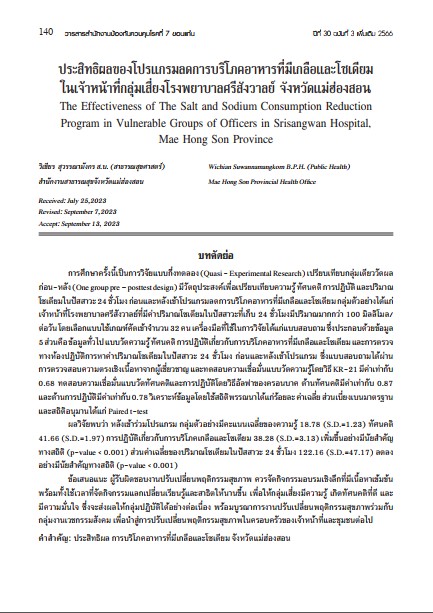
The Effectiveness of The Salt and Sodium Consumption Reduction Program in Vulnerable Groups of Officers in Srisangwan Hospital, Mae Hong Son Province
Keywords:
Effectiveness, Salt and sodium consumption, Mae Hong Son provinceAbstract
This study is a quasi - experimental research study as a comparison of a one group pre -posttest design with the aim of comparing knowledge, attitudes, practices, and the 24-hour urinary sodium level before and after participating in the salt and sodium consumption reduction program. The sample consisted of 32 officers of Srisangwan Hospital who had a 24-hour urinary sodium level greater than 100 mmol/day by inclusion criteria. The research instrument included a questionnaire that consisted of five sections: general information, knowledge test form, attitude test, practice about salt and sodium food consumption, and laboratory tests to determine the amount of sodium in the urine 24 hours before and after participating in the program. The questionnaire was tested by experts for content accuracy and by KR-21 and Cronbach's alpha method for content confidence. As a result, the knowledge level was equal to 0.68, the attitude level was equal to 0.87, and the practice value was equal to 0.78. Data were analyzed using descriptive statistics such as percentage, mean, and standard deviation and inferential statistics such as Paired t-test. The results of the research found that after participating in the program sample group there was an average score of knowledge 18.78 (S.D.=1.23), attitude 41.66 (S.D.=1.97), practice regarding salt and sodium consumption 38.28 (S.D.=3.13), a statistically significant increase (p-value < 0.001). The mean 24-hour urine sodium content was 122.16 (S.D.=47.17), a statistically significant decrease (p-value < 0.001).
Suggestions for those responsible for health behavior modification: they should provide in-depth training activities with intense content, as well as extended learning exchanges and demonstrations, so that vulnerable groups have knowledge, a positive attitude, and confidence that result in continuous group practice. In addition, integrate health behavior modification with the social medicine department to lead further health behavior modification in the families of officers and the community.
References
กองโรคไม่ติดต่อ กรมควบคุมโรค. ยุทธศาสตร์ลดการบริโภคเกลือและโซเดียมในประเทศไทย ปี พ.ศ. 2559 - 2568. นนทบุรี: สำนักงานกิจการโรงพิมพ์องค์การสงเคราะห์ทหารผ่านศึก ในพระบรมราชูปถัมภ์; 2559.
สิทธิพงษ์ ยิ้มสวัสดิ์. การศึกษาความชุกของการรับประทานโซเดียมปริมาณสูงในประชากรจังหวัดแม่ฮ่องสอน ประเทศไทย. วารสารวิชาการสาธารณสุข 2566; 32(3): 400-16.
Bloom BS. Taxonomy of educational objectives, Handbook: The Cognitive Domain. New York; David McKay; 1956.
ชลธิชา บุญศิริ, นพวรรณ เปียซื่อ, พรรณวดี พุธวัฒนะ, สุรศักดิ์ กันตชูเวสศิร. ผลของโปรแกรมส่งเสริมการบริโภคอาหารลดโซเดียมต่อความรู้และปริมาณโซเดียมในปัสสาวะของนักศึกษาพยาบาล. วารสารสภาการพยาบาล 2560; 32(3): 104-19.
กรมควบคุมโรค. รายงานสถานการณ์โรค NCDs เบาหวาน ความดันโลหิตสูง และปัจจัยเสี่ยงที่เกี่ยวข้อง พ.ศ. 2562. นนทบุรี; อักษรกราฟฟิคแอนด์ดีไซน์; 2563.
ณิชาภัทร มณีพันธ์, ณรงค์กร ชัยวงศ์, เวียงพิงค์ ทวีพูล. ปัจจัยทำนายพฤติกรรมการบริโภคอาหารรสเค็มของประชาชนในเขตเทศบาลเมืองชุมเห็ด จังหวัดบุรีรัมย์. งานวิจัยนำเสนอเวทีประชุมวิชาการระดับชาติ คณะพยาบาลศาสตร์ มรภ.อุบล วันที่ 7 พฤษภาคม 2564.
ปรัศนี ศรีกัน, สมศรี ทาทาน, วราภรณ์ ศรีจันทร์พาล, ชลธิมา ปิ่นสกุล. ความสัมพันธ์ระหว่างความรู้ ความสามารถในการดูแลตนเอง พฤติกรรมการลดการบริโภคอาหารที่มีโซเดียมสูง และปริมาณโซเดียมในปัสสาวะของนักศึกษาและบุคลากรของวิทยาลัยพยาบาลบรมราชชนนี พะเยา. วารสารวิทยาลัยพยาบาลบรมราชชนนี กรุงเทพ 2561; 34(3): 21-33.
Downloads
Published
How to Cite
Issue
Section
License
Copyright (c) 2023 สำนักงานป้องกันควบคุมโรคที่7จังหวัดขอนแก่น

This work is licensed under a Creative Commons Attribution-NonCommercial-NoDerivatives 4.0 International License.
ความรับผิดชอบ
บทความที่ลงพิมพ์ในวารสารสำนักงานป้องกันควบคุมโรคที่ 7 ขอนแก่น ถือเป็นผลงานทางวิชาการหรือวิจัย และวิเคราะห์ตลอดจนเป็นความเห็นส่วนตัวของผู้เขียน ไม่ใช่ความเห็นของวารสารสำนักงาน ป้องกันควบคุมโรคที่ 7 จังหวัดขอนแก่น หรือ ของกองบรรณาธิการแต่ประการใด ผู้เขียนต้องรับผิดชอบต่อบทความของตนเอง
ลิขสิทธ์บทความ
บทความที่ได้รับการตีพิมพ์จะถือเป็นลิขสิทธิ์ของสำนักงานป้องกันตวบคุมโรคที่ 7 จังหวัดขอนแก่น