Effects of a Food Consumption Behaviors Development Program for Hypertensive Patients at Pho Tak District, Nong Khai Province
Keywords:
Food consumption behaviors, Hypertension, Perceived self-efficacy, Food consumption behaviors development programAbstract
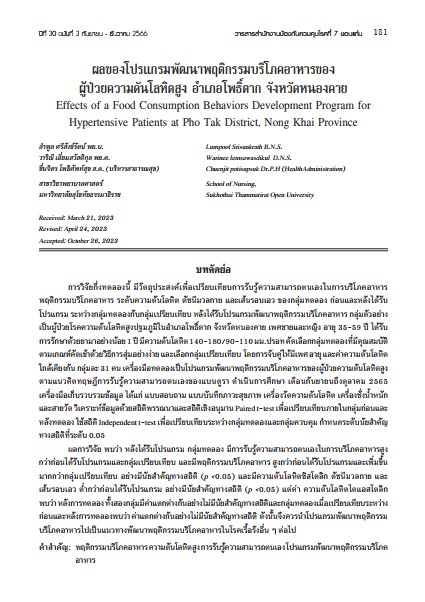
The objectives of this quasi-experimental research were to compare the perceived self-efficacy in food consumption behavior, actual food consumption behaviors, and health status, including blood pressure, body mass index, and waist circumference, of an experimental group before and after the experiment, and after the experiment between the experimental group and a comparison group. The sample comprised primary hypertension, male and female, aged 35-59 years, who had been treated with antihypertensive drugs for at least 1 year, with blood pressure between 140-180/90-110 mmHg. The experimental group who had characteristics within the inclusion criteria were selected by the simple random sampling technique, and a comparison group was selected with similar age, sex, and blood pressure, with 31 persons in each group. The experimental tool was the Food Consumption Behaviors Development Program for hypertensive patients based on the self-efficacy theory of Bandura. The trial period was from September to October, 2022. The data collecting tools were: a questionnaire; health condition record; sphygmomanometer; scale and measuring tape. Data were analyzed by descriptive statistics and Inferential statistics Paired t-test to compare within groups before and after the experiment. Independent t-test statistics were used to compare between the experimental and control groups. The statistical significance level was set at the 0.05.
The results showed that: after the experiment, scores for perceived self-efficacy in food consumption of the experimental group were significantly higher than before the experiment and higher than the comparison group (p < 0.05). Food consumption behavior scores were significantly higher than before the experiment and increased more than the comparison group (p < .05).The mean systolic blood pressure, body mass index, and waist circumference of the experimental group were significantly lower than before the experiment (p < 0.05), but not different from the comparison group, and the mean diastolic blood pressure of the experimental group was not different than that before the experiment and not different from the comparison group. Therefore, the Food Consumption Behaviors Development Program should be used as a guideline for development Food Consumption Behaviors in other chronic diseases.
Downloads
References
World Health Organization. Hypertension [internet]. 2020 [cite 2022 Oct 5]. Avalable from: https://www.who.int/news-room/fact-sheets/detail/hypertension.
สำนักโรคไม่ติดต่อ กรมควบคุมโรค กระทรวงสาธารณสุข. สถานการณ์การดำเนินงานด้านป้องกันควบคุมโรคไม่ติดต่อ(NCDs). พิมพ์ครั้งที่ 2. นนทบุรี: กรมควบคุมโรค กระทรวงสาธารณสุข; 2562.
มันทนา ประทีปะเสน, เรวดี จงสุวัฒน์, ฉัตรภา หัตถโกศล. ชุดความรู้เรื่อง การบริโภคเกินไม่ได้ สัดส่วน เค็มเกิน. กรุงเทพฯ: โรงพิมพ์สำนักงานพระพุทธศาสนาแห่งชาติ; 2554.
Bandura A. Self-efficacy: The Exercise of control. New York: W.H. Freeman; 1997.
ศูนย์ข้อมูลอำเภอโพธิ์ตาก. รายงานตัวชี้วัดประจำปี 2563. สำนักงานสาธารณสุขอำเภอโพธิ์ตาก: หนองคาย; 2563.
นิยม บุระคร. การประยุกต์ใช้ทฤษฎีการรับรู้ความสามารถแห่งตนเพื่อปรับเปลี่ยนพฤติกรรมการรับประทานอาหารและการออกกำลังกายของผู้ป่วยโรคความดันโลหิตสูง [วิทยานิพนธ์ปริญญาสาธารณสุขศาสตร์มหาบัณฑิต]. นครราชสีมา: มหาวิทยาลัยราชภัฏนครราชสีมา; 2561.
อรุณ จิรวัฒน์กุล. สถิติในงานวิจัยเลือกใช้อย่างไรให้เหมาะสม. พิมพ์ครั้งที่ 2. กรุงเทพฯ: ส. เอเชียเพรส (1989); 2558. หน้า 70.
อุไรวรรณ ชัยชนะวิโรจน์, ชญาภา วันทุม. การทดสอบความตรงตามเนื้อหาของเครื่องมือวิจัย. วารสารการพยาบาลและสุขภาพ 2560; 11(2): 105-11.
สมโภชน์ เอี่ยมสุภาษิต. ทฤษฎีและเทคนิคการปรับพฤติกรรม. พิมพ์ครั้งที่ 9. กรุงเทพฯ: สำนักพิมพ์จุฬาลงกรณ์มหาวิทยาลัย; 2562.
Bonwell CC, Eison JA. Active learning: Creating excitement in the classroom [internet]. 2023 [cite 2023 Feb 2]. Avalable from: https://files.eric.ed.gov/fulltext/ED336049.pdf
อาภาพร เผ่าวัฒนา, สุรินธร กลัมพากร, สุนีย์ ละกำปั่น, ทัศนีย์ รวิวรกุล, บรรณาธิการ. การสร้างเสริมสุขภาพและป้องกันโรคในชุมชน: การประยุกต์แนวคิดและทฤษฎีสู่การปฏิบัติ (ฉบับปรับปรุง). กรุงเทพฯ: เอ็ม เอ็น คอมพิวออฟเซท; 2561.
อารีรัตน์ คนสวน. ผลของโปรแกรมการส่งเสริมสมรรถนะแห่งตนและการสนับสนุนทางสังคมต่อพฤติกรรมการควบคุมอาหารและระดับความดันโลหิตในผู้ป่วยโรคความดันโลหิตสูงที่ควบคุมความดันโลหิตไม่ได้. [วิทยานิพนธ์ปริญญาพยาบาลศาสตรมหาบัณฑิต]. สงขลา: มหาวิทยาลัยสงขลานครินทร์; 2557.
หนึ่งฤทัย สิงห์ทา. ผลของโปรแกรมส่งเสริมสมรรถนะแห่งตนต่อพฤติกรรมการป้องกันโรคของกลุ่มเสี่ยงโรคความดันโลหิตสูง อำเภอบ้านโคก จังหวัดอุตรดิตถ์. [วิทยานิพนธ์ปริญญาพยาบาลศาสตรมหาบัณฑิต]. พิษณุโลก: มหาวิทยาลัยนเรศวร; 2558.
ศิราณี โพธิ์ศรี. ผลของโปรแกรมการจัดการตนเองต่อการรับรู้สมรรถนะแห่งตน พฤติกรรมสุขภาพและความดันโลหิต ในผู้ป่วยโรคความดันโลหิตสูงชนิดไม่ทราบสาเหตุ. [วิทยานิพนธ์ปริญญาพยาบาลศาสตรมหาบัณฑิต]. ชลบุรี: มหาวิทยาลัยบูรพา; 2556.
สุภาพร ทิพย์กระโทก. ผลของโปรแกรมการจัดการตนเอง เพื่อปรับเปลี่ยนพฤติกรรมสุขภาพ ค่าดัชนีมวลกาย และเส้นรอบเอว ของอาสาสมัครสาธารณสุขประจำหมู่บ้านที่มีภาวะอ้วนลงพุง. [วิทยานิพนธ์ปริญญาสาธารณสุขศาสตรมหาบัณฑิต]. นครราชสีมา: มหาวิทยาลัยราชภัฎนครราชสีมา; 2563.
Downloads
Published
How to Cite
Issue
Section
License
Copyright (c) 2024 สำนักงานป้องกันควบคุมโรคที่7จังหวัดขอนแก่น

This work is licensed under a Creative Commons Attribution-NonCommercial-NoDerivatives 4.0 International License.
ความรับผิดชอบ
บทความที่ลงพิมพ์ในวารสารสำนักงานป้องกันควบคุมโรคที่ 7 ขอนแก่น ถือเป็นผลงานทางวิชาการหรือวิจัย และวิเคราะห์ตลอดจนเป็นความเห็นส่วนตัวของผู้เขียน ไม่ใช่ความเห็นของวารสารสำนักงาน ป้องกันควบคุมโรคที่ 7 จังหวัดขอนแก่น หรือ ของกองบรรณาธิการแต่ประการใด ผู้เขียนต้องรับผิดชอบต่อบทความของตนเอง
ลิขสิทธ์บทความ
บทความที่ได้รับการตีพิมพ์จะถือเป็นลิขสิทธิ์ของสำนักงานป้องกันตวบคุมโรคที่ 7 จังหวัดขอนแก่น