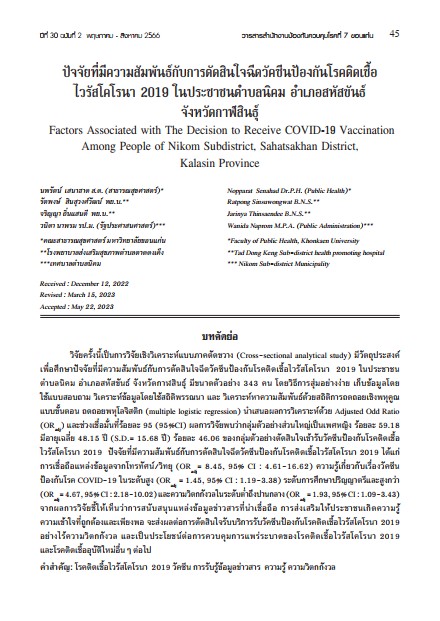
Factors Associated with The Intension to Receive COVID-19 Vaccination Among People of Nikom Subdistrict, Sahatsakhan District, Kalasin Province
Keywords:
Corona-virus 2019, Vaccine, Information Exposure, Knowledge, AnxietyAbstract
The cross-sectional analytical research aimed to examine the factors associated with the decision to receive COVID-19 vaccination among people of Nikom subdistrict, Sahatsakhan district, Kalasin province. The sample were 343 people with randomly selected by simple random sampling techniques. Data were collected by questionnaires and analyzed by descriptive statistics and multiple logistic regression which showed adjusted odd ratio (ORadj) at 95% confidence interval. The results showed that most of the samples were female (59.18 %) with the average age of48.15±15.68 years old. Forty-six point zero six percent of sample decision to receive COVID-19 vaccination.Factors associated with receive COVID-19 vaccination were; who relied on COVID-19 information from television/radio (ORadj = 8.45, 95% CI : 4.61-16.62), had high knowledge of COVID-19 vaccination (ORadj = 1.45, 95% CI : 1.19-3.38), had education ≥ Bachelor's degree (ORadj = 4.67; 95% CI: 2.18-10.02) and Low to medium anxiety (ORadj = 1.93, 95% CI :1.09-3.43). The findings from this study should be used to development a strategy for reliable information support, promoting people's knowledge as a correct and sufficient understanding to make a decision to receive COVID-19 vaccination without anxiety. That will be the greatest benefit to control the spread of the corona virus infection 2019 in the future.
Downloads
References
กรมควบคุมโรค กระทรวงสาธารณสุข. แนวทางการให้วัคซีนโควิด 19 ในสถานการณ์การระบาดประเทศไทย [อินเทอร์เน็ต]. 2564 [เข้าถึงเมื่อ 7 พฤศจิกายน 2564]. เข้าถึงได้จาก: https://dl.parliament.go.th/handle/20.500.13072/590809.
Sam C, Whiteaker C, Recht H, Pogkas D, Murray P, Halford D, Bryant E. Mapping the coronavirus outbreak across the world. bloomberg reporting, National Health Commission of the PRC and Johns Hopkins University [Internet]. 2021 [Cited 2021 April 6]. Available from: https://www.bloomberg.com/graphics/2020-coronavirus-cases-world-map/?srnd=coronavirus.
Randolph HE, Barreiro LB. Herd immunity: understanding COVID-19. Immunity 2020; 52(5): 737-41.
Dong M, He F, Deng Y. How to understand herd immunity in the context of COVID-19. Viral immunol. 2021; 34(3): 174-81.
Dowdy D, D’Souza G. Early herd immunity against COVID-19: A dangerous misconception. Johns Hopkins Coronavirus Research Center. 2020.
Soares P, Rocha JV, Moniz M, Gama A, Laires PA, Pedro AR, et al. Factors associated with COVID-19 vaccine hesitancy. Vaccine 2021; 9(3): 300.
National Academies of Sciences, Engineering, and Medicine. Framework for equitable allocation of COVID‐19 vaccine [Internet]. 2020 [Cited 2021 Jan 23]. Available from: https://www.nap.edu/catalog/25917/framework-for-equitable-allocation-of-covid-19-vaccine.
McAteer J, Yildirim I, Chahroudi A. The VACCINES Act: deciphering vaccine hesitancy in the time of COVID-19. Clin Infect Dis 2020; 71(15): 703-5.
World Health Organizations. Ten threats to global health in 2019.2019 [Internet]. 2019 [Cited 2021 Feb 1]. Available from: https://www.who.int/news-room/spotlight/ten-threats-to-global-health-in-2019.
Harrison EA, Wu JW. Vaccine confidence in the time of COVID-19. Eur j epidemiol 2020; 35(4): 325-30.
MacDonald NE. Vaccine hesitancy: Definition, scope and determinants. Vaccine 2015; 33(34): 4161-4.
Salali GD, Uysal MS. COVID-19 vaccine hesitancy is associated with beliefs on the origin of the novel coronavirus in the UK and Turkey [Internet]. Psychol Med 2020 [Cited 2021 February 1]: Available from: DOI: 10.1017/S0033291720004067
Bendau A, Plag J, Petzold MB, Ströhle A. COVID-19 vaccine hesitancy and related fears and anxiety [Internet]. Int immunopharmacol 2021[Cited 2021 June 3]; 97: 107724. Available from: https://doi.org/10.1016/j.intimp.2021.107724
Sullivan KM. Sample Size for a Proportion or Descriptive Study [Iternet]. 2019 [Cited 2020 August 30] Available from : https://www.openepi.com/SampleSize/SSPropor.htm.
Sherman SM, Smith LE, Sim J, Amlôt R, Cutts M, Dasch H, et al. COVID-19 vaccination intention in the UK: results from the COVID-19 vaccination acceptability study (CoVAccS), a nationally representative cross-sectional survey. Hum vaccines immunother 2021; 17(6): 1612-21.
Khubchandani J, Sharma S, Price JH, Wiblishauser MJ, Sharma M, Webb FJ. COVID-19 vaccination hesitancy in the United States: a rapid national assessment. J community health 2021; 46(2): 270-7.
Park S, Massey PM, Stimpson JP. Primary source of information about COVID-19 as a determinant of perception of COVID-19 severity and vaccine uptake. J Gen Intern Med 2021; 36(10): 3088-95.
Ng BP, Park C. The role of media sources for COVID-19 information on engaging in recommended preventive behaviors among Medicare beneficiaries aged≥ 65 years. The J Gerontology 2022; 77(7): 191-8.
Reiter PL, Pennell ML, Katz ML. Acceptability of a COVID-19 vaccine among adults in the United States: How many people would get vaccinated?. Vaccine 2020; 38(42): 6500-7.
ชำนาญ มาลัย, ถนอม นามวงศ์. ปัจจัยที่มีความสัมพันธ์กับการตัดสินใจฉีดวัคซีนป้องกันโรคโควิด 19 ในผู้ป่วยโรคเรื้อรัง จังหวัดยโสธร. วารสารวิชาการสาธารณสุขชุมชน 2022; 8(4), 205-5.
Petrie KJ, Faasse K, Thomas MG. Public perceptions and knowledge of the Ebola virus, willingness to vaccinate, and likely behavioral responses to an outbreak. Disaster medicine and public health preparedness. 201; 10(4): 674-80.
Downloads
Published
How to Cite
Issue
Section
License
Copyright (c) 2023 สำนักงานป้องกันควบคุมโรคที่7จังหวัดขอนแก่น

This work is licensed under a Creative Commons Attribution-NonCommercial-NoDerivatives 4.0 International License.
ความรับผิดชอบ
บทความที่ลงพิมพ์ในวารสารสำนักงานป้องกันควบคุมโรคที่ 7 ขอนแก่น ถือเป็นผลงานทางวิชาการหรือวิจัย และวิเคราะห์ตลอดจนเป็นความเห็นส่วนตัวของผู้เขียน ไม่ใช่ความเห็นของวารสารสำนักงาน ป้องกันควบคุมโรคที่ 7 จังหวัดขอนแก่น หรือ ของกองบรรณาธิการแต่ประการใด ผู้เขียนต้องรับผิดชอบต่อบทความของตนเอง
ลิขสิทธ์บทความ
บทความที่ได้รับการตีพิมพ์จะถือเป็นลิขสิทธิ์ของสำนักงานป้องกันตวบคุมโรคที่ 7 จังหวัดขอนแก่น