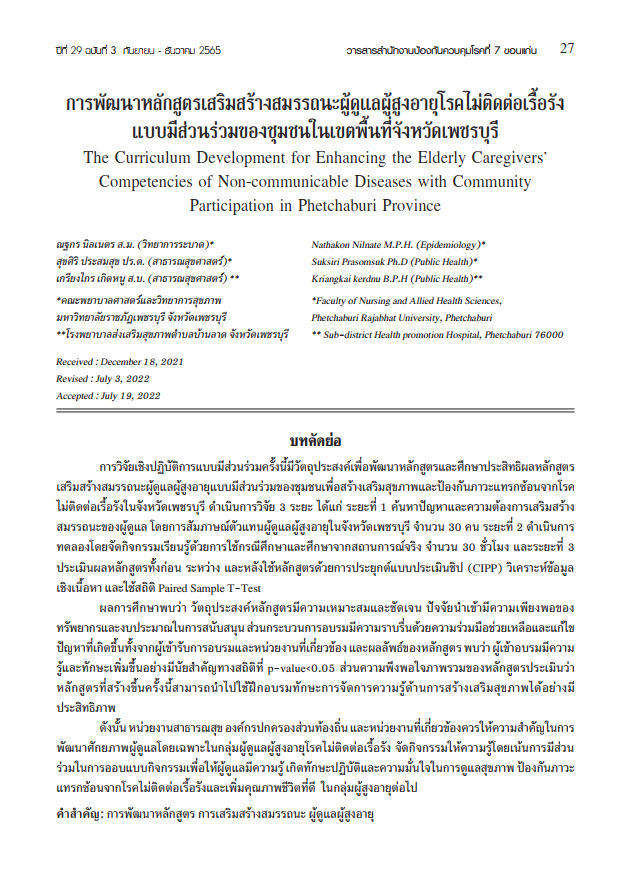
The Curriculum Development for Enhancing the Elderly Caregivers’ Competencies of Non-communicable Diseases with Community Participation in Phetchaburi Province
Keywords:
Curriculum Development, Competencies Promotion, Elderly CaregiversAbstract
This participatory action research aimed to develop the curriculum and evaluate the effect of Curriculum
Enhancing the Elderly Caregivers’ Competencies of Non-communicable Diseases with Community Participation
in Phetchaburi Province. The study is divided into three stages: study, data on the problem, and the need to promote the skills of elderly cares, thirty elderly caregivers were interviewed. Phase two: Implementation of the curriculum. Their activities of teaching and learning implementation were taken on for a total of thirty hours. Phase three: the curriculum was assessed before, during, and after the course using the CIPP Evaluation Model (CIPP). Data were analyzed using content analysis, and Paired Sample T-Test.
The results showed that the objectives were appropriate and clear. Regarding input evaluation, the adequacy of resources and budget for support was demonstrated. As for the training process, it is smooth with cooperation to help solve problems that arise from both trainees and related agencies. For product evaluation, the study revealed that the learners had knowledge and skills higher than before participation in the program, with statistical significance at the level of.001. As for the satisfaction with the methods and activities of the curriculum, it showed that the created curriculum can be used to effectively train knowledge management skills in health promotion.
Therefore, public health agencies, local government organizations, and related agencies should focus on the development of caregivers, especially among the elderly with chronic non-communicable diseases. There are training activities to educate by participating in the design of activities to provide caregivers with the knowledge and practical skills they need to gain confidence that they can take care of their health. Prevent complications from chronic non-communicable diseases and increase the quality of life in the elderly.
Downloads
References
มูลนิธิสถาบันวิจัยและพัฒนาผู้สูงอายุไทย. สถานการณ์ผู้สูงอายุไทย [อินเทอร์เน็ต]. 2557[เข้าถึงเมื่อ 12 ตุลาคม 2564]. เข้าถึงได้จาก: https://thaitgri.org/?p=36746
สำนักอนามัยผู้สูงอายุ กรมอนามัย กระทรวงสาธารณสุข. ร้อยละของผู้สูงอายุที่มีภาวะพึ่งพิงได้รับการดูแลตาม Care Plan ระดับจังหวัด ปีงบประมาณ 2563[อินเทอร์เน็ต]. 2564 [เข้าถึงเมื่อ 12 ตุลาคม 2564]. เข้าถึงได้จาก: http://dashboard.anamai.moph.go.th.
กรมควบคุมโรค กระทรวงสาธารณสุข. รายงานสถานการณ์โรค NCDs เบาหวาน ความดันโลหิตสูงและปัจจัยเสี่ยงที่เกี่ยวข้อง พ.ศ. 2562. นนทบุรี: อักษรกราฟฟิคแอนด์ดีไซน์; 2562.
เจิมศักดิ์ ปิ่นทอง. การปฏิรูประบบรองรับสังคมสูงวัย. กรุงเทพฯ: โอเดียนสโตร์; 2558.
สำนักงานหลักประกันสุขภาพแห่งชาติ. คู่มือสนับสนุนการบริหารจัดการระบบบริการดูแลระยะยาวด้านสาธารณสุขสำหรับผู้สูงอายุที่มีภาวะพึ่งพิงในระบบหลักประกันสุขภาพแห่งชาติ. กรุงเทพฯ: สำนักงานหลักประกันสุขภาพแห่งชาติ; 2559.
ศูนย์อนามัยที่ 5 กรมอนามัย กระทรวงสาธารณสุข. รายงานการตรวจราชการกระทรวงสาธารณสุข จังหวัดเพชรบุรี ประจำปีงบประมาณ พ.ศ. 2560. ราชบุรี: ศูนย์อนามัยที่ 5 กรมอนามัย กระทรวงสาธารณสุข; 2561.
สำนักงานสถิติแห่งชาติ. รายงานการสำรวจประชากรผู้สูงอายุในประเทศไทย พ.ศ. 2563 [อินเทอร์เน็ต]. 2564 [เข้าถึงเมื่อ 18 สิงหาคม 2564]. เข้าถึงได้จาก:
http://www.nso.go.th/ sites/2020.
สำนักงานสาธารณสุขจังหวัดเพชรบุรี. สรุปผลการตรวจราชการและนิเทศงานกรณีปกติ รอบที่ 2 ประจำปีงบประมาณ 2563. เพชรบุรี: สำนักงานสาธารณสุขจังหวัดเพชรบุรี; 2564.
โรงพยาบาลส่งเสริมสุขภาพตำบลบ้านลาด อำเภอบ้านลาด จังหวัดเพชรบุรี. รายงานผลการดำเนินงาน ประจำปีงบประมาณ 2562. เพชรบุรี: โรงพยาบาลส่งเสริมสุขภาพตำบลบ้านลาด; 2563.
เยาวรัตน์ รุ่งสว่าง, ยุพาวรรณ ทองตะนุนาม, จตุพร หนูสวัสดื์, ศรัญญา ปานปิ่น. การพัฒนาสมรรถนะผู้จัดการการดูแลผู้สูงอายุ จังหวัดนนทบุรี: การติดตามประเมินผลโครงการ. วารสารวิจัยทางวิทยาศาสตร์สุขภาพ 2563; 14: 93-104.
เบญจมาศ ตระกูลงามเด่น, วณิดา มงคลสินธุ์, ดลนภา สร่างไธสง. การประเมินหลักสูตรผู้จัดการการดูแลผู้สูงอายุในเขตพื้นที่กรุงเทพมหานคร ของคณะพยาบาลศาสตร์เกื้อการุณย์ มหาวิทยาลัยนวมินทราธิราช. วารสารเกื้อการุณย์ 2561; 25(2): 210-28.
Kemmis S. McTaggart C. The Action Research Planner. 3rd ed. Deakin University: Distributed by Deakin University Press; 1988.
ปภาสินี แซ่ติ๋ว, ชไมพร จินต์คณาพันธ์, ศราวุธ เรืองสวัสด, ธนิดา ทีปะปาล. การศึกษาศักยภาพของผู้ดูแลผู้สูงอายุหลังจากอบรมหลักสูตรผู้ดูแลผู้สูงอายุ 70 ชั่วโมง ของวิทยาลัยพยาบาลบรมราชชนนีสุราษฎร์ธานี. วารสารพยาบาลทหารบก 2562; 20: 300-10.
เกศกาญจน์ ทันประภัสสร. การพัฒนาหลักสูตรเสริมสร้างคุณภาพชีวิตผู้สูงอายุ กรณีศึกษาเทศบาลนครพิษณุโลก[วิทยานิพนธ์ปริญญาการศึกษาดุษฎีบัณฑิต]. พิษณุโลก: มหาวิทยาลัยนเรศวร; 2561.
สถาบันวิจัยและประเมินเทคโนโลยีทางการแพทย์ กรมการแพทย์ กระทรวงสาธารณสุข. สถานการณ์โรคเบาหวาน/ความดันโลหิตสูงและภาวะแทรกซ้อนในประเทศไทย ปี 2561 [อินเทอร์เน็ต]. 2561 [เข้าถึงเมื่อ 15 สิงหาคม 2564]. เข้าถึงได้จาก: http://www.imrta.dms.moph.go.th/imrta.
Bloom, Hastings JT, Madaus DF. Hanbook on Formative and Summative Evaluation of student Learning. New York: Mc Grow Hill Book Company, Inc; 1971.
ธวัชชัย วรพงศธร. หลักการวิจัยทางสาธารณสุขศาสตร์. ครั้งที่ 3. กรุงเทพมหานคร: สำนักพิมพ์แห่งจุฬาลงกรณ์มหาวิทยาลัย; 2540.
Dubovi I, Levy ST, Dagan E. Now I know how! The learning process of medication administration among nursing students with non-immersive desktop virtual reality simulation. Computers & Education 2017; 113: 16–27.
Kim PH, Kim KN. A phenomenological study to the simulation class of adult nursing students. Asia-pacific Journal of Multimedia Services Convergent with Art, Humanities, and Sociology 2018; 8: 541–50.
Kim D. Development and Effect of Virtual Reality Practice Program for Improving Practical Competency of Caregivers Specializing in Dementia. Healthcare (Basel) 2021; 9: 1390.
Downloads
Published
How to Cite
Issue
Section
License
Copyright (c) 2022 สำนักงานป้องกันควบคุมโรคที่7จังหวัดขอนแก่น

This work is licensed under a Creative Commons Attribution-NonCommercial-NoDerivatives 4.0 International License.
ความรับผิดชอบ
บทความที่ลงพิมพ์ในวารสารสำนักงานป้องกันควบคุมโรคที่ 7 ขอนแก่น ถือเป็นผลงานทางวิชาการหรือวิจัย และวิเคราะห์ตลอดจนเป็นความเห็นส่วนตัวของผู้เขียน ไม่ใช่ความเห็นของวารสารสำนักงาน ป้องกันควบคุมโรคที่ 7 จังหวัดขอนแก่น หรือ ของกองบรรณาธิการแต่ประการใด ผู้เขียนต้องรับผิดชอบต่อบทความของตนเอง
ลิขสิทธ์บทความ
บทความที่ได้รับการตีพิมพ์จะถือเป็นลิขสิทธิ์ของสำนักงานป้องกันตวบคุมโรคที่ 7 จังหวัดขอนแก่น