The Experiences Smoking E-cigarette among Teenage Girls in Higher Education Institutions in Khon Kaen Province
Keywords:
experience, teenage girls, e-cigaretteAbstract
A qualitative research type of the Hermeneutic Phenomenology aims to study experiences, the meaning of smoking, patters and processes of e-cigarette smoking among teenage girls in higher education institutions in Khon Kaen province. Totaling 6 participants (18-21 years) by using purposive sampling and snowball techniques. Data were collected by using interviewed and non-participatory observation until data saturation. Content analyses and Colaizzi’s method were used for data analysis.
Found that the perception of participants and meaning of e-cigarette smoking were in both positive and negative views. The positive perceptions weighs more than the negative positively, there was no difference between the gender equality, they could smoke anywhere because it had a pleasant smell and was easily drunk. They were self-confident in their peers, not old-fashioned and be the leaders. Causing to lose body weight and quit the normal smoking cigarettes and relieve stress. The negative perceptions were made them addictive by nicotine which had the negative effect on health and risk of contracting the COVID-19 epidemic. These causes of money decease and it was illegal. Routes of e-cigarette smoking, from contact with e-cigarettes to addiction were 3 routes as; 1) they wanted to try : they were wanting to try at the invitation of friends, it was the strange item that looks good, try and stick due to the novelty of the e-liquid and modern equipment, they could be smoking anywhere they wanted, 2) they wanted to imitate, to be as smart as their friends, looked cool and wanted to be a part of their group and 3) they intend to smoke in order to reduce loneliness and relieve stress. Although teenage girls perceived vaping to be the negative health and economic impact, but still had great popularity from the modern image. Therefore, the persons involved were parents, health personnel and teachers in higher educational institutions should work together to find ways to reduce and quit the consumption of e-cigarettes among teenage girls, for example, by setting a good example of not smoking, talk to their child about the risks of e-cigarettes. Schools, in collaboration with health personnel, provide the curriculum to educate teenage girls that focus on the negative effects on their health. Establish regulations for the prohibition of e-cigarette smoking in educational establishments and find ways to create a feeling of restraint in the way of e-cigarette among teenage girls. In addition, the relevant laws should be revised and strictly enforced by both smokers and sellers.
Downloads
References
Pearson J, Richardson A, Niaura R, Vallone D, Abrams D. E-cigarette awareness use and harm perception in US adults. American Journal of Public Health 2012; 102(17): 58-66.
ชนิกา เจริญจิตต์กุล.บุหรี่ไฟฟ้า: ภัยเงียบของวัยรุ่น E-cigarette: Silent Dangers to Youth. Journal of the Royal Thai Army Nurses 2557; 15(3): 149–54.
สถาบันบัณฑิตบริหารธุรกิจ ศศินทร์จุฬาลงกรณ์ มหาวิทยาลัย. โครงการศึกษาผลกระทบของบุหรี่ไฟฟ้าที่มีต่อผู้มีส่วนได้ส่วนเสียในประเทศไทยและข้อเสนอแนะในการบริหารจัดการจากภาครัฐ [อินเทอร์เน็ต]. 2557 [เข้าถึงเมื่อ 18 ตุลาคม 2563]. เข้าถึงได้จาก: http://www.thaitobacco.or.th/th/wp-content/uploads/2015/07/ 140305_ECIG-Report-Template_V28.pdf.
กันยพัชร์ เศรษฐ์โชฎึก. บุหรี่ไฟฟ้า: ภัยคุกคามสุขภาพของวัยรุ่น. วารสารวิชาการสาธารณสุข 2559; 25(6):1076.
นภารัตน์ อมรพุฒิสถาพร.บุหรี่ไฟฟ้าเสี่ยงโรคปอดอักเสบ [อินเทอร์เน็ต]. 2562 [เข้าถึงเมื่อ 12 มกราคม 2563]. เข้าถึงได้จาก: https://news.thaipbs.or.th/content/284391?read meta=%7B%22label%22%3A%22articlepage_number2%22%2C%22group%22%3A%22NA%22%7D.
ฐิติมา โกศัลวิตร.วัยรุ่นหญิงไทยกับความเห็นเกี่ยวกับบุหรี่และการสูบบุหรี่ในผู้หญิง [วิทยานิพนธ์ป ริ ญ ญ า ศิ ล ป ศ า ส ต ร ม ห า บั ณ ฑิ ต ส า ข า วิ ช าสังคมศาสตร์และการพัฒนา]. จังหวัดอุบลราชธานี: มหาวิทยาลัยอุบลราชธานี; 2549.
ธีรยุทธ หล้าคำภา. ปัจจัยที่ส่งผลให้สูบบุหรี่ไฟฟ้า: กรณีศึกษานักศึกษาของมหาวิทยาลัยแห่งหนึ่งในจังหวัดขอนแก่น [การวิจัยในหลักสูตรสาธารณสุขศาสตรบัณฑิต สาขาวิชาสาธารณสุขชุมชน]. จังหวัดขอนแก่น: วิทยาลัยการสาธารณสุขสิรินธร; 2563.
พงศ์ธร นาคอก. การให้ความหมายต่อทัศนคติและพฤติกรรมการสูบบุหรี่ไฟฟ้าของวัยรุ่นหญิงในสถานศึกษาจังหวัดขอนแก่น [การวิจัยในหลักสูตรสาธารณสุขศาสตรบัณฑิต สาขาวิชาสาธารณสุขชุมชน]. จังหวัดขอนแก่น: วิทยาลัยการสาธารณสุขสิรินธร; 2563.
ประไพพิมพ์ สุธีวสินนนท์, ประสบชัย พสุนนท์. กลยุทธ์การเลือกตัวอย่างสำหรับการวิจัยเชิงคุณภาพ. วารสารปาริชาต 2559; 29(2): 37.
วรกิจ คาโดซาว่า. ควันจากน้ำ: ทัศนคติและการบริโภคเชิงสัญลักษณ์ของผู้บริโภคต่อบุหรี่ไฟฟ้า [การค้นคว้าอิสระหลักสูตรบริหารธุรกิจมหาบัณฑิต คณะพาณิชยศาสตร์และการบัญชี].กรุงเทพฯ: มหาวิทยาลัยธรรมศาสตร์; 2559.
อัญญา ปลดเปลื้อง. การวิเคราะห์ข้อมูลเชิงปรากฏการณ์วิทยา, Data Analysis in Phenomenology Studies. Nursing Journal of the Ministry of Public Health 2556; 23(2): 1–10.
Creswell JW. Qualitative inquiry and research design: Choosing among five approaches 3rd ed. Thousand Oaks, CA: Sage Publications, Inc.; 2013.
กรมกิจการสตรีและสถาบันครอบครัว, กระทรวงการพัฒนาสังคมและความมั่นคงของมนุษย์. ความรู้เบื้องต้นเกี่ยวกับความเสมอภาคระหว่างเพศ [อินเทอร์เน็ต]. 2563 [เข้าถึงเมื่อ 21 ธันวาคม 2563]. เข้าถึงได้จาก: ricd.go.th› plugins› includes› download.
Piñeiro B, Correa JB, Simmons VN, Harrell PT, Menzie NS, Unrol M, et al. Gender Differences in Use and Expectancies of E-Cigarettes: Online Survey Results. Addictive Behaviors [Internet]. 2016 [Cited 18 October 2020].Available from: Sciencedirect.com/science/article/abs/pii/s0306460315300174via%3Dihub.
กมลพร ยศนันท์. มาตรการทางกฎหมายในการควบคุมบุหรี่ไฟฟ้า. วารสารบัณฑิตศึกษานิติศาสตร์ 2563; 3(4): 446-7.
พิชญ์เนตร เรขะวิชัยดิษฐ์. มาตรการทางกฎหมายในการควบคุมบุหรี่ไฟฟ้า [วิทยานิพนธ์หลักสูตรนิติศาสตรมหาบัณฑิต สาขากฎหมายทรัพยากรธรรมชาติและสิ่งแวดล้อม คณะนิติศาสตร์]. กรุงเทพฯ: มหาวิทยาลัยธรรมศาสตร์; 2560.
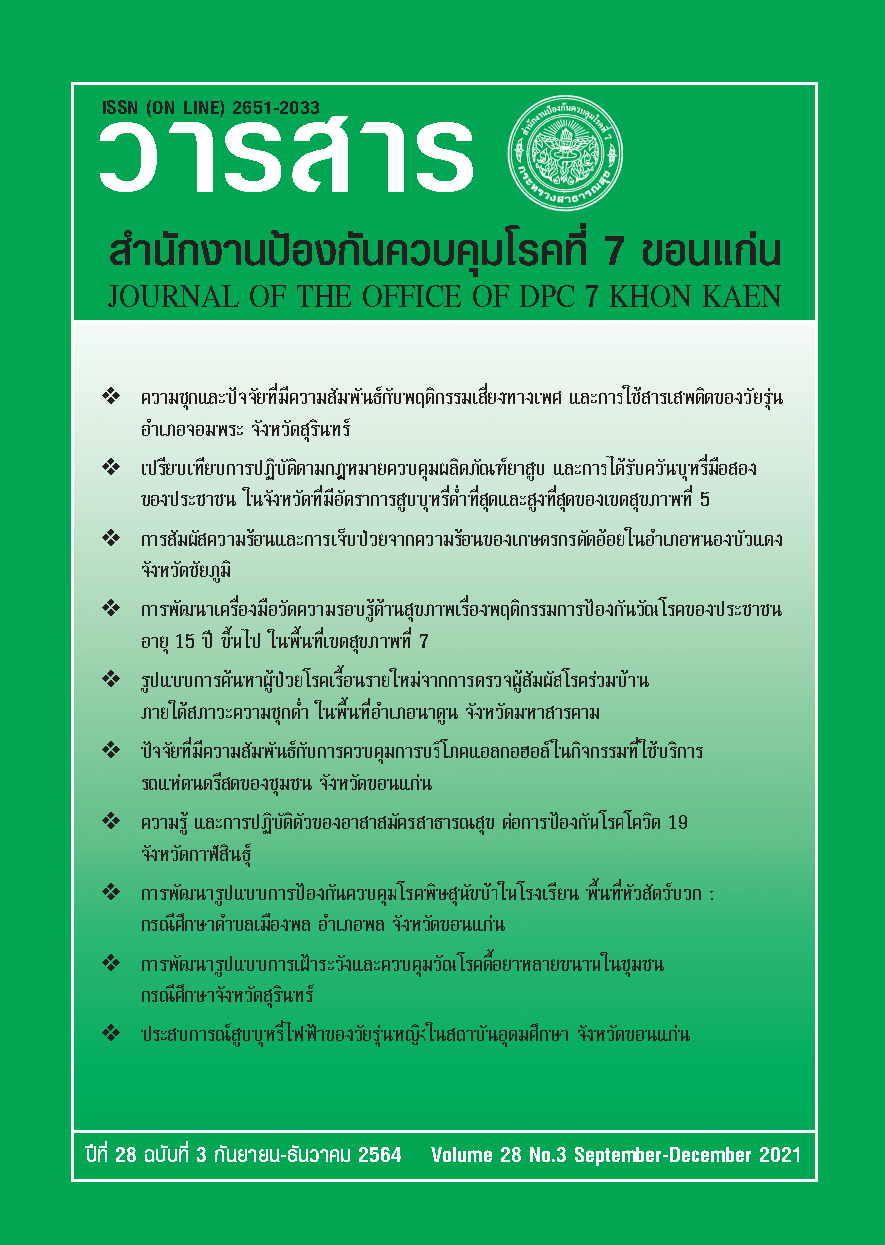
Downloads
Published
How to Cite
Issue
Section
License
ความรับผิดชอบ
บทความที่ลงพิมพ์ในวารสารสำนักงานป้องกันควบคุมโรคที่ 7 ขอนแก่น ถือเป็นผลงานทางวิชาการหรือวิจัย และวิเคราะห์ตลอดจนเป็นความเห็นส่วนตัวของผู้เขียน ไม่ใช่ความเห็นของวารสารสำนักงาน ป้องกันควบคุมโรคที่ 7 จังหวัดขอนแก่น หรือ ของกองบรรณาธิการแต่ประการใด ผู้เขียนต้องรับผิดชอบต่อบทความของตนเอง
ลิขสิทธ์บทความ
บทความที่ได้รับการตีพิมพ์จะถือเป็นลิขสิทธิ์ของสำนักงานป้องกันตวบคุมโรคที่ 7 จังหวัดขอนแก่น