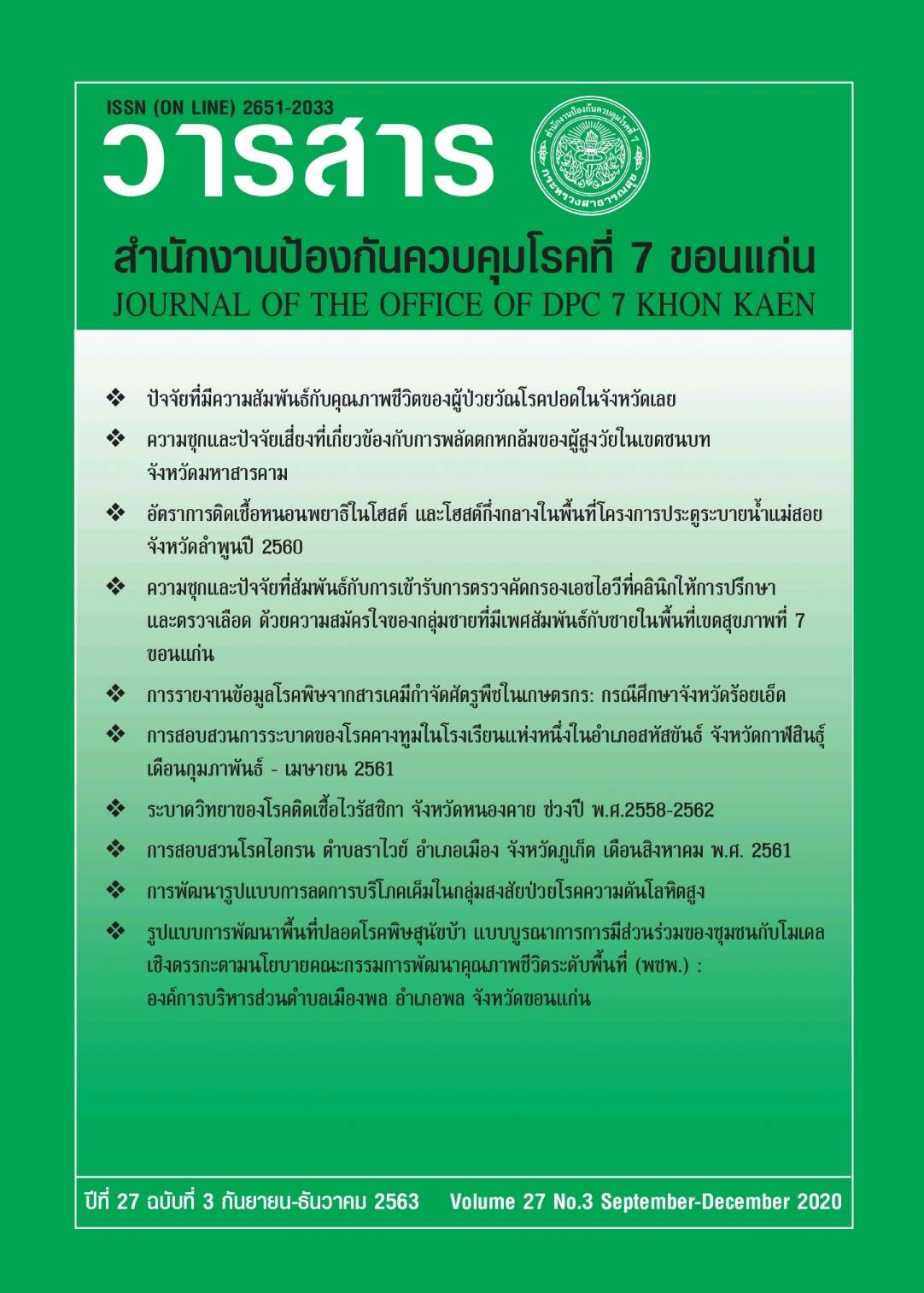
The Development of a Reduced Salty Intake Model in the High Blood Pressure Suspected Cases
Keywords:
Salty reduction, the group of suspected patients with high blood pressure, SaltyAbstract
High blood pressure is a risk factor for leading to cardiovascular disease, chronic kidney disease. The suspected group is at high risk of developing hypertension. This study is action research based on the concept of Kemmis and McTaggart, develop a pattern for reducing salty consumption among suspected patients with hypertension. There were 2 groups of samples. 1) Co-developer of the model, which is a mentor team in the community 2) A group of suspected patients with high blood pressure in 18 communities, 50 people per community, totaling 900 people. Developed between October 2018 - September 2019, included: phase 1 preparation before research Group chat Analyze the problem situation, phase 2 is to plan, perform, observe and reflect on results, through the process of 6 networks (relatives, merchants, volunteers, community leaders, local health workers) and 6 steps 1) Establishing a working group 2) Evaluating and analyzing the community 3) Preparing a salt reduction community plan 4) Follow up on the suspected group, emphasize home visits to empower and randomly measure salinity levels in food; 5) Surveillance system in the community and 6) Control and monitoring. Phase 3 Summary and evaluation collect information from questionnaires, physical examination and measure the level of salinity in food. Data were analyzed by descriptive statistics, presented with frequency, percentage, mean and standard deviation, compared knowledge, sodium level before and after by Paired t-test, set the level of statistical significance at 0.05. The results showed that the reduction of salty consumption among the suspected hypertensive patients, that has been model developed, consisting of 6 networks, 6 phases. After operation the group of suspected hypertensive patients, mean age 56.29 years (SD 11.05 years), had a statistically significant increase in knowledge score of 87.11% (Mean difference 3.35; 95%CI 3.18-3.52, p-value<0.001). The amount of sodium in the diet has decreased, before the mean was 413.42 mg (SD 125.42), and after was 303.82 mg (SD 116.98), sodium level decreased by 70.11% which was statistically significant (Mean difference 109.60; 95%CI 101.90-117.29, p-value<0.001). This model of reduction in salty consumption among suspected hypertensive patients has been developed and suitable for the community, improves the effectiveness of reducing the consumption of salty. To prevent or delay the occurrence of high blood pressure and have a seamless working style in the same goal.
Downloads
References
World Health Organization. (2013). Global Action Plan for the Prevention and Control of Noncommunicable Diseases 2013-2020. Geneva: World Health Organization.
กรมควบคุมโรค. สถานการณ์การดำเนินงานด้านการป้องกันควบคุมโรคไม่ติดต่อ (NCDs) . นนทบุรี. 2561.
สำนักโรคไม่ติดต่อ กรมควบคุมโรค. ข้อมูลโรคไม่ติดต่อ [อินเทอร์เน็ต]. 2561 [เข้าถึงเมื่อ 16 กันยายน 2562]. เข้าถึงได้จาก: www.thaincd.com/2016/mission/documents- detail.php?id=13486&tid=32&gid=l-020
ยุทธศาสตร์การลดการบริโภคเกลือและโซเดียม ในประเทศไทย พ.ศ. 2559-2568. กระทรวง สาธารณสุข; 2559.
Health Data Center. ข้อมูลเพื่อตอบสนอง Service Plan สาขาโรคไม่ติดต่อ (NCD DM, HT, CVD).https://hdcservice.moph.go.th/hdc/reports/page.php7cat_id=b2b59e64c4e6c92d4blecl6a599d882b เข้าถึงเมื่อ 16 พฤศจิกายน 2561.
Kemmis S, McTaggart R. The Action Research Planner. Australia: Deakin University Press; 1988.
Kuder G, Richardson M. The theory of estimation of test reliability. Psychometrika;1937.
Bloom BS. Taxonomy of EducationalObjectives The Classification of Educational Goals. New York: David Mckay Company; 1972.
ณัฐธิวรรณ พันธ์มุง, ขนิษฐา ศรีสวัสดิ์, ประภัสรา บุญทวี.การวิจัยทดลอง การใช้ชุดมาตรการลดบริโภคเค็มในชุมชนต้นแบบ. วารสารวิชาการกรมสนับสนุนบริการสุขภาพ 2563;16(3):39-48.
พรทิพย์ นิ่มขุนทด. ความสัมพันธ์ระหว่างพฤติกรรมการรับประทานอาหารเค็มกับโรคความดันโลหิตสูงและโรคหลอดเลือดหัวใจ: มหาวิทยาลัยเทคโนโลยีสุรนารี; 2559.
ชลธิชา บุญศิริ. ผลของโปรแกรมส่งเสริมการบริโภคอาหารลดโซเดียมต่อความรู้และปริมาณโซเดียมในการปัสสาวะของนักศึกษาพยาบาล. วารสารสภาการพยาบาล 2560.32(3):119-34; 2560.
กาญจนา มณีทัพ, สมจิต แดนสีแก้ว. สถานการณ์การบริโภคเกลือของผู้ป่วยความดันโลหิตสูง ตำบลทางขวาง อำเภอแวงน้อย จังหวัดขอนแก่น. วารสารการพยาบาลและการดูแลสุขภาพ 2560. 35(4): 139-49.
สมาคมความดันโลหิตสูงแห่งประเทศไทย. ลดเค็ม พิชิตภัยเงียบ [อินเทอร์เน็ต]. 2560. [เข้าถึงเมื่อวันที่ 16 กันยายน 2562]. เข้าถึงได้จาก:http://www.thaihypertension.org/files/237_1.LowSalt.pdf.
Irwan MA, Kato M, Kitaoka K, Ueno E, Tsujiguchi H, Shogenji M. Development of the salt reduction and efficacy-maintenance program in Indonesia. Nursing and Health Sciences 2016. 18:519–532.
Downloads
Published
How to Cite
Issue
Section
License
ความรับผิดชอบ
บทความที่ลงพิมพ์ในวารสารสำนักงานป้องกันควบคุมโรคที่ 7 ขอนแก่น ถือเป็นผลงานทางวิชาการหรือวิจัย และวิเคราะห์ตลอดจนเป็นความเห็นส่วนตัวของผู้เขียน ไม่ใช่ความเห็นของวารสารสำนักงาน ป้องกันควบคุมโรคที่ 7 จังหวัดขอนแก่น หรือ ของกองบรรณาธิการแต่ประการใด ผู้เขียนต้องรับผิดชอบต่อบทความของตนเอง
ลิขสิทธ์บทความ
บทความที่ได้รับการตีพิมพ์จะถือเป็นลิขสิทธิ์ของสำนักงานป้องกันตวบคุมโรคที่ 7 จังหวัดขอนแก่น