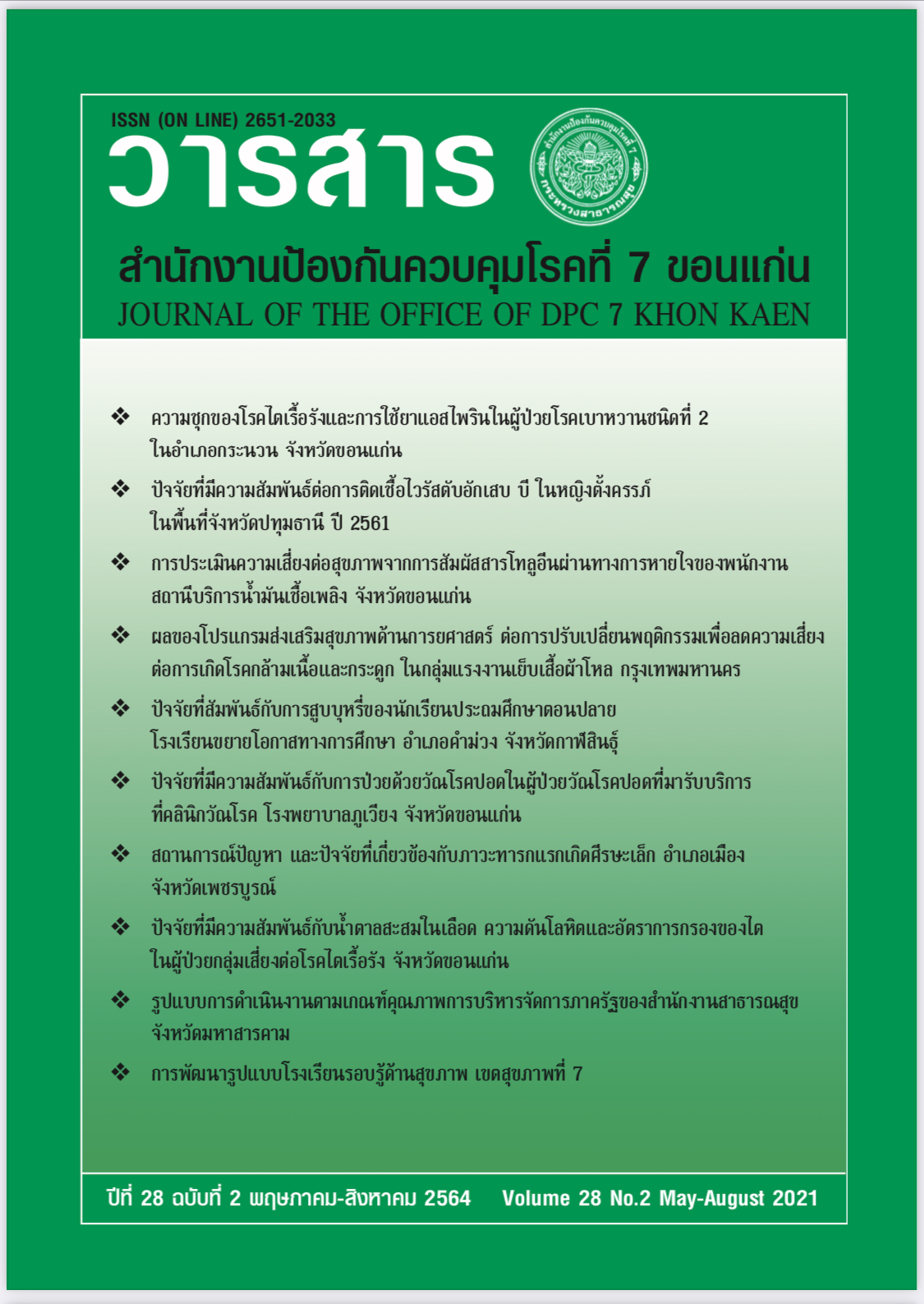
Problem situation and associated factors of neonatal microcephaly, Muang district, Phetchabun province
Keywords:
Problem situation, Associated factors of neonatal microcephaly, Phetchabun provinceAbstract
This study was a retrospective cross-sectional study aimed to assess the prevalence, describe epidemiological characteristics, and identify associated factors with neonatal microcephaly in Muang district, Phetchabun province. The data was gathered by reviewing a medical record of a newborn, delivered from 1st January 2014 – 31st December 2018. The sample size was 250. The definition of neonatal microcephaly was a newborn who has a head circumference (HC) less than the 3rd percentile of standard HC by gestational age (GA) and sex. The analytical study was done by using chi-square and multiple logistic regression for univariate and multivariate analysis, respectively.
During 2014-2018, the prevalence of neonatal microcephaly was 6.4% (16/250). The cases were 7 boys and 9 girls, boy per girl ratio was 1:1.3. The trend of neonatal microcephaly was increasing from 4% in 2014 and peak (12%) in 2017 then decreased to 4% in 2018. The multivariate analysis showed that low birth weight was an associated factor with neonatal microcephaly (Adjusted Odds Ratio=46.83, 95% CI: 11.81 – 185.65, P-value <0.001).
The prevalence of neonatal microcephaly in this study was higher than a previous study, may come from different methodologies. This study was a retrospective study, some associated factors may not record in a medical record. The study on possible associated factors may be needed for further study.
Downloads
References
Centers for Disease Control and Prevention. Facts about Microcephaly [Internet]. 2020 [Cited 9 May 2020]. Available from: https://www.cdc.gov/ncbddd/birthdefects/microcephaly.html.
World Health Organization. Microcephaly [Internet]. 2018 [Cited 9 May 2020]. Available from: https://www.who.int/news-room/fact-sheets/detail/microcephaly.
Alfaro-Murillo JA, Parpia AS, Fitzpatrick MC, Tamagnan JA, Medlock J, Ndeffo-Mbah ML, et al. A Cost-Effectiveness Tool for Informing Policies on Zika Virus Control. PLOS Neglected Tropical Diseases 2016;10(5): e0004743.
Hinjoy S, Kongyu S, Poonkesorn S, Sangwanloy S. Statistical correlations between infection of dengue viruses, chikungunya virus, measles, rubella and children with microcephaly less than one year of age in Thailand. Disease control journal 2014;42(4):280-9.
World Health Organization. Screening, assessment and management of neonates and infants with complications associated with Zika virus exposure in utero [Internet]. 2016 [Cited 9 May 2020]. Available from: http://www.who.int/csr/resources/publications/zika/assessment-infants/en/.
Buathong R. Situation of Zika virus infection in Thailand 2012-2016 [Internet]. 2017 [Cited 9 May 2020]. Available from: http://nih.dmsc.moph.go.th/data/data/59/22_6/1_2.pdf.
Wongsurawat T, Athipanyasilp N, Jenjaroenpun P, Jun SR, Kaewnapan B, Wassenaar T M, et al. Case of Microcephaly after Congenital Infection with Asian Lineage Zika Virus, Thailand. Emerging infectious diseases 2018;24(9):1758–61.
Darasawang W, Rattanathumsakul T, Suwanchairob O, Wijit W, Siriarayapon P, Laosiritaworn Y, et al. First reported case of Zika virus infection associated with Guillian Barre Syndrome in Asia, Phetchabun Province, Thailand, 2016. Weekly Epidemiological Surveillance Report 2018; 49: 717-26.
Thammaros T, Chalom K, Hanshaoworakul W, Thitichai P, Tantiworrawit P, Pongpanich S. Prevalence and associated factors of neonatal microcephaly in Thailand, 2014-2018. OSIR 2019; 12(3): 100-8.
The Royal College of Pediatricians of Thailand and Paediatric Society of Thailand. Guidance for the Evaluation and Management of Infants with Possible Congenital Zika Virus Infection [Internet]. 2016 [Cited 9 May 2020]. Available from: http://www.ped.si.mahidol.ac.th/HA/CPG/GuidelineCongenitalZikaSyndrome19-9-59.pdf.
World Health Organization. Global Nutrition Targets 2025: Low birth weight policy brief [Internet]. 2014 [Cited 9 May 2020]. Available from: https://www.who.int/nutrition/publications/globaltargets2025_policybrief_lbw/en/.
World Health Organization. Length/height-for-age [Internet]. [Cited 9 May 2020]. Available from: https://www.who.int/toolkits/child-growth-standards/standards/length-height-for-age.
Sutan R, Yeong ML, Mahdy ZA, Shuhaila A, Rohana J, Ishak S, et al. Trend of head circumference as a predictor of microcephaly among term infants born at a regional center in Malaysia between 2011-2015. Research and Reports in Neonatology 2018; 8: 9-17.
Kirchengast S, Hartmann B. Impact of maternal age and maternal somatic characteristics on newborn size. Am J Hum Biol 2003; 15(2): 220-8.
Shajari H, Marsoosy V, Aslani M, Mohammady MR, Heshmaty P. The effect of maternal age, gestational age and parity on the size of the newborn. Acta Medica Iranica 2006; 44(6): 400-4.
Polzlberger E, Hartmann B, Hafner E, Stumpflein I, Kirchengast S. Maternal Height and Pre-Pregnancy Weight Status Are Associated with Fetal Growth Patterns and Newborn Size. J Biosoc Sci 2017; 49(3): 392-407.
de Sá SA, Willner E, Duraes Pereira TA, de Souza VR, Teles Boaventura G, Blondet de Azeredo V. Anemia in pregnancy: Impact on weight and in the development of anemia in newborn. Nutr Hosp 2015; 32(5): 2071-79.
Thammaros T. The neonatal microcephaly reporting system evaluation in Samutsakhon Province, January 2017, why data quality is important. The 9th TEPHINET Global Scientific Conference; Aug 7-11; Chiang-mai. Thailand; 2017. P.356.
ICD10DATA. Microcephaly [Internet]. 2020 [Cited 9 May 2020]. Available from: https://www.icd10data.com/ICD10CM/CODES/Q00-Q99/Q00-Q07/Q02-/Q02.
de Araújo TVB, Ximenes RAdA, Miranda-Filho DdB, Souza WV, Montarroyos UR, de Melo APL, et al. Association between microcephaly, Zika virus infection, and other risk factors in Brazil: final report of a case-control study. The Lancet Infectious Diseases 2018; 18(3): 328-36.
Bureau of Epidemiology, Department of disease control. Zika situation awareness team. Nonthaburi: Ministry of public health, Thailand; 2017.
Adiele DF, Elem UO. Biostatistical analysis of birth weight and head circumference of babies a case study of Nigeria. Global Journal of Mathematical Sciences 2013; 12(1): 5-12.
Kaur M, Chauhan A, Manzar MD, Rajput MM. Maternal Anaemia and Neonatal Outcome: A Prospective Study on Urban Pregnant Women. J Clin Diagn Res 2015; 9(12): QC04-QC8.
Gondwe A, Ashorn P, Ashorn U, Dewey KG, Maleta K, Nkhoma M, et al. Pre-pregnancy body mass index (BMI) and maternal gestational weight gain are positively associated with birth outcomes in rural Malawi. PLoS One 2018; 13(10): e0206035.
Xiao L, Ding G, Vinturache A. Associations of maternal pre-pregnancy body mass index and gestational weight gain with birth outcomes in Shanghai, China. Sci Rep 2017; 7: 41073.
World Health Organization. Zika virus [Internet]. 2018 [Cited 9 May 2020]. Available from: https://www.who.int/news-room/fact-sheets/detail/zika-virus
Downloads
Published
How to Cite
Issue
Section
License
ความรับผิดชอบ
บทความที่ลงพิมพ์ในวารสารสำนักงานป้องกันควบคุมโรคที่ 7 ขอนแก่น ถือเป็นผลงานทางวิชาการหรือวิจัย และวิเคราะห์ตลอดจนเป็นความเห็นส่วนตัวของผู้เขียน ไม่ใช่ความเห็นของวารสารสำนักงาน ป้องกันควบคุมโรคที่ 7 จังหวัดขอนแก่น หรือ ของกองบรรณาธิการแต่ประการใด ผู้เขียนต้องรับผิดชอบต่อบทความของตนเอง
ลิขสิทธ์บทความ
บทความที่ได้รับการตีพิมพ์จะถือเป็นลิขสิทธิ์ของสำนักงานป้องกันตวบคุมโรคที่ 7 จังหวัดขอนแก่น