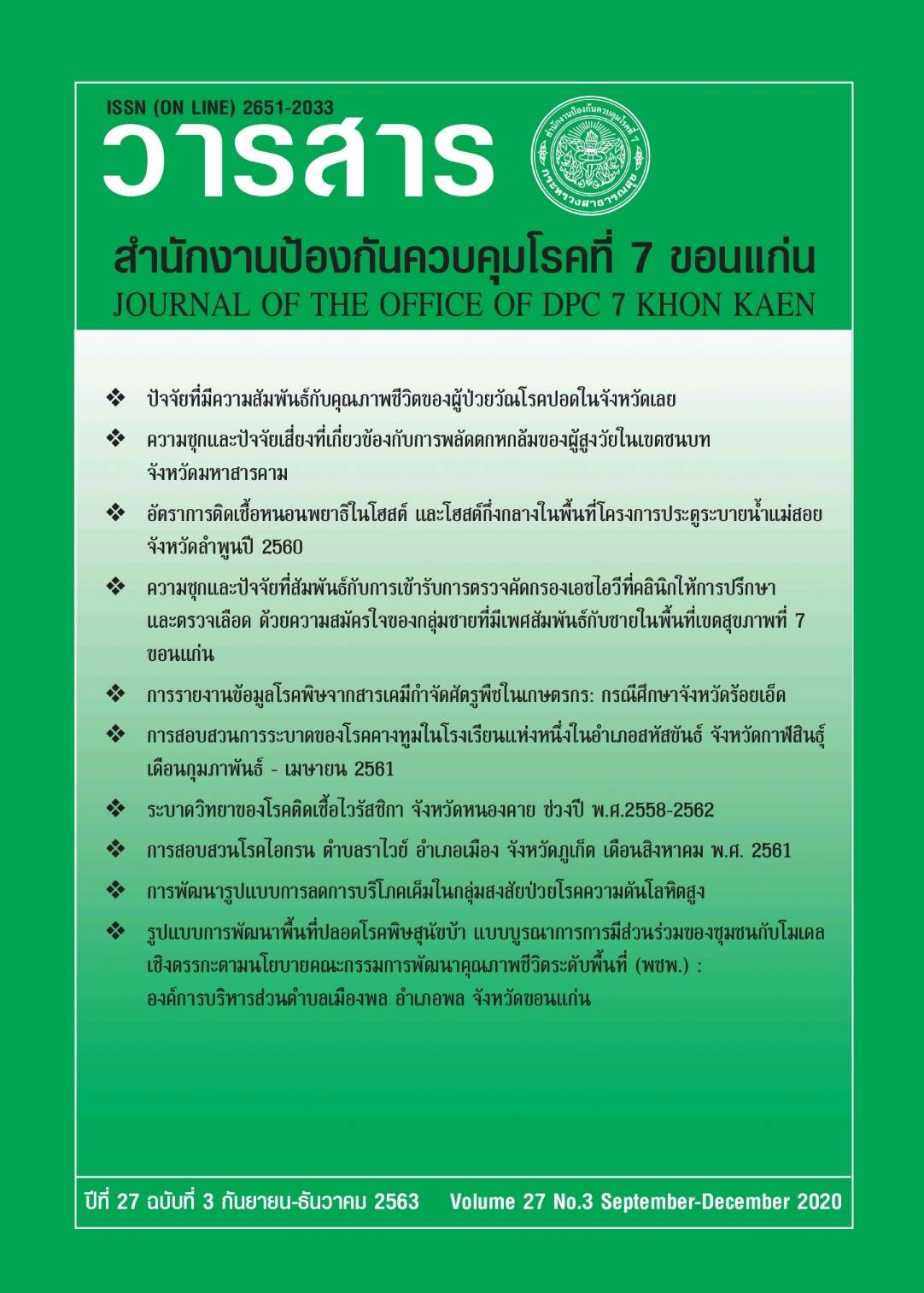
Epidemiology of Zika Virus Infection Nong Khai Province During the year 2015-2019
Keywords:
Epidemiology, Zika Virus InfectionAbstract
This cross sectional descriptive study and research objective was to study descriptive epidemiology (person, place, and time) and the factors associated with symptoms of the Zika Virus disease. the populations were all with Zika Virus Infection of 47 patients in Nong Khai Province during 1 January 2015 until 31 December 2019. The data were analyzed by statistics for investigation report for Zika virus infection and Aedes larvae survey was conducted to collect data. Using for statistics: frequency, percentages, means and Chi-Square Tests (c2).
Research results show that characteristics of person a total of all 47 patients were treated with Zika virus. Most of cases were female (63.8%), 25-44 years old (42.6%), farmers (27.7%), students (25.5%), employed and laborers (21.3%) respectively. Residence the most reported cases were living in Pho Tak District 22 cases (46.8%), Rattanawapi District 13 cases (27.7%), Phon Phisai District 10 cases (21.3%) and Fao Rai District 2 cases (4.3%) respectively. Distribution of disease by time with Zika virus in 2015 and 2018 there were no patient reports, Patients starting from 2016, 2017 and 2019. Overall of Zika virus patients were most found in July, May and September. In 2016, there were 11 cases, most in July 6 cases, the first started on 28 June 2016, last on 14 September 2016. In 2017, there were 12 patients, the first started on 1 January 2017, last on 3 July 2017, the most in May 4 cases. In the year 2019, there were 24 cases, the first started on 23 January 2019, last on 27 October 2019, the most in September 19 cases. Risk factors of disease occurrence during the 14 days before onset, 68.1% of patients touched, residential homes in the radius of the suspected/ Zika confirmed 51-100 meters, 42.6% and travel in risk areas 36.2% respectively. 93.6% of new Zika virus case who had 1-2 households and 6.4% pregnant women in the village. Mosquito larvae was vector, surveyed during the first day after sickness, Mosquitoes larvae found in levels higher than the threshold, at patients home (HI means =36.8), community (HI means =19.9), religious place (CI means =30.9), school (CI means =39.3). Found that the factors related to the symptoms of Zika virus infection Statistical significance Including sex, joint pain/ muscle pain (p = 0.019), fatigue (p = 0.002), places include joint/ muscle pain (p = 0.013) and all symptoms of Zika virus were not related to age group and occupation. Conclusion: the risk of disease distribution by characteristics of person, place, and time was correlated with the symptoms of Zika virus infection with statistical significance.
Downloads
References
กรมการแพทย์ กระทรวงสาธารณสุข. แนวทางการวินิจฉัย ดูแลรักษาโรคไข้ซิกา (Zika virus disease) สำหรับแพทย์ และบุคลากรทางการแพทย์และสาธารณสุข. คณะกรรมการวิชาการด้านการรักษาพยาบาลโรคอุบัติใหม่อุบัติซ้ำ กรมการแพทย์ กระทรวงสาธารณสุข. (1); 2559: 1-9.
กรมควบคุมโรค. องค์ความรู้เรื่อง โรคไข้ซิกา (Zika virus disease). สำนักระบาดวิทยา; 2559: 1-3. <ออนไลน์>[เข้าถึงเมื่อ 17 มีนาคม 2563]. จาก: http://beid.ddc.moph.go.th
สำนักงานป้องกันควบคุมโรคที่ 8 อุดรธานี. รายงานการเฝ้าระวังทางระบาดวิทยา ผู้ป่วยในระบบเฝ้าระวัง รง. 506 สำนักงานป้องกันควบคุมโรคที่ 8 อุดรธานี; 2562.
กรมควบคุมโรค กระทรวงสาธารณสุข. คู่มือเฝ้าระวังเหตุการณ์ และควบคุมโรคระบาดในชุมชน กรมควบคุมโรค กระทรวงสาธารณสุข. นนทบุรี: สำนักระบาดวิทยา กรมควบคุมโรค; 2559: 1-5.
กรมควบคุมโรค. องค์ความรู้เรื่อง โรคไข้ซิกา (Zika virus disease). สำนักระบาดวิทยา; 2559: 1-3. <ออนไลน์>[เข้าถึงเมื่อ 17 มีนาคม 2563]. จาก: http://beid.ddc.moph.go.th
สำนักโรคติดต่ออุบัติใหม่สำนักโรคติดต่ออุบัติใหม่. รายงานสถานการณ์โรคติดเชื้อไวรัสซิกา (Zika virus disease) ประจำวันที่ 15 พฤษภาคม 2560. <ออนไลน์>[เข้าถึงเมื่อ 21 มีนาคม 2563]. เข้าถึงได้จาก: http://beid.ddc.moph.go.th
กระทรวงสาธารณสุข.คู่มือการป้องกันควบคุมโรคติดเชื้อไวรัส Zikaสำหรับบุคลากรทางการแพทย์และสาธารณสุข ปี 2559.นนทบุรี: สำนักโรคติดต่ออุบัติใหม่ กรมควบคุมโรค กระทรวงสาธารณสุข. สำนักงานกิจการโรงพิมพ์ องค์การสงเคราะห์ทหารผ่านศึก; 2559.
จุไร วงศ์สวัสดิ์, ปฐมา สุทธา, สุมนมาลย์ อุทยมกุล, สุมาลี ชะนะมา, กุลกัญญา โชคไพบูลย์กิจ. อุบัติการณ์การติดเชื้อไวรัสซิกาในผู้ป่วยที่สงสัยไข้เดงกี่. วารสารวิจัยระบบสาธารณสุข 2560; 11(4): 564-571.
กรมควบคุมโรค กระทรวงสาธารณสุข. แนวทางการดำเนินงานการเฝ้าระวังและสอบสวนโรคติดเชื้อไวรัสซิกา (Zika virus infection).นนทบุรี: สำนักระบาดวิทยา กรมควบคุมโรค; 2559:1-7.
นวลปราง ประทุมศรี. การระบาดโรคติดเชื้อไวรัสซิกา เขตสุขภาพที่ 4 ประเทศไทย, กันยายน-ธันวาคม 2559. สานักงานป้องกันควบคุมโรคที่ 4 จังหวัดสระบุรี กรมควบคุมโรค กระทรวงสาธารณสุข, 2559.
Zambranaa JV, Carrillob FB, Calderona RB, Colladoa D, Sancheza N, Ojedaa S, et al. Seroprevalence, risk factor, and spatial analyses of Zika virus infection after the 2016 epidemic in Managua, Nicaragua. PNAS 2018; 115(37): 9294–99.
Downloads
Published
How to Cite
Issue
Section
License
ความรับผิดชอบ
บทความที่ลงพิมพ์ในวารสารสำนักงานป้องกันควบคุมโรคที่ 7 ขอนแก่น ถือเป็นผลงานทางวิชาการหรือวิจัย และวิเคราะห์ตลอดจนเป็นความเห็นส่วนตัวของผู้เขียน ไม่ใช่ความเห็นของวารสารสำนักงาน ป้องกันควบคุมโรคที่ 7 จังหวัดขอนแก่น หรือ ของกองบรรณาธิการแต่ประการใด ผู้เขียนต้องรับผิดชอบต่อบทความของตนเอง
ลิขสิทธ์บทความ
บทความที่ได้รับการตีพิมพ์จะถือเป็นลิขสิทธิ์ของสำนักงานป้องกันตวบคุมโรคที่ 7 จังหวัดขอนแก่น