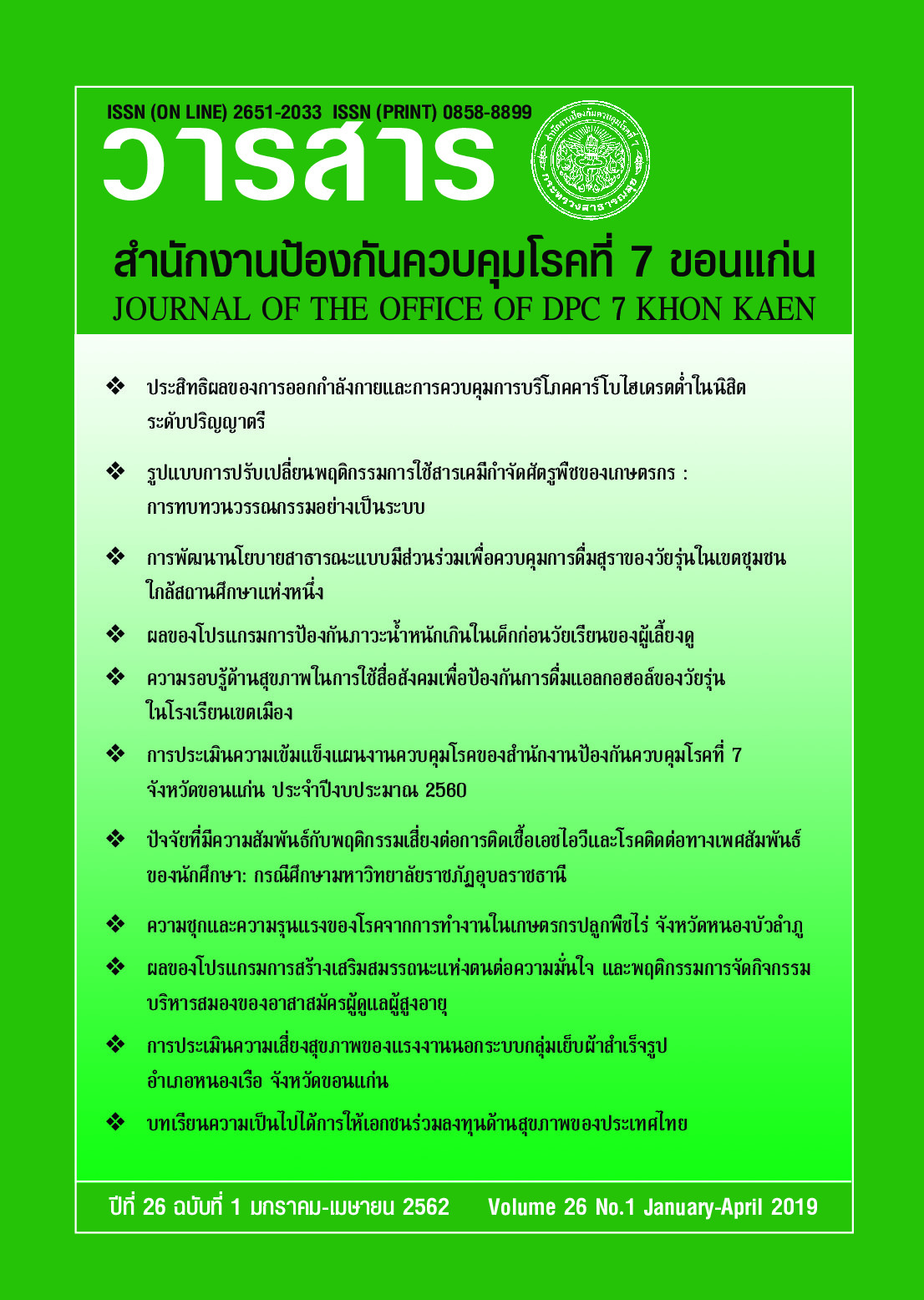
Factors Associated with Risk Behavior of HIV Infection and Sexually Transmitted Diseases of Students: The Case Study in Ubon Ratchathani Rajabhat University
Keywords:
HIV / AIDS, risk behaviors, studentsAbstract
This study aims to investigate the prevalence and factors associated with risk behavior for HIV infection and sexually transmitted diseases of students in Ubon Ratchathani Rajabhat University. This cross-sectional study used questionnaires to collect data between January and November 2016.
From the study it was found that among 245 students who were interviewed were 84.9 percent male and 15.1 percent female. 64.1 percent of these students was correctly answers of AIDs questions as UNGASS indicators. Among all students interviewed 198 people (80.8 %) have ever experienced sexual intercourse and the average age of their first sex was 16.33 (SD = 2.179). 49 percent of these students reported that they had not used condom for their first sex. Among the students who ever have sexual experience, 20.3 percent used drugs before having sex, and 35 percent drank alcohol before having sex. From the study of factors associated with risk behavior of HIV infection and sexually transmitted infection it was found that students who did not live with their families had the risky behavior of HIV infection and sexually transmitted infection 2.14 times more than students who live with their families (OR = 2.14; 95% CI 1.21 - 3.84). Students who had ever used drugs had not the risky behavior of HIV infection and sexually transmitted infection 0.61 times more than students who did not use drugs (OR = 0.39; 95% CI 0.22 - 0.71). Moreover, students who drank alcohol before having sex had the risky behavior of HIV infection and sexually transmitted infection 2.70 times than students who did not drink alcohol before having sex with statistical significance (OR = 2.70; 95% CI 1.48 - 4.92).
The results of the study suggested that it is important for the families to be involved in the creation of knowledge and the right attitude to students. This also influences to all the public and private sectors for co-operating to create the prevention of HIV and Sexually transmitted diseases .
References
2. สำนักโรคเอดส์ วัณโรค และโรคติดต่อทางเพศสัมพันธ์. รายงานผลการดำเนินงาน. นนทบุรี:
สำนักโรคเอดส์ วัณโรค และโรคติดต่อทางเพศสัมพันธ์; 2556.
3. Word Health Organization. WHO. AIDS and STD [internet]. [cited 2016 October 27]. Available From URL: https://www.who.int/hiv/en/; 2016.
4. Krejcie, RV, and Morgan, D.W. Determining Sample Size for Rearch Activities. Education. Psychological measurement 1970; 607-610.
5. สำนักระบาดวิทยา กรมควบคุมโรค. ระบบเฝ้าระวังพฤติกรรม. [ออนไลน์]. [เข้าถึงเมื่อ 7 กุมภาพันธ์ 2559]. เข้าถึงได้จาก: https://www.boe.moph.go.th/aids/bss.php; 2559.
6. จุฑามาศ เบ้าคำกอง. ปัจจัยที่มีผลต่อการมีเพศสัมพันธ์ของนักเรียนหญิง ชั้น ม.5 และนักเรียนหญิงอาชีวศึกษา ชั้น ปวช.2 จังหวัดปทุมธานี ปี 2556. วารสารโรคเอดส์ 2557; 27(1): 209-218.
7. สถาบันพัฒนาการสาธารณสุขอาเซียน มหาวิทยาลัยมหิดล. รายงานการสำรวจการเฝ้าระวังพฤติกรรมที่สัมพันธ์กับการติดเชื้อเอชไอวี ในประชากร 6 กลุ่มเป้าหมาย พื้นที่กรุงเทพมหานคร ปี2550. นครปฐม: สถาบันพัฒนาการสาธารณสุขอาเซียน มหาวิทยาลัยมหิดล; 2550.
8. น้องนุช ฆวีวงค์. ปัจจัยที่มีผลต่อความตั้งใจในการใช้บริการสุขภาพด้านเพศและอนามัยเจริญพันธ์ของเยาวชนในจังหวัดระยอง [วิทยานิพนธ์ปริญญาพยาบาลศาสตรมหาบัณฑิต]. ชลบุรี: มหาวิทยาลัยบูรพา; 2555.
9. กระทรวงสาธารณสุข. นโยบายและยุทธศาสตร์การพัฒนาอนามัยการเจริญพันธ์แห่งชาติฉบับที่ 1 (พ.ศ.2553-2557). นนทบุรี: องค์การสงเคราะห์ทหารผ่านศึก; 2553.
10. ศิรินันท์ กิตติสุขสถิต, นพวรรณ มาดารัตน์, วาที สิทธิ, แครี ริคเตอร์ และอุไรวรรณ คะนึงสุขเกษม. หนูยังไม่อยากเป็นแม่: เส้นทางชีวิตที่น่าห่วงใยของแม่วัยเด็กในสังคมไทย. นครปฐม: สถาบันวิจัยประชากรและสังคม มหาวิทยาลัยมหิดล; 2554.
11. สุภาวิณี บัวจำรัส. พฤติกรรมการป้องกันโรคเอดส์ของนักศึกษาในวิทยาลัยการ
อาชีพแห่งหนึ่งจังหวัดชัยภูมิ [วิทยานิพนธ์วิทยาศาสตรมหาบัณฑิต]. ชลบุรี: มหาวิทยาลัยบูรพา; 2554.
Downloads
Published
How to Cite
Issue
Section
License
ความรับผิดชอบ
บทความที่ลงพิมพ์ในวารสารสำนักงานป้องกันควบคุมโรคที่ 7 ขอนแก่น ถือเป็นผลงานทางวิชาการหรือวิจัย และวิเคราะห์ตลอดจนเป็นความเห็นส่วนตัวของผู้เขียน ไม่ใช่ความเห็นของวารสารสำนักงาน ป้องกันควบคุมโรคที่ 7 จังหวัดขอนแก่น หรือ ของกองบรรณาธิการแต่ประการใด ผู้เขียนต้องรับผิดชอบต่อบทความของตนเอง
ลิขสิทธ์บทความ
บทความที่ได้รับการตีพิมพ์จะถือเป็นลิขสิทธิ์ของสำนักงานป้องกันตวบคุมโรคที่ 7 จังหวัดขอนแก่น