The Associated Factors with Unsuccessful Tuberculosis Treatment Outcomes among HIV-TB Co-Infected patients in Surin Province
Keywords:
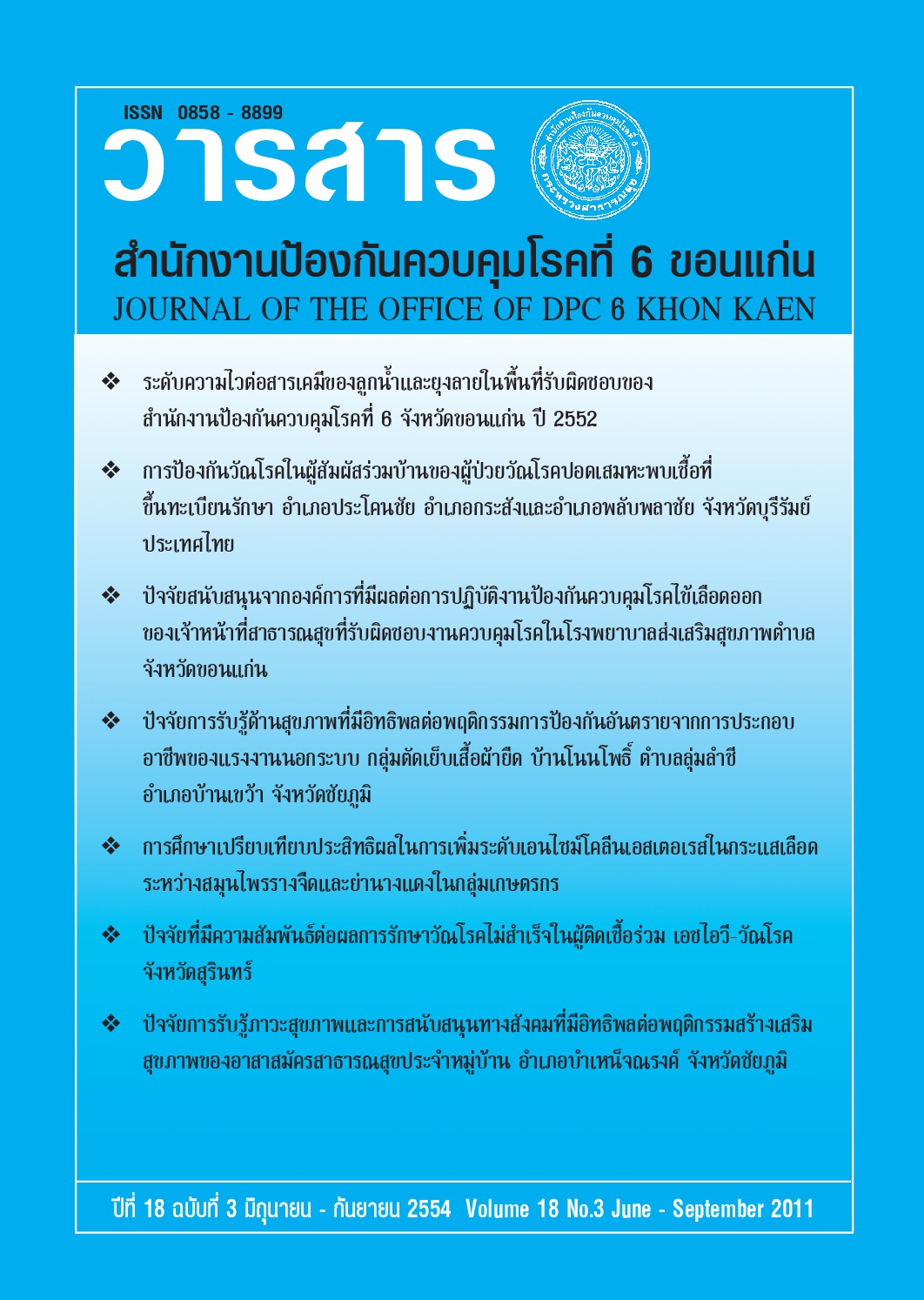
Tuberculosis, HIV/AIDS, Co-infection, Unsuccessful treatment outcomeAbstract
Tuberculosis (TB) is the most common opportunistic infection in HIV-infected patients as well as the leading cause of death. Rates of HIV and TB in Surin Province, Thailand exceed, but data on co-infection rates,TB treatment outcomes in TB/HIV co-infected patients are lacking. This study aimed to identify the factorsassociated with unsuccessful TB treatment outcomes among TB/HIV co-infected patients during the frst 6 monthsof initiating anti-TB regimens. A retrospective cohort study was conducted among 466 TB/HIV patients whowere registered and treated TB during September 2006 to August 2011 at 13 district hospitals and 1 provincialhospital in Surin province. Data were collected from medical records and relevant TB and HIV reports. Baselinecharacteristics and TB treatment outcomes were presented as descriptive statistics. Risk factors of unsuccessfulTB treatment outcome were conducted by multiple logistic regression analysis and strength of association wasreported as relative risk (RR) with 95% confdent interval (95%CI). All analyzes were performed using STATA
programme version 8.20 at level of signifcant equal 0.05. The results showed that; in a fnal 6-month TB treatment,138 (29.61%) were unsuccessful outcome. Three hundred and forty four (73.82%) patients received opportunisticinfection prophylaxis, and 321 (68.88%) received ART. The factors associated with unsuccessful TB treatmentoutcome consisted of CAT 2 regimen (RRadj=3.72, 95%CI: 1.05-13.17), CAT 4 or other (RRadj=3.05, 95%CI: 1.07-8.64), CD4 count < 25 cell/µl (RRadj=2.81, 95%CI: 1.01-7.85), unknown CD4 count (RRadj=3.14,95%CI : 1.16-8.48), AIDS stage (RRadj=6.48, 95%CI: 2.36-17.78), currently smoking (RRadj
=4.14, 95%CI: 1.47 – 11.59) and poor adherence to anti-TB (ATB) (RRadj=4.68, 95%CI: 2.37-9.23). Only pooradherence to ART is a great deal high risk of unsuccessful TB treatment outcome (RRadj=30.77, 95%CI: 11.95 - 79.24). Patients who were former smoker (RRadj=0.29, 95%CI: 0.11-0.80), fnished junior high
school (RRadj=0.41, 95%CI: 0.18-0.97) and senior high school or bachelor degree (RRadj=0.20, 95%CI: 0.02-0.28), received fluconazole (RRadj=0.18, 95%CI: 0.04-0.83), received ART before TB treatmentand received ART during TB treatment were precisely protective factors (RRadj= 0.04, 95%CI: 0.01-0.12 andRRadj= 0.03, 95% CI: 0.01-0.09). Therefore, counseling and increasing knowledge for stop smoking andmodifying the health system for increasing an OI prophylaxis, also adherence to both ART and ATB were stronglyprotective against unsuccessful TB treatment outcome.
Downloads
Published
How to Cite
Issue
Section
License
ความรับผิดชอบ
บทความที่ลงพิมพ์ในวารสารสำนักงานป้องกันควบคุมโรคที่ 7 ขอนแก่น ถือเป็นผลงานทางวิชาการหรือวิจัย และวิเคราะห์ตลอดจนเป็นความเห็นส่วนตัวของผู้เขียน ไม่ใช่ความเห็นของวารสารสำนักงาน ป้องกันควบคุมโรคที่ 7 จังหวัดขอนแก่น หรือ ของกองบรรณาธิการแต่ประการใด ผู้เขียนต้องรับผิดชอบต่อบทความของตนเอง
ลิขสิทธ์บทความ
บทความที่ได้รับการตีพิมพ์จะถือเป็นลิขสิทธิ์ของสำนักงานป้องกันตวบคุมโรคที่ 7 จังหวัดขอนแก่น