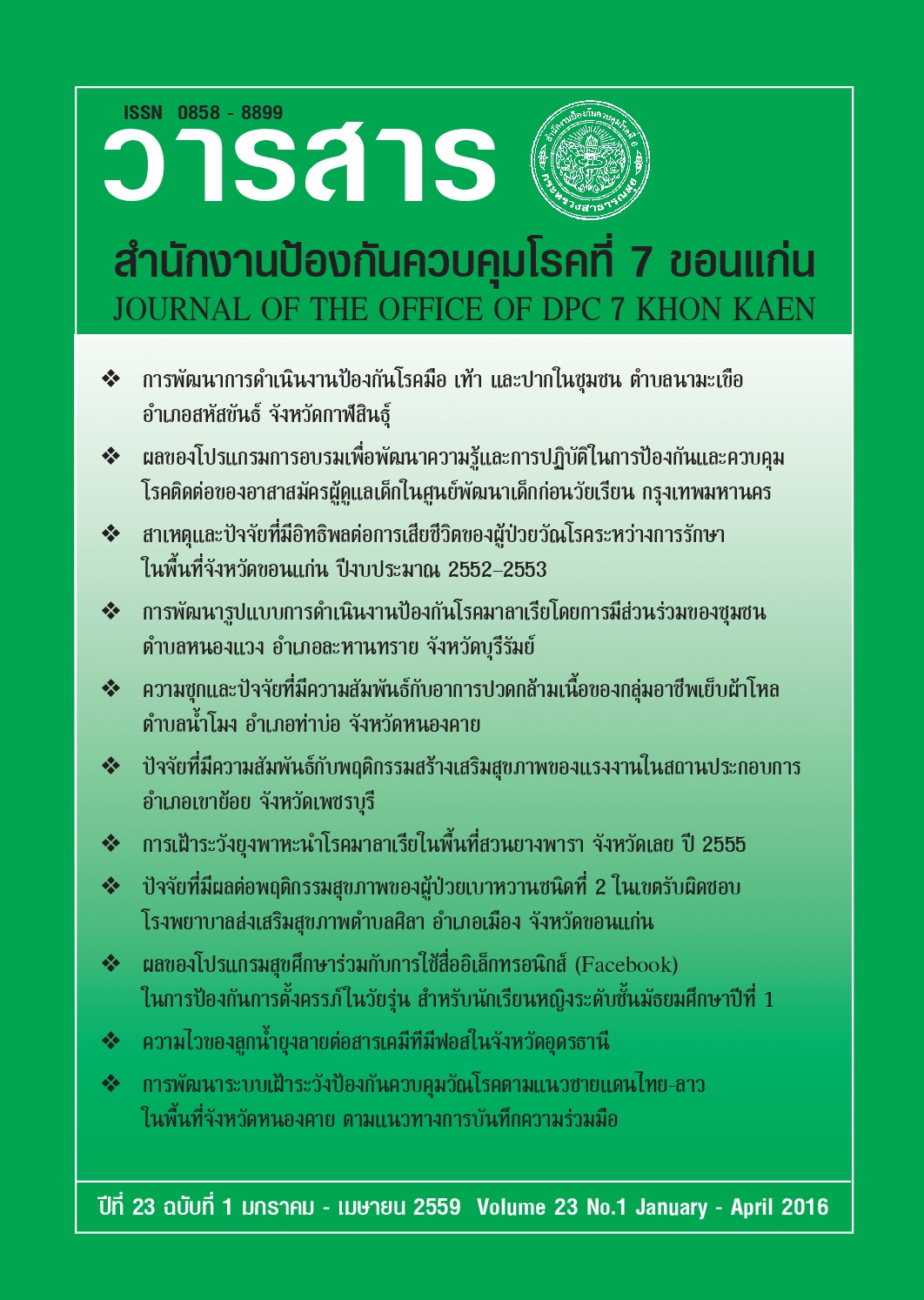
Factors related to Health Promoting Behaviors of Industrial Workers, Khaoyoi District, Petchaburi Province
Keywords:
Personal factors, Health Factors, Behavioral Health RiskAbstract
Worker is an important factor affecting production quality. Promoting health and well-being is an crucial activities in occupational health services. The purpose of this research was to study health status and health promoting behaviors of industrial workers in Khaoyoi District, Petchaburi Province. Subjects were 381 workers at least 15 years of age selected by stratified random sampling by the size of industry. Data were collected by using questionnaire and analyzed by using statistical software package. Statistical analyses used were frequency, percentage, mean, chi-square and Pearson correlation coefficients.
Results showed that most of the workers perceived their health status at good level (84.8 %). Annual health examination indicated that overweight and obesity was 26.5 % and 4.5 %, respectively. Other health problems included hypertension (2.3%), anemia (18.5%), high cholesterol (1.5 %), high triglyceride (1.7%), abnormal HDL (14.4 %), high blood sugar at risk of diabetes mellitus (0.3%). Abnormal vision, dental caries, gingivitis, and hearing problems were 28.6%, 88.2%, 11.8 %, and 1.0 %. There were also workers with AIDS (0.5%), syphilis (0.5%), and hepatitis B (0.3%). Abnormal chest x-ray was 0.3%. For male workers aged 40 years and older, 74.4 % had slightly prostatic hypertrophy and 2.0 % had hormone deficiency symptoms. For female workers aged 45 years and older, 31.6% had menopausal symptoms. About 10.8 % of workers experienced work-related injuries. Workers mostly had overall health promoting behaviors at fair level (87.9%) and good level (5.8%). Poor health status was reported at 6.3 %. Considering each dimension of health promoting behaviors, it was found that most of the subjects had behaviors related to self-actualization, health responsibility, nutrition, stress management, and interpersonal relationship at good level (75.6% / 67.7% / 56.2% / 82.2% / 71.1, and 81.9% respectively). Personal factors including marital status, education, and age had significant relationship with health promoting behaviors (p<0.05) Age had positive relationship with health promoting behaviors at low level (r = 0.135, p-value = 0.016). Working factors including years of work in the enterprises had positive relationship with health promoting behaviors at low level (r = 0.120, p-value = 0.031). Health factors including perceived health status had positive relationship with health promoting behaviors at low level (r = 0.226, p-value < 0.001). Overall health risk behaviors had relationship with health promoting behaviors at p< 0.05
Findings suggest to promote health behaviors of workers, managers should develop workplace health promotion policy. Public health sectors should also collaborate with workplace personnel to support health education program and health care services related to exercise, nutrition, and stress management for workers to enhance appropriate health behaviors.
Downloads
Downloads
Published
How to Cite
Issue
Section
License
ความรับผิดชอบ
บทความที่ลงพิมพ์ในวารสารสำนักงานป้องกันควบคุมโรคที่ 7 ขอนแก่น ถือเป็นผลงานทางวิชาการหรือวิจัย และวิเคราะห์ตลอดจนเป็นความเห็นส่วนตัวของผู้เขียน ไม่ใช่ความเห็นของวารสารสำนักงาน ป้องกันควบคุมโรคที่ 7 จังหวัดขอนแก่น หรือ ของกองบรรณาธิการแต่ประการใด ผู้เขียนต้องรับผิดชอบต่อบทความของตนเอง
ลิขสิทธ์บทความ
บทความที่ได้รับการตีพิมพ์จะถือเป็นลิขสิทธิ์ของสำนักงานป้องกันตวบคุมโรคที่ 7 จังหวัดขอนแก่น