The Effect of Education and Practice Development Program for Prevention and Control of Communicable Diseases for Care-giver Volunteers in The Early Childhood Development Centers, Bangkok
Keywords:
Prevention and Control of Communicable Diseases, Care-giver Volunteers, Early childhoodAbstract
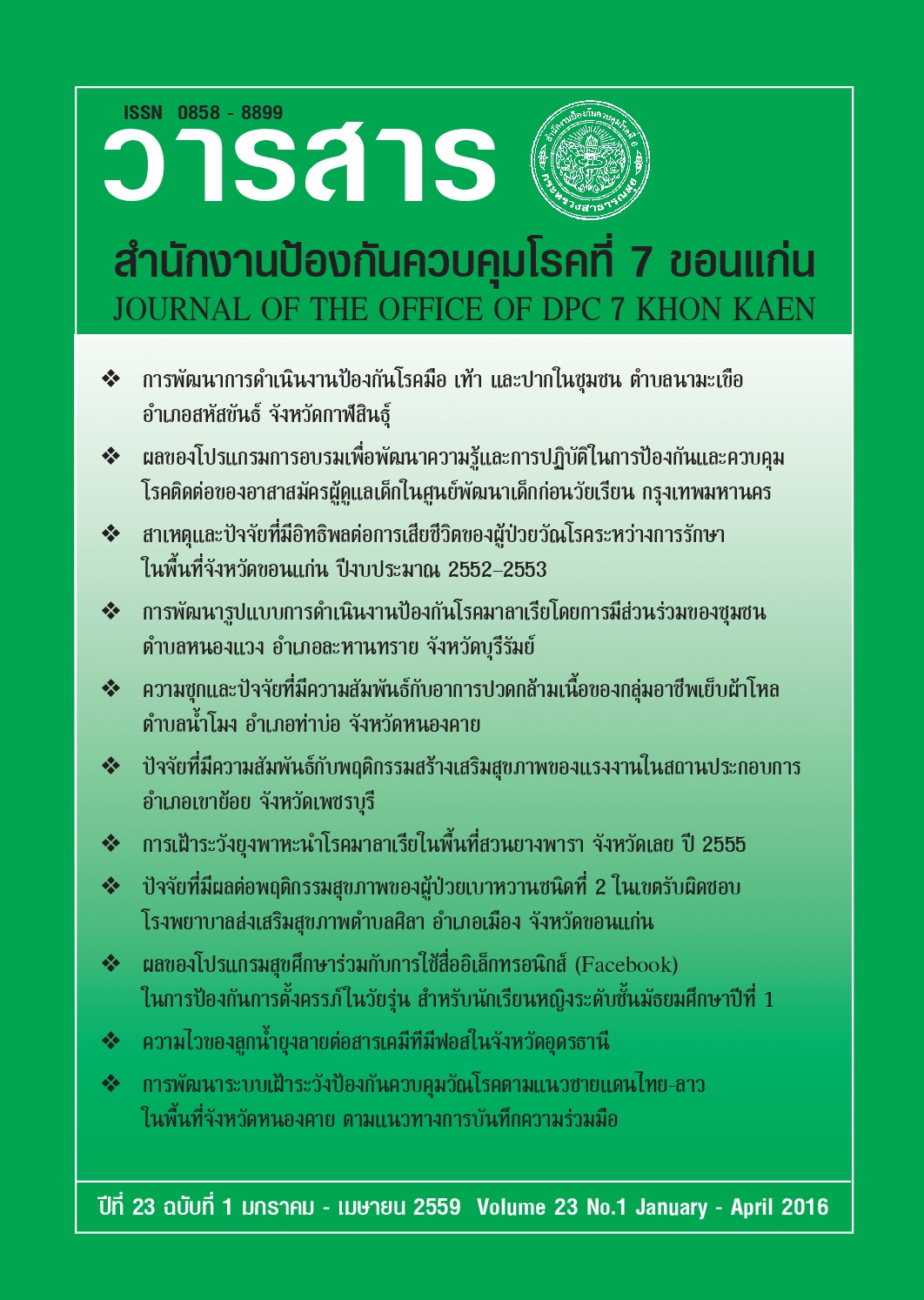
The Early Childhood Development Centers of Bangkok are the places for taking care children from low income families, which both parents need to work during day time. Pre-school children will be taught before compulsory education there. A lot of children being taking care in the center can cause disease infection especially in respiratory system and gastrointestinal tract. Therefore, effective prevention and control of communicable diseases is the important tool to reduce and solve illness from frequently contagious disease found in the centers. Care-givers are key persons to prevent germ dispersion according to the time spent on the children, therefore knowledge, attitude, and skill on related issues are needed. Hence, the objective of this study is to evaluate the one day training program on knowledge and implementation development to prevention and control of communicable diseases to 50 care-giver volunteers at the early childhood development centers of Bangkok. The tools for this research is measurement of knowledge, attitude, and implementation. The questionnaires were applied before (1st measurement), immediately after the training (2nd measurement) and 1 month after the training (3rd measurement) from June to August 2015.
The results showed that for knowledge, attitude, and implementation for prevention and control of communicable diseases the average scores from immediately after the training and 1 month after the training are significantly higher than the scores from before the training. Moreover, for implementation the average scores from 1 month after the training are significantly higher than immediately after the training while for the knowledge and attitude the average scores are not significantly different. In conclusion, the results reveal that the training program on knowledge and implementation development to prevention and control of communicable diseases is effective to enhance knowledge, attitude and implementation for the care-giver volunteers can prevent germ dispersion in the early childhood development centers.
Downloads
Downloads
Published
How to Cite
Issue
Section
License
ความรับผิดชอบ
บทความที่ลงพิมพ์ในวารสารสำนักงานป้องกันควบคุมโรคที่ 7 ขอนแก่น ถือเป็นผลงานทางวิชาการหรือวิจัย และวิเคราะห์ตลอดจนเป็นความเห็นส่วนตัวของผู้เขียน ไม่ใช่ความเห็นของวารสารสำนักงาน ป้องกันควบคุมโรคที่ 7 จังหวัดขอนแก่น หรือ ของกองบรรณาธิการแต่ประการใด ผู้เขียนต้องรับผิดชอบต่อบทความของตนเอง
ลิขสิทธ์บทความ
บทความที่ได้รับการตีพิมพ์จะถือเป็นลิขสิทธิ์ของสำนักงานป้องกันตวบคุมโรคที่ 7 จังหวัดขอนแก่น