เทคนิคทางห้องปฏิบัติการเพื่อการตรวจติดตาม SARS-CoV-2 ในสิ่งแวดล้อมสำหรับการเฝ้าระวัง ป้องกัน และการควบคุมโรคในหน่วยบริการสุขภาพ
คำสำคัญ:
SARS-CoV-2, การเก็บตัวอย่างแบบรวม, พื้นผิวจุดสัมผัสร่วม, จำนวนรอบการขยายสัญญาณบทคัดย่อ
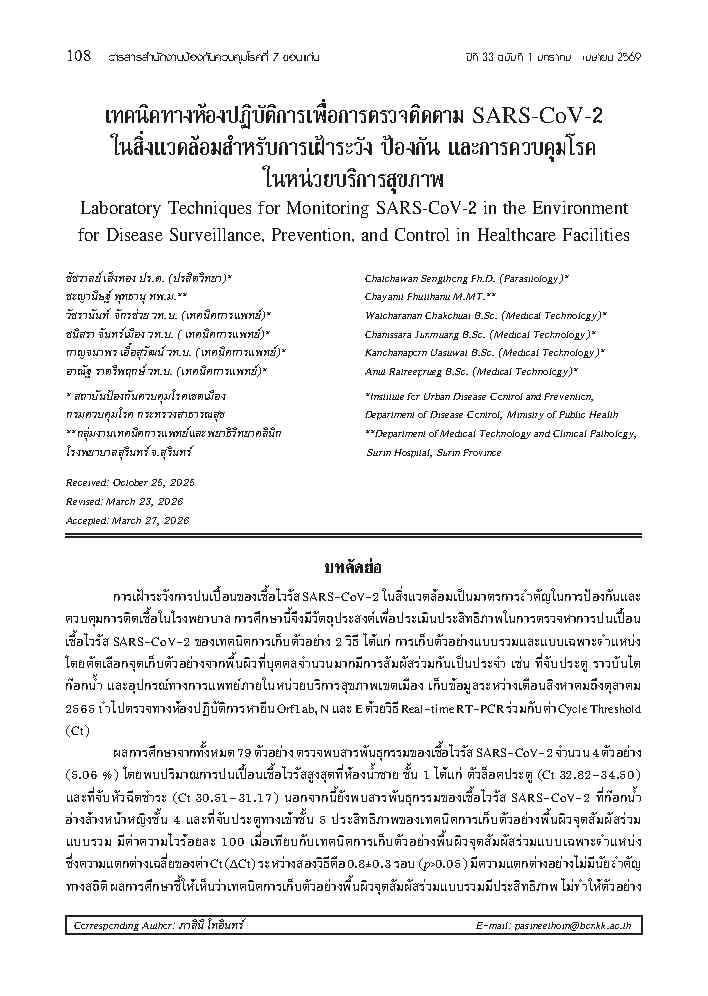
การเฝ้าระวังการปนเปื้อนของเชื้อไวรัส SARS-CoV-2 ในสิ่งแวดล้อมเป็นมาตรการสำคัญในการป้องกันและควบคุมการติดเชื้อในโรงพยาบาล การศึกษานี้จึงมีวัตถุประสงค์เพื่อประเมินประสิทธิภาพในการตรวจหาการปนเปื้อนเชื้อไวรัส SARS-CoV-2 ของเทคนิคการเก็บตัวอย่าง 2 วิธี ได้แก่ การเก็บตัวอย่างแบบรวมและแบบเฉพาะตำแหน่ง โดยคัดเลือกจุดเก็บตัวอย่างจากพื้นผิวที่บุคคลจำนวนมากมีการสัมผัสร่วมกันเป็นประจำ เช่น ที่จับประตู ราวบันได ก๊อกน้ำ และอุปกรณ์ทางการแพทย์ภายในหน่วยบริการสุขภาพเขตเมือง เก็บข้อมูลระหว่างเดือนสิงหาคมถึงตุลาคม 2565 นำไปตรวจทางห้องปฏิบัติการหายีน Orf1ab, N และ E ด้วยวิธี Real-time RT-PCR ร่วมกับค่า Cycle Threshold (Ct)
ผลการศึกษาจากทั้งหมด 79 ตัวอย่าง ตรวจพบสารพันธุกรรมของเชื้อไวรัส SARS-CoV-2 จำนวน 4 ตัวอย่าง (5.06 %) โดยพบปริมาณการปนเปื้อนเชื้อไวรัสสูงสุดที่ห้องน้ำชาย ชั้น 1 ได้แก่ ตัวล็อคประตู (Ct 32.82–34.50) และที่จับหัวฉีดชำระ (Ct 30.51–31.17) นอกจากนี้ยังพบสารพันธุกรรมของเชื้อไวรัส SARS-CoV-2 ที่ก๊อกน้ำอ่างล้างหน้าหญิงชั้น 4 และที่จับประตูทางเข้าชั้น 5 ประสิทธิภาพของเทคนิคการเก็บตัวอย่างพื้นผิวจุดสัมผัสร่วมแบบรวม มีค่าความไวร้อยละ 100 เมื่อเทียบกับเทคนิคการเก็บตัวอย่างพื้นผิวจุดสัมผัสร่วมแบบเฉพาะตำแหน่ง ซึ่งความแตกต่างเฉลี่ยของค่า Ct (ΔCt) ระหว่างสองวิธีคือ 0.8 ± 0.3 รอบ (p >0.05) มีความแตกต่างทางสถิติอย่างไม่มีนัยสำคัญทางสถิติ ผลการศึกษาชี้ให้เห็นว่าเทคนิคการเก็บตัวอย่างพื้นผิวจุดสัมผัสร่วมแบบรวมมีประสิทธิภาพ ไม่ทำให้ตัวอย่างถูกเจือจาง แม้จะมีปริมาณไวรัสต่ำ นอกจากนี้ยังช่วยลดภาระงานของห้องปฏิบัติการลงประมาณร้อยละ 50 สามารถนำไปใช้กำหนดมาตรการป้องกันการแพร่กระจายเชื้อ SARS-CoV-2 ในสิ่งแวดล้อมของสถานพยาบาล
Downloads
เอกสารอ้างอิง
สถาบันรับรองคุณภาพสถานพยาบาล (องค์การมหาชน). มาตรฐานโรงพยาบาลและบริการสุขภาพ ฉบับที่ 5. พิมพ์ครั้งที่ 2. นนทบุรี: ก.การพิมพ์เทียนกวง; 2564. หน้า 147-51.
Paton S, Spencer A, Garratt I, Thompson KA, Dinesh I, Aranega-Bou P, et al. Persistence of severe acute respiratory syndrome Coronavirus 2 (SARS-CoV-2) virus and viral RNA in relation to surface type and contamination concentration. Appl Environ Microbiol 2021; 87(14): e0052621. doi: 10.1128/aem.00526-21.
Zhou J, Otter JA, Price JR, Cimpeanu C, Meno Garcia D, Kinross J, Boshier PR, et al. Investigating severe acute respiratory syndrome Coronavirus 2 (SARS-CoV-2) surface and air contamination in an acute healthcare setting during the peak of the Coronavirus Disease 2019 (COVID-19) pandemic in London. Clin Infect Dis 2021; 73(7): e1870–7. doi: 0.1093/cid/ciaa905.
Ye G, Lin H, Chen S, Wang S, Zeng Z, Wang W, et al. Environmental contamination of SARS-CoV-2 in healthcare premises. J Infect 2020; 81(2): e1-5. doi: 10.1016/j.jinf.2020.04.034.
Vicente VA, Lustosa BPR, Grisolia ME, Pavini Beato C, Balsanelli E, de Souza Gubert Fruet V, et al. Environmental detection of SARS-CoV-2 virus RNA in health facilities in Brazil and a systematic review on contamination sources. Int J Environ Res Public Health 2021; 18(7): 3824. doi: 10.3390/ijerph18073824.
Niyomdecha N, Noisumdaeng P, Archawametheekul P, Angkham S, Norapong B, Fungkrajai M, et al. Detecting severe acute respiratory syndrome coronavirus 2 (SARS-CoV-2) and bacteria on highly common contaminated surfaces at urban hospital and public areas. Nat Life Sci Commun 2023; 22(1): e2023010. doi: 10.12982/NLSC.2023.010.
Bansal A, Trieu MC, Eriksson EM, Zhou F, McVernon J, Brokstad KA, et al. SARS-CoV-2 infection rates and associated risk factors in healthcare workers: systematic review and meta-analysis. Sci Rep 2025; 15(1): 4705. doi: 10.1038/s41598-025-89472-5.
Santarpia JL, Rivera DN, Herrera VL, Morwitzer MJ, Creager HM, Santarpia GW, et al. Aerosol and surface contamination of SARS-CoV-2 observed in quarantine and isolation care. Sci Rep 2020; 10(1): 12732. doi: 10.1038/s41598-020-69286-3.
Prather KA, Marr LC, Schooley RT, McDiarmid MA, Wilson ME, Milton DK. Airborne transmission of SARS-CoV-2. Science 2020; 370(6514): 303-4. doi: 10.1126/science.abf0521.
Tiacharoen V, Denpetkul T, Kosoltanapiwat N, Maneekan P, Thippornchai N, Saeoueng A, et al. Detection of SARS-CoV-2 and variants in hospital wastewater in a developing country. Water 2022; 14(23): 3798. doi: 10.3390/w14233798.
Phumisantiphong U, Rupprom K, Wongsuk T, Manomaipiboon A, Maneerit J, Vimonvattana A, et al. Severe acute respiratory syndrome coronavirus 2 variants in patients with coronavirus disease 2019 and environmental sampling from the hospital and market during the coronavirus disease 2019 pandemic in Thailand. Diagn Microbiol Infect Dis 2025; 111(2): 116604. doi: 10.1016/j.diagmicrobio.2024.116604.
Rupprom K, Thongpanich Y, Sukkham W, Utrarachkij F, Kittigul L. Surveillance of norovirus, SARS-CoV-2, and bocavirus in air samples collected from a tertiary care hospital in Thailand. Sci rep 2024; 14(1): 22240. doi: 10.1038/s41598-024-73369-w.
Kampf G, Pfaender S, Goldman E, Steinmann E. SARS-CoV-2 detection rates from surface samples do not implicate public surfaces as relevant sources for transmission. Hygiene 2021; 1(1): 24-40. doi:10.3390/hygiene1010003.
Mondelli MU, Colaneri M, Seminari EM, Baldanti F, Bruno R. Low risk of SARS-CoV-2 transmission by fomites in real-life conditions. Lancet Infect Dis 2021; 21(5): e112. doi: 10.1016/S1473-3099(20)30678-2.
Peccia J, Zulli A, Brackney DE, Grubaugh ND, Kaplan EH, Casanovas-Massana A, et al. Measurement of SARS-CoV-2 RNA in wastewater tracks community infection dynamics. Nat Biotechnol 2020; 38(10): 1164-7. doi: 10.1038/s41587-020-0684-z.
World Health Organization. Surface sampling of coronavirus disease (COVID-19): a practical “how to” protocol for health care and public health professionals [Internet]. 2020 [cited 2025 Nov 12]. Available form: https://www.who.int/publications/i/item/surface-sampling-of-coronavirus-disease-(-covid-19)-a-practical-how-to-protocol-for-health-care-and-public-health-professionals.
นัตฏิยา ศรีสุราช, ศศิประภา วัฒนวิเศษ, พรรณิชา วงศ์สายเชื้อ. ประเมินการตรวจหาเชื้อ SARS-CoV-2 จากตัวอย่างรวม ด้วยวิธี Real time RT-PCR ในจังหวัดขอนแก่น. วารสารเทคนิคการแพทย์ 2564; 49(3): 7909-21.
Abrahão JS, Sacchetto L, Rezende IM, Rodrigues RAL, Crispim APC, Moura C, et al. Detection of SARS-CoV-2 RNA on public surfaces in a densely populated urban area of Brazil: A potential tool for monitoring the circulation of infected patients. Sci Total Environ 2021; 766: 142645. doi: 10.1016/j.scitotenv.2020.142645.
Ye G, Lin H, Chen S, Wang S, Zeng Z, Wang W, et al. Environmental contamination of SARS-CoV-2 in healthcare premises. J Infect 2020; 81(2): e1–5. doi: 10.1016/j.jinf.2020.04.034.
Kim UJ, Lee SY, Lee JY, Lee A, Kim SE, Choi OJ, et al. Air and environmental contamination caused by COVID-19 patients: a multi-center study. J Korean Med Sci 2020; 35(37): e332. doi: 10.3346/jkms.2020.35.e332.
Amoah ID, Pillay L, Deepnarian N, Awolusi O, Pillay K, Ramlal P, et al. Detection of SARS-CoV-2 RNA on contact surfaces within shared sanitation facilities. Int J Hyg Environ Health 2021; 236: 113807. doi: 10.1016/j.ijheh.2021.113807.
ดาวน์โหลด
เผยแพร่แล้ว
รูปแบบการอ้างอิง
ฉบับ
ประเภทบทความ
สัญญาอนุญาต
ลิขสิทธิ์ (c) 2026 สำนักงานป้องกันควบคุมโรคที่ 7 จังหวัดขอนแก่น

อนุญาตภายใต้เงื่อนไข Creative Commons Attribution-NonCommercial-NoDerivatives 4.0 International License.
ความรับผิดชอบ
บทความที่ลงพิมพ์ในวารสารสำนักงานป้องกันควบคุมโรคที่ 7 ขอนแก่น ถือเป็นผลงานทางวิชาการหรือวิจัย และวิเคราะห์ตลอดจนเป็นความเห็นส่วนตัวของผู้เขียน ไม่ใช่ความเห็นของวารสารสำนักงาน ป้องกันควบคุมโรคที่ 7 จังหวัดขอนแก่น หรือ ของกองบรรณาธิการแต่ประการใด ผู้เขียนต้องรับผิดชอบต่อบทความของตนเอง
ลิขสิทธ์บทความ
บทความที่ได้รับการตีพิมพ์จะถือเป็นลิขสิทธิ์ของสำนักงานป้องกันตวบคุมโรคที่ 7 จังหวัดขอนแก่น