
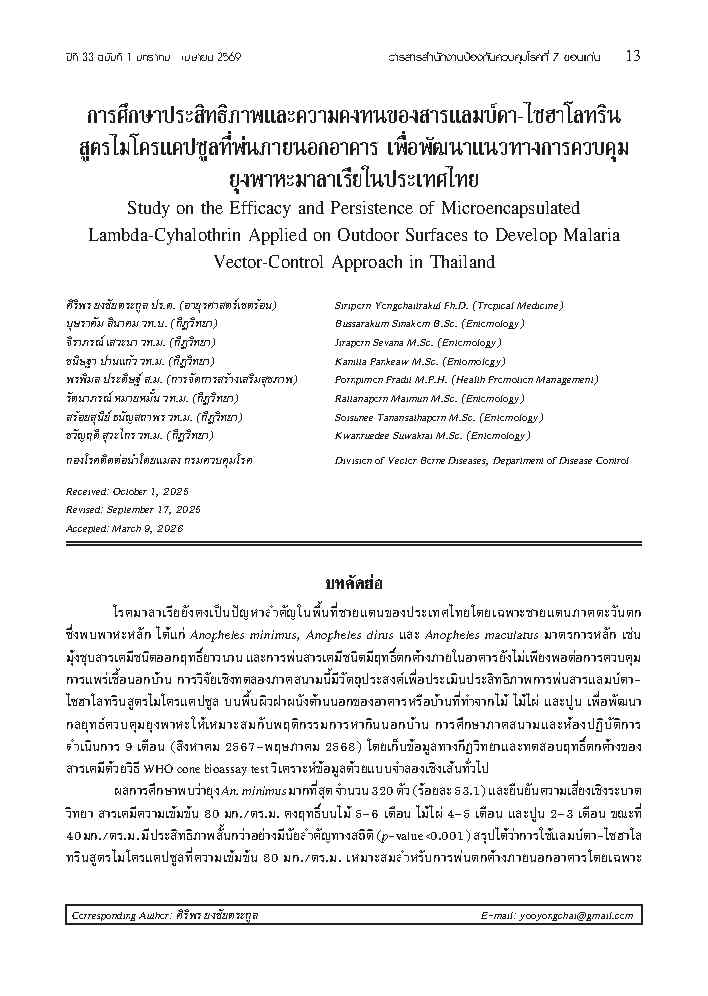
การศึกษาประสิทธิภาพและความคงทนของสารแลมบ์ดา-ไซฮาโลทรินสูตรไมโครแคปซูลที่พ่นภายนอกอาคาร เพื่อพัฒนาแนวทางการควบคุมยุงพาหะมาลาเรียในประเทศไทย
คำสำคัญ:
โรคมาลาเรีย, การพ่นสารตกค้างภายนอก, แลมบ์ดา-ไซฮาโลทรินสูตรไมโครแคปซูลบทคัดย่อ
โรคมาลาเรียยังคงเป็นปัญหาสำคัญในพื้นที่ชายแดนของประเทศไทยโดยเฉพาะชายแดนภาคตะวันตกซึ่งพบพาหะหลัก ได้แก่ Anopheles minimus, Anopheles dirus และ Anopheles maculatus มาตรการหลัก เช่น มุ้งชุบสารเคมีชนิดออกฤทธิ์ยาวนาน และการพ่นสารเคมีชนิดมีฤทธิ์ตกค้างภายในอาคารยังไม่เพียงพอต่อการควบคุมการแพร่เชื้อนอกบ้าน การวิจัยเชิงทดลองภาคสนามนี้มีวัตถุประสงค์เพื่อประเมินประสิทธิภาพการพ่นสารแลมบ์ดา-ไซฮาโลทรินสูตรไมโครแคปซูล บนพื้นผิวฝาผนังด้านนอกของอาคารหรือบ้านที่ทำจากไม้ ไม้ไผ่ และปูน เพื่อพัฒนากลยุทธ์ควบคุมยุงพาหะให้เหมาะสมกับพฤติกรรมการหากินนอกบ้าน การศึกษาภาคสนามและห้องปฏิบัติการ ดำเนินการ 9 เดือน (สิงหาคม 2567–พฤษภาคม 2568) โดยเก็บข้อมูลทางกีฏวิทยาและทดสอบฤทธิ์ตกค้างของสารเคมีด้วยวิธี WHO cone bioassay test วิเคราะห์ข้อมูลด้วยแบบจำลองเชิงเส้นทั่วไป
ผลการศึกษาพบว่ายุง An. minimus มากที่สุด จำนวน 320 ตัว (ร้อยละ 53.1) และยืนยันความเสี่ยงเชิงระบาดวิทยา สารเคมีความเข้มข้น 80 มก./ตร.ม. คงฤทธิ์บนไม้ 5–6 เดือน ไม้ไผ่ 4–5 เดือน และปูน 2–3 เดือน ขณะที่ 40 มก./ตร.ม. มีประสิทธิภาพสั้นกว่าอย่างมีนัยสำคัญทางสถิติ (p-value <0.001) สรุปได้ว่าการใช้แลมบ์ดา-ไซฮาโลทรินสูตรไมโครแคปซูลที่ความเข้มข้น 80 มก./ตร.ม. เหมาะสมสำหรับการพ่นตกค้างภายนอกอาคารโดยเฉพาะบนพื้นผิวไม้ และควรใช้เป็นมาตรการเสริมร่วมกับการพ่นสารเคมีชนิดมีฤทธิ์ตกค้างภายในอาคารและมุ้งชุบสารเคมีชนิดออกฤทธิ์ยาวนานเพื่อเพิ่มประสิทธิภาพในการควบคุมการแพร่เชื้อนอกบ้าน และเสริมความยั่งยืนของมาตรการควบคุมและกำจัดโรคมาลาเรียของประเทศไทย
Downloads
เอกสารอ้างอิง
กรมควบคุมโรค. ยุทธศาสตร์การกำจัดโรคมาลาเรียแห่งชาติ พ.ศ. 2560-2569. กรุงเทพฯ: โรงพิมพ์ชุมนุมสหกรณ์การเกษตรแห่งประเทศไทย; 2560.
World Health Organization. Global technical strategy for malaria 2016-2030. Geneva: World Health Organization; 2015.
Protopopoff N, Mosha JF, Lukole E, Charlwood JD, Wright A, Mwalimu CD, et al. Effectiveness of a long-lasting piperonyl butoxide-treated insecticidal net and indoor residual spray interventions, separately and together, against malaria transmitted by pyrethroid-resistant mosquitoes: a cluster, randomised controlled, two-by-two factorial design trial. Lancet 2018; 391(10130): 1577-88. doi: 10.1016/S0140-6736(18)30427-6.
Rowland M, Boko P, Odjo A, Asidi A, Akogbeto M, N'Guessan R. A new long-lasting indoor residual formulation of the organophosphate insecticide pirimiphos methyl for prolonged control of pyrethroid-resistant mosquitoes: an experimental hut trial in Benin. PLoS One 2013; 8(7): e69516. doi: 10.1371/journal.pone.0069516.
World Health Organization. Guidelines for testing mosquito adulticides for indoor residual spraying and treatment of mosquito nets. Geneva: World Health Organization; 2006.
World Health Organization. Equipment for vector control: specification guidelines. 4th ed. Geneva: World Health Organization; 2019.
World Health Organization. Manual for indoor residual spraying: application of residual sprays for vector control. 3rd ed. Geneva: World Health Organization; 2015.
Rattanarithikul R, Harrison BA, Harbach RE, Panthusiri P, Coleman RE. Illustrated keys to the mosquitoes of Thailand. IV. Anopheles. Southeast Asian J Trop Med Public Health 2006; 37(Suppl 2): 1-128.
World Health Organization. Test procedures for insecticide resistance monitoring in malaria vector mosquitoes. 2nd ed. Geneva: World Health Organization; 2022.
World Health Organization. Guidelines for malaria vector control. Geneva: World Health Organization; 2019.
Chaumeau V, Cerqueira D, Zadrozny J, Kittiphanakun P, Andolina C, Chareonviriyaphap T, et al. Insecticide resistance in malaria vectors along the Thailand-Myanmar border. Parasit Vectors 2017; 10(1): 165. doi: 10.1186/s13071-017-2102-z.
Mutagahywa J, Ijumba JN, Pratap HB, Molteni F, Mugarula FE, Magesa SM, et al. The impact of different sprayable surfaces on the effectiveness of indoor residual spraying using a microencapsulated formulation of lambda-cyhalothrin against Anopheles gambiae s.s. Parasit Vectors 2015; 8: 79. doi: 10.1186/s13071-015-0795-4.
Yu F, Wang Y, Zhao Y, Chou J, Li X. Preparation of polyurea microcapsules by interfacial polymerization of isocyanate and chitosan oligosaccharide. Materials 2021; 14(13): 3753. doi: 10.3390/ma14133753.
Mmbando AS, Ngowo HS, Kilalangongono M, Abbas S, Matowo NS, Moore SJ, et al. Small-scale field evaluation of push-pull system against early-and outdoor-biting malaria mosquitoes in an area of high pyrethroid resistance in Tanzania. Wellcome Open Res 2017; 2: 112. doi: 10.12688/wellcomeopenres.13006.1.
Wong ML, Chua TH, Leong CS, Khaw LT, Fornace K, Wan-Sulaiman WY, et al. Seasonal and spatial dynamics of the primary vector of Plasmodium knowlesi within a major transmission focus in Sabah, Malaysia. PLoS Negl Trop Dis 2015; 9(10): e0004135. doi: 10.1371/journal.pntd.0004135.
ดาวน์โหลด
เผยแพร่แล้ว
รูปแบบการอ้างอิง
ฉบับ
ประเภทบทความ
สัญญาอนุญาต
ลิขสิทธิ์ (c) 2026 สำนักงานป้องกันควบคุมโรคที่ 7 จังหวัดขอนแก่น

อนุญาตภายใต้เงื่อนไข Creative Commons Attribution-NonCommercial-NoDerivatives 4.0 International License.
ความรับผิดชอบ
บทความที่ลงพิมพ์ในวารสารสำนักงานป้องกันควบคุมโรคที่ 7 ขอนแก่น ถือเป็นผลงานทางวิชาการหรือวิจัย และวิเคราะห์ตลอดจนเป็นความเห็นส่วนตัวของผู้เขียน ไม่ใช่ความเห็นของวารสารสำนักงาน ป้องกันควบคุมโรคที่ 7 จังหวัดขอนแก่น หรือ ของกองบรรณาธิการแต่ประการใด ผู้เขียนต้องรับผิดชอบต่อบทความของตนเอง
ลิขสิทธ์บทความ
บทความที่ได้รับการตีพิมพ์จะถือเป็นลิขสิทธิ์ของสำนักงานป้องกันตวบคุมโรคที่ 7 จังหวัดขอนแก่น