
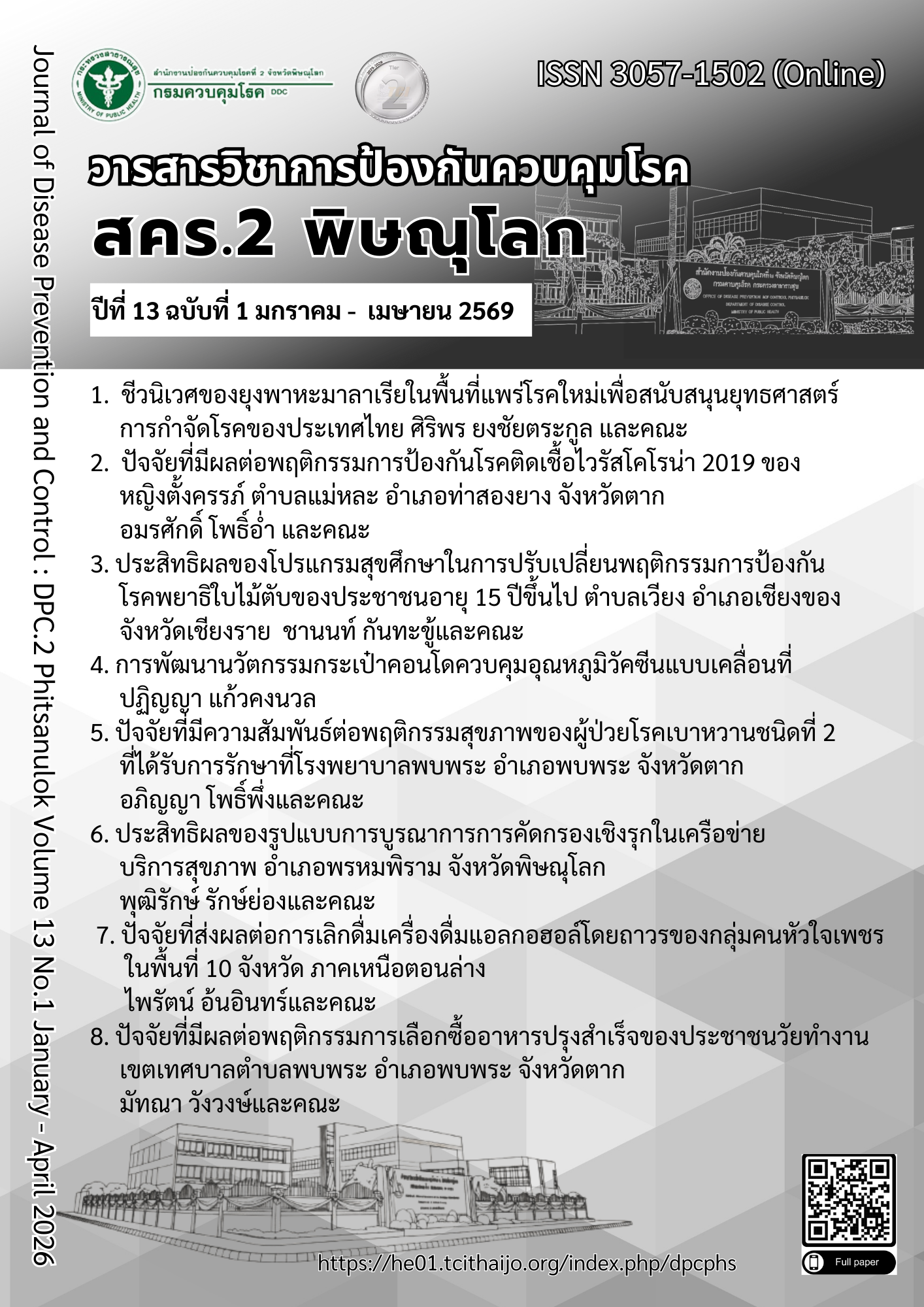
Malaria Vector Bionomics in New Foci for Thailand's Disease Elimination Strategy
Article Sidebar
Main Article Content
Abstract
Thailand has set a goal to eliminate malaria by 2026. However, in 2022, the number of malaria cases increased to 10,155 with 301 new foci reported areas that had been free of transmission for more than three years. The research aimed to study the bionomics of malaria vectors in these new foci, focusing on geographical and seasonal variation, in order to provide evidence for effective control strategies and policy development. This cross - sectional study was carried out in 127 of the 301 new foci (42.19%) covering 35 provinces in six regions from 2023 to 2024. Mosquitoes were collected using the WHO Human Landing Collection (HLC) method. Three main vector species (Anopheles minimus, An. dirus, and An. maculatus) were found in 83.5% of surveyed sites, indicating vectorial capacity. Most vectors (73.2%) exhibited outdoor biting behavior with peak biting activities occurring between 20:00 and 22:00 hours. Regional variation was evident: the western region showed the highest prevalence (92.0%), while the southern region recorded the highest mosquito density (3.57 mosquitoes/h). These findings highlight the need to expand vector control strategies beyond indoor measures to include indoor intervention, tailored responses based on local risk contexts, and intensified prevention in high - risk areas. Such approaches are essential to prevent re - establishment of transmission and to achieve and sustain malaria elimination in Thailand.
Article Details

This work is licensed under a Creative Commons Attribution-NonCommercial-NoDerivatives 4.0 International License.
ข้อลิขสิทธิ์วารสาร
บทความหรือข้อคิดเห็นใดๆ ที่ปรากฏในวารสารวิชาการป้องกันควบคุมโรค สคร. 2 พิษณุโลก เป็นวรรณกรรมของผู้เขียน กองบรรณาธิการวิชาการ และ สำนักงานป้องกันควบคุมโรคที่ 2 จังหวัดพิษณุโลกไม่จำเป็นต้องเห็นพ้องด้วยทั้งหมดหรือร่วมรับผืิดชอบใดๆ
References
World Health Organization. World malaria report 2024: addressing inequity in the global malaria response. Geneva: World Health Organization; 2024.
World Health Organization. Global technical strategy for malaria 2016–2030. Geneva: World Health Organization; 2015.
กรมควบคุมโรค. ยุทธศาสตร์การกำจัดโรคไข้มาลาเรียแห่งชาติ พ.ศ. 2560–2569. กรุงเทพมหานคร: อักษรกราฟฟิคแอนด์ดีไซน์; 2559.
Lertpiriyasuwat C, Sudathip P, Kitchakarn S, Areechokchai D, Naowarat S, Shah JA, et al. Implementation and success factors from Thailand’s 1 - 3 - 7 surveillance strategy for malaria elimination. Malar J 2021;20:201. doi: 10.1186/s12936-021-03740-z.
Division of Vector - Borne Diseases, Department of Disease Control. Annual malaria report 2021. Nonthaburi: Department of Disease Control; 2022.
Division of Vector - Borne Diseases, Department of Disease Control. Malaria situation report 2022. Nonthaburi: Department of Disease Control; 2023.
Division of Vector - Borne Diseases, Department of Disease Control. Technical manual for entomological surveillance. Nonthaburi: Department of Disease Control; 2022.
World Health Organization. Guidelines for malaria vector control. Geneva: World Health Organization; 2019.
Rattanarithikul R, Harrison BA, Harbach RE, Panthusiri P, Coleman RE. Illustrated keys to the mosquitoes of Thailand. IV. Anopheles. Southeast Asian J Trop Med Public Health 2006;37 Suppl 2:1 - 128.
World Health Organization. Malaria entomology and vector control: learner’s guide. Geneva: World Health Organization; 2003.
Cohen J. Statistical power analysis for the behavioral sciences. 2nd ed. New York: Lawrence Erlbaum Associates; 1988.
Sawilowsky SS. New effect size rules of thumb. J. Mod. Appl. Stat. Methods 2009;8:597 - 599.
เสมาทอง พัชร์พิบูล, พรมชาติ จอมพล, บัวครื้น สมัญญา, วงศ์กวานกรม วัชรีญา, ติดเทียน วรวิทย์. การสอบสวนโรคมาลาเรีย ตำบลชมพู อำเภอเนินมะปราง จังหวัดพิษณุโลก. วารสารวิชาการป้องกันควบคุมโรค สคร.2 พิษณุโลก 2565;9(2):93 - 100.
Sumarnrote A, Overgaard HJ, Chareonviriyaphap T, Kobayashi J, Bangs MJ, Sochantha T. Biting patterns and seasonality of Anopheles mosquitoes in relation to malaria transmission in the Thai–Cambodian border area. Parasit Vectors 2020;13:501. doi:10.1186/s13071 - 020 - 04386 - 8.
Edwards HM, Sriwichai P, Kirabittir K, Prachumsri J, Chavez IF, Hii J. Transmission risk beyond the village: entomological and human factors contributing to residual malaria transmission in an area approaching malaria elimination on the Thailand–Myanmar border. Malar J 2019;18:221. doi:10.1186/s12936-019-2852-5.
