
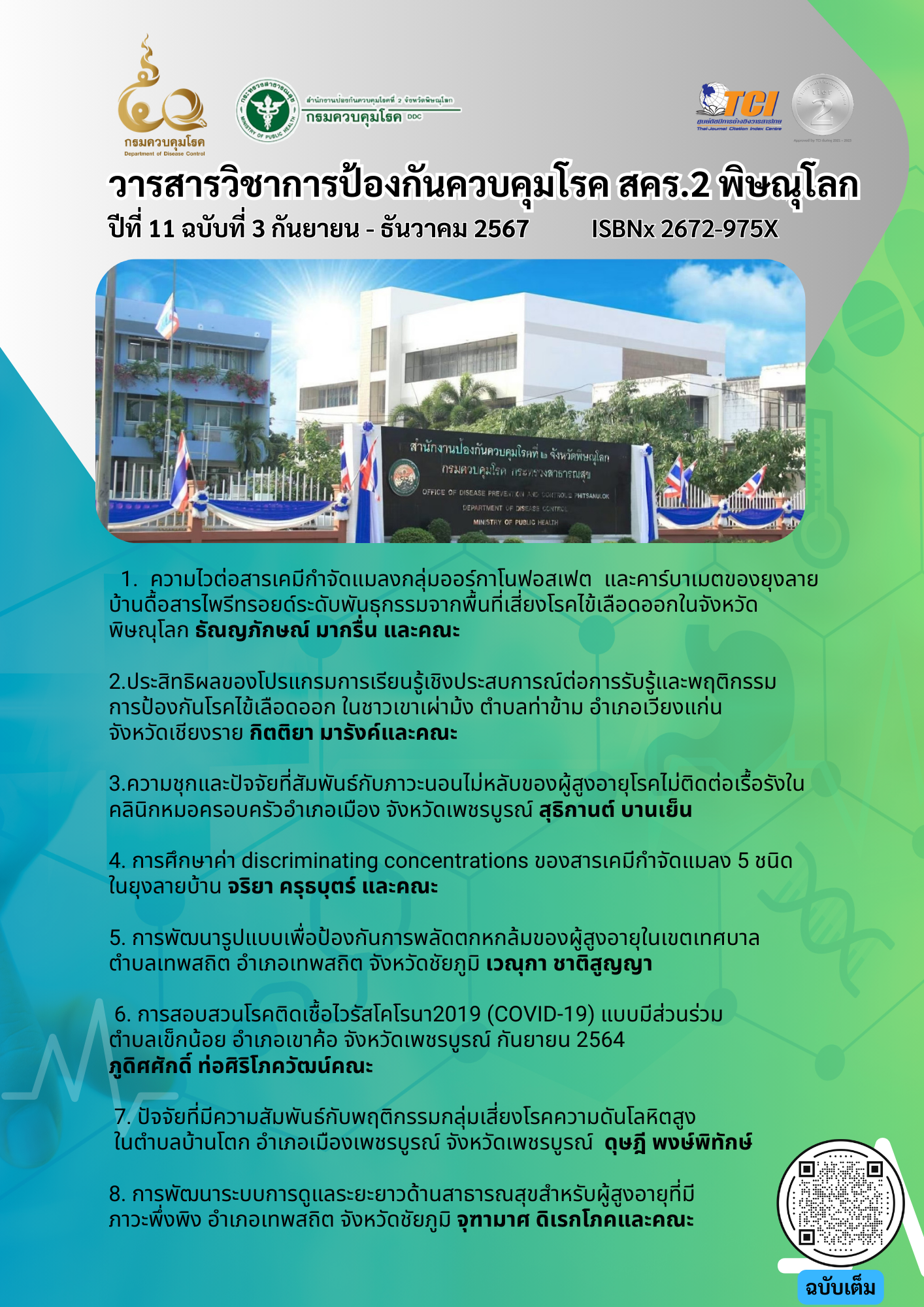
1.ความไวต่อสารเคมีกำจัดแมลงกลุ่มออร์กาโนฟอสเฟตและคาร์บาเมตของยุงลายบ้าน ดื้อสารไพรีทรอยด์ระดับพันธุกรรมจากพื้นที่เสี่ยงโรคไข้เลือดออกในจังหวัดพิษณุโลก
Article Sidebar
Main Article Content
บทคัดย่อ
งานวิจัยนี้ได้ศึกษาความไวต่อสารเคมีกำจัดแมลงกลุ่มออร์กาโนฟอสเฟตและคาร์บาเมตของยุงลายบ้านดื้อสารไพรีทรอยด์ระดับพันธุกรรมจากพื้นที่เสี่ยงโรคไข้เลือดออกในจังหวัดพิษณุโลก นำยุงลายบ้าน จากจังหวัดพิษณุโลกมาทดสอบความไวต่อสารเคมีกำจัดแมลง 16 ชนิด โดยวิธีขององค์การอนามัยโลกและศึกษาการกลายพันธุ์ของยีน para ในยุงลายบ้านดื้อสารไพรีทรอยด์ โดยวิธี PCR และ DNA sequencing จากการศึกษาพบว่า ยุงลายบ้านมีความไวต่อ fenitrothion malathion และ fenobucarb โดยมีอัตราตายเฉลี่ย ร้อยละ 100 ที่ 24 ชั่วโมง แต่ดื้อต่อ pirimiphos-methyl, propoxur และสารไพรีทรอยด์ทั้ง 10 ชนิด โดยมีอัตราตายเฉลี่ยร้อยละ 3.00±2.00 -87.00±5.03 ซึ่งอัตราตายเฉลี่ยของยุงลายบ้านมีความต่างอย่างมีนัยสำคัญทางสถิติ (p<0.05) นอกจากนี้ พบการกลายพันธุ์ของยีน para ที่ V1016G ในยุงลายบ้าน โดยมีความถี่การกลายพันธุ์เฉลี่ยเท่ากับ 0.52 สารเคมีกำจัดแมลงกลุ่มออร์กาโนฟอสเฟตและคาร์บาเมต อาจเป็นทางเลือกสำหรับใช้ในการควบคุมยุงลายบ้านดื้อสารไพรีทรอยด์ระดับพันธุกรรมเพื่อป้องกันโรค ที่นำโดย ยุงลายบ้าน
Article Details

อนุญาตภายใต้เงื่อนไข Creative Commons Attribution-NonCommercial-NoDerivatives 4.0 International License.
ข้อลิขสิทธิ์วารสาร
บทความหรือข้อคิดเห็นใดๆ ที่ปรากฏในวารสารวิชาการป้องกันควบคุมโรค สคร. 2 พิษณุโลก เป็นวรรณกรรมของผู้เขียน กองบรรณาธิการวิชาการ และ สำนักงานป้องกันควบคุมโรคที่ 2 จังหวัดพิษณุโลกไม่จำเป็นต้องเห็นพ้องด้วยทั้งหมดหรือร่วมรับผืิดชอบใดๆ หากพบว่าบทความของท่านมีการคัดลอกผลงานทางวิชาการ (plagiarism) มากกว่า 25 เปอร์เซ็นวารสารขอปฏิเสธการตีพิมพ์เผยแพร่ทุกกรณี วิธีตรวจสอบการคัดลอกผลงานทางวิชาการ (plagiarism)
เอกสารอ้างอิง
Bureau of Vector-Borne Diseases Control (BVBD), Department of Disease Control (DDC). Dengue Fever [Internet]. 2022 [cited 2022 Nov 30]. Available from: http://doe.moph.go.th/
surdata/506wk/y65/d262766_4765.pdf. (In Thai).
Chareonviriyaphap T, Bangs MJ, Suwonkerd W, Kongmee M, Corbel V, Ngoen-Klan R. Review of insecticide resistance and behavioral avoidance of vectors of human diseases in Thailand. Parasit Vectors. 2013; 6:280.
World Health Organization (WHO). Safety of pyrethroids for public health use. [Internet]. 2005. [cited 2022 November 25]. Available from: https://www.who.int/publications/i/item/
WHO.PCS.RA.2005.1.
Division of Vector Borne Diseases (DVBD), Department of Disease Control (DDC). Reporting of Insecticide Susceptibility in Mosquito Vectors [Internet]. 2022 [cited 2022 Nov 20]. Available from:
https://drive.google.com/drive/folders/1Kzxz3iEgyAzNpIDSEWJ0QTy_eVoS7F
JY. (In Thai)
Fan Y, O'Grady P, Yoshimizu M, Ponlawat A, Kaufman PE, Scott JG. Evidence for both sequential mutations and recombination in the evolution of kdr alleles in Aedes aegypti. PLoS Negl Trop Dis. 2020;14(4).
Srisa – ard, B. Preliminary research. (Ten edition). Bangkok: Suweriyasan Printing; 2017. (In Thai).
WHO. Monitoring and managing insecticide resistance in Aedes mosquito populations. Interim guidance for entomologists. [Internet]. 2016 [cited 2022 December 10]. Available from: https://apps.who.int/iris/bitstream/handle/10665/204588/WHO_ZIKV_VC_16.1_eng. pdf? sequence=2&isAllowed=y.
Chung HH, Cheng IC, Chen YC, Lin C, Tomita T, Teng HJ. Voltage-gated sodium channel intron polymorphism and four mutations comprise six haplotypes in an Aedes aegypti population in Taiwan. PLoS Negl Trop Dis. 2019; 13(3).
Kumar S, Stecher G, Li M, Knyaz C, Tamura K. MEGA X: Molecular Evolutionary Genetics Analysis across Computing Platforms. Mol Biol Evol. 2018 Jun 1;35(6):1547-1549. doi:
1093/molbev/msy096. PMID: 29722887; PMCID: PMC596755
10. IBM Corp. Released 2020. IBM SPSS Statistics for Windows, Version 27.0. Armonk, NY: IBM Corp
Abbott W. A method of computing the effectiveness of an insecticide. J Econ Entomol. 1925;18:265–267.
Yanola J, Somboon P, Walton C, Nachaiwieng W, Somwang P, Prapanthadara L. High‐throughput assays for detection of the F1534C mutation in the voltage‐gated sodium channel gene in permethrin‐resistant Aedes aegypti and the distribution of this mutation throughout Thailand. Trop Med Int Health. 2011;16(4):501-9.
Pusawang K, Sattabongkot J, Saingamsook J, Zhong D, Yan G, Somboon P, Wongpalee SP, Cui L, Saeung A, Sriwichai P. Insecticide Susceptibility Status of Anopheles and Aedes Mosquitoes in Malaria and Dengue Endemic Areas, Thai-Myanmar Border. Insects. 2022;9:13(11):1035.
Stenhouse SA, Plernsub S, Yanola J, Lumjuan N, Dantrakool A, Choochote W. Detection of the V1016G mutation in the voltage-gated sodium channel gene of Aedes aegypti (Diptera: Culicidae) by allele-specific PCR assay, and its distribution and effect on deltamethrin resistance in Thailand. Parasit Vectors.2013;6:253.
Sirisopa P, Thanispong K, Chareonviriyaphap T, Juntarajumnong W. Resistance to Synthetic Pyrethroids in Aedes aegypti (Diptera: Culicidae) in Thailand. Kasetsart J. Nat. Sci. 2014;48: 577–586.
Liu N. Insecticide resistance in mosquitoes: impact, mechanisms, and research directions. Annu Rev Entomol. 2015;60:537-59.
Du Y, Nomura Y, Satar G, Hu Z, Nauen R, He SY. Molecular evidence for dual pyrethroid-receptor sites on a mosquito sodium channel. Proc Natl Acad Sci U S A. 2013;110(29):11785-90.
Haddi K, Tomé HVV, Du Y, Valbon WR, Nomura Y, Martins GF. Detection of a new pyrethroid resistance mutation (V410L) in the sodium channel of Aedes aegypti: a potential challenge for mosquito control. Sci Rep. 2017;7:46-49.
Srisawat R, Komalamisra N, Eshita Y, ZhengM, Ono K, Itoh TQ. Point mutations in domain II of the voltage-gated sodium channel gene in deltamethrin-resistant Aedes aegypti (Diptera: Culicidae). Appl Entomol Zoo. 2010;45:275–82.
Saavedra-Rodriguez K, Maloof FV, Campbell CL, Garcia Rejon J, Lenhart A, Penilla P, Rodriguez A, Sandoval AA , Flores AE, Ponce G, Lozano S , Black WC. Parallel evolution of vgsc mutations at domains IS6, IIS6 and IIIS6 in pyrethroid resistant Aedes aegypti from Mexico. Sci Rep. 2018;30.8(1):6747.
