
HIV-1 drug resistance during the transition from NNRTI- to INSTI-based therapy in Thailand: prevalence, resistance-associated mutations, and antiretroviral
Article Sidebar
Main Article Content
Abstract
Background: Antiretroviral therapy (ART) effectively suppresses HIV replication and reduces HIV-related morbidity and mortality; however, HIV drug resistance (HIVDR) remains a major challenge to long-term treatment success.
Objectives: This study investigated the prevalence of HIVDR, resistance-associated mutations (RAMs), antiretroviral susceptibility profiles, and factors associated with HIVDR among HIV-infected patients receiving ART at Queen Savang Vadhana Memorial Hospital, Thailand.
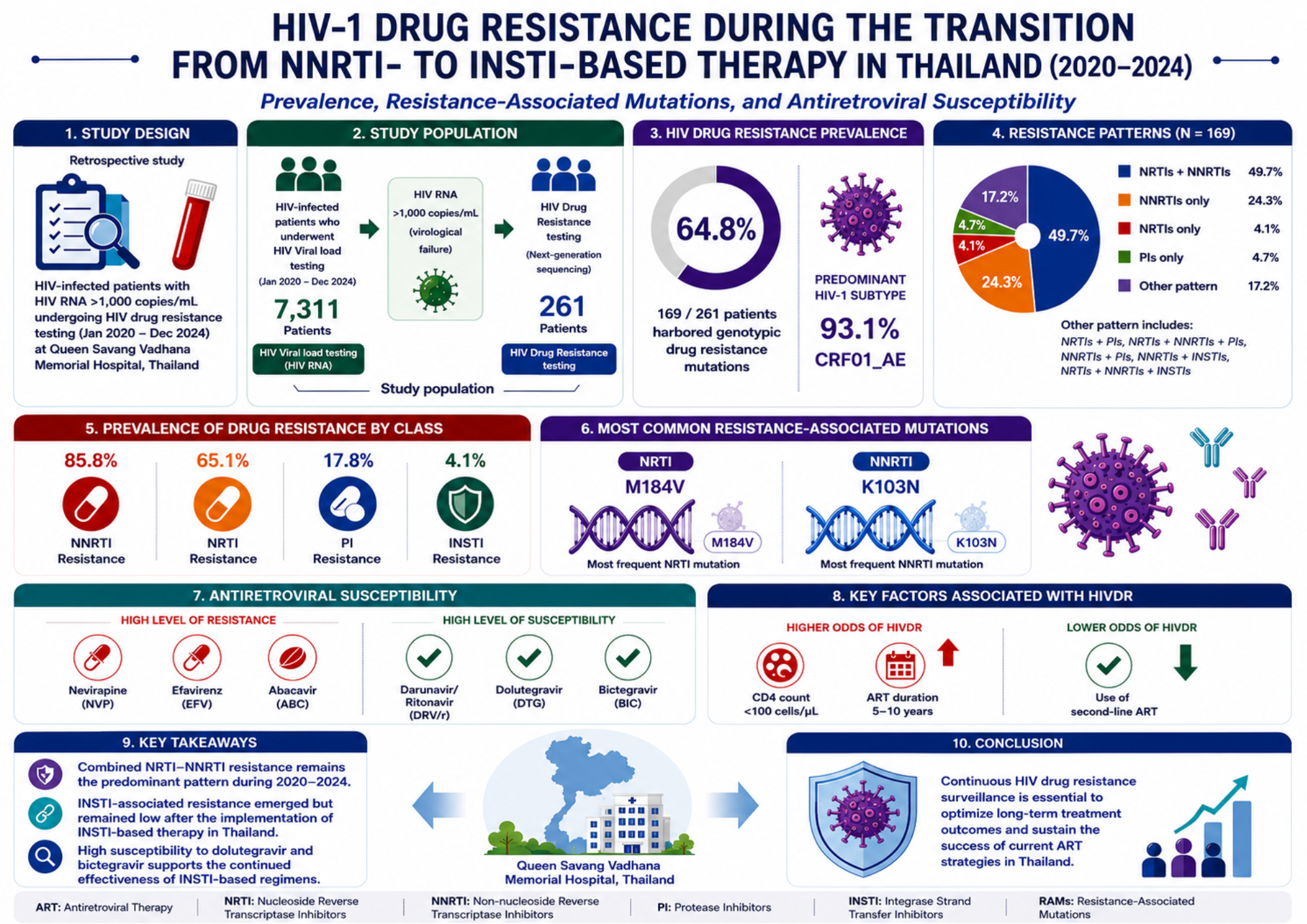
Materials and methods: A retrospective study was conducted among 261 HIV-infected patients with HIV RNA levels >1,000 copies/mL who underwent HIVDR testing between January 2020 and December 2024. Drug resistance was determined using next-generation sequencing (NGS)-based assay simultaneously analyzes the protease (codons 1-99), reverse transcriptase (codons 1-376), and integrase (codons 1-288) regions of the HIV-1 pol gene. Variant-calling thresholds were 20% was applied to samples with HIV RNA ≥1,000 copies/mL, 5% was used for samples with HIV RNA ≥15,000 copies/mL, and resistance interpreted using the Stanford HIV Drug Resistance Database (HIVdb version 9.4).
Results: Among 261 patients, 169 (64.8%) harbored genotypic drug resistance mutations. CRF01_AE was the predominant HIV-1 subtype (93.1%). Dual resistance to nucleoside reverse transcriptase inhibitors (NRTIs) and non-nucleoside reverse transcriptase inhibitors (NNRTIs) was the most common resistance pattern (49.7%), followed by NNRTI-only resistance (24.3%). NNRTI resistance was the most prevalent resistance class (85.8%), followed by NRTI (65.1%), protease inhibitor (PI) (17.8%), and integrase strand transfer inhibitor (INSTI) resistance (4.1%). M184V and K103N were the most frequently detected NRTI- and NNRTI-associated mutations, respectively. Resistance to nevirapine, efavirenz, and abacavir was common, whereas susceptibility to darunavir/ritonavir, dolutegravir, and bictegravir remained high. Patients with CD4 counts <100 cells/μL and ART duration of 5-10 years were more likely to harbor drug resistant HIV strains, whereas second-line ART was associated with lower odds of HIVDR.
Conclusion: Combined NRTI-NNRTI resistance remained the predominant HIVDR pattern during 2020-2024. Although INSTI-associated resistance emerged following the implementation of INSTI-based therapy in Thailand, its prevalence remained low, supporting the continued effectiveness of dolutegravir-based regimens. Continuous HIVDR surveillance remains essential to optimize long-term treatment outcomes.
Article Details

This work is licensed under a Creative Commons Attribution-NonCommercial-NoDerivatives 4.0 International License.
Personal views expressed by the contributors in their articles are not necessarily those of the Journal of Associated Medical Sciences, Faculty of Associated Medical Sciences, Chiang Mai University.
References
The Joint United Nations Programme on HIV/AIDS (UNAIDS). Fact sheet: latest global and regional statistics on the status of the AIDS epidemic. 2025. [cited 2026 Feb 4]. Available from: https://www.unaids.org/sites/default/files/media_asset/UNAIDS_FactSheet_en.pdf.
Division of AIDS and Sexually Transmitted Diseases, Department of Disease Control. HIV outbreak situation in Thailand. 2023. [cited 2024 Oct 24]. Available from: https://ddc.moph.go.th/upload/publish/1549120240328063459.pdf (in Thai).
Department of Disease Control. Thailand national guidelines on HIV/AIDS treatment and prevention 2021/2022. 2022. [cited 2024 Dec 11]. Available from: https://www.ddc.moph.go.th/uploads/publish/1281020230201071837.pdf. (in Thai).
Department of Disease Control. National guideline on HIV, syphilis, HBV and HCV testing for diagnosis and monitoring. 2025. [cited 2026 Jun 2]. Available from: https://www.ddc.moph.go.th/uploads/publish/1731520251215160357.pdf. (in Thai).
Gandhi RT, Landovitz RJ, Sax PE, Smith DM, Springer SA, Günthard HF, et al. Antiretroviral drugs for treatment and prevention of HIV in adults: 2024 recommendations of the International Antiviral Society-USA panel. JAMA. 2025; 333(7): 609-28. doi: 10.1001/jama.2024.24543.
Athipanyasilp N. Detection of antiretroviral drug resistance and impact of HIV drug resistance database on result interpretation. Siriraj Med Bull. 2018; 11(2): 118-24. Available from: https://he02.tci-thaijo.org/index.php/simedbull/article/view/150676. (in Thai).
Vela Diagnostics. Sentosa® SQ HIV-1 genotyping reagents v2.0 (4×24). [cited 2026 Apr 22]. Available from: https://www.veladx.com/.
Stanford University. HIV drug resistance database (HIVdb). 2026. [cited 2026 May 2]. Available from: https://hivdb.stanford.edu/.
Wensing AM, Calvez V, Ceccherini-Silberstein F, Charpentier C, Günthard HF, Jacobsen DM, et al. 2025 update of the drug resistance mutations in HIV-1. Top Antivir Med. 2025; 33(2): 457-73.
Phadungpattanodom J. The situation of HIV-1 antiretroviral drug resistance in Phranangklao Hospital. J Med Public Health Reg 4. 2020; 10(2): 48-57. Available from: https://he01.tci-thaijo.org/index.php/JMPH4/article/view/248455. (in Thai).
Keerativasee S, Maneesriwongku P, Intharaprapan S, Teerakulphisut N, Tiengyou P, Pimnumyen N. Prevalence of HIV drug resistance by next generation sequencing technology in the lower Northern region. Thai AIDS J. 2022; 34(2): 100-12. doi: 10.14456/taj.2022.8. (in Thai).
Treeboonmuang P, Putthanachote N. Drug resistance testing of HIV patients/AIDS antiviral HIV drugs treatment at Roi Et Hospital: a retrospective study. Health Sci J Thai. 2021; 3(1): 10-6. Available from: https://he02.tci-thaijo.org/index.php/HSJT/article/view/241163. (in Thai).
Nilsakul J, Boonprachern S, Homganjhan B. Prevalence of HIV-1 antiretroviral drugs resistance and viral gene mutations in patients of Sunprasitthiprasong Hospital. J Med Public Health Ubon Ratchathani. 2023; 6(3): 196-208. (in Thai).
Koedsuk A, Tipkrua N, Thepchai N. HIV drug resistance rate and HIV drug resistance mutation gene in Ban Pong Hospital. Off Dis Prev Control 5 Ratchaburi Prov J. 2023; 7(1): 48-65. (in Thai).
Phoomniyom S, Bromnavej A, Chanthara C, Thongdaard R, Karaipoom P. Predicament and antiretroviral drug resistance among people living with HIV in the upper southern region of Thailand. J Dis Prev Control Integr Health Sci. 2025; 1(1): 1-16. (in Thai).
Saengthong P. Prevalence of HIV-1 antiretroviral drugs resistance and viral gene mutations correlation with antiretroviral drug resistance at Songkhla Hospital. Songkhla Hosp J. 2025; 5(1): 1-22. (in Thai).
Chantawong S. Antiretroviral resistance and gene mutations in patients with high HIV viral load at Lampang Hospital. J Med Dept Serv. 2023; 48(1): 44-50. (in Thai).
Kamomit W, Tantapaku S. A retrospective study of prevalence and viral mutation patterns among adult HIV-infected patients in Khon Kaen Regional Hospital. Thai J Pharm Pract. 2022; 14(2): 289-303. (in Thai).
Thao VP, Quang VM, Day JN, Chinh NT, Shikuma CM, Farrar J, et al. High prevalence of PI resistance in patients failing second-line ART in Vietnam. J Antimicrob Chemother. 2016; 71(3): 762-74. doi: 10.1093/jac/dkv385.
Pipitò L, Cannella S, Mascarella C, Graceffa D, Trizzino M, Iaria C, et al. Next-generation sequencing analysis for HIV-1 genotyping and drug resistance mutations mapping in Sicily, Italy. Viruses. 2025; 17(8): 1129. doi: 10.3390/v17081129.
World Health Organization. WHO recommends dolutegravir as preferred HIV treatment option in all populations. 2019. [cited 2026 May 14]. Available from: https://www.who.int/news/item/22-07-20-19-who-recommends-dolutegravir-as-preferredhiv-treatment-option-in-all-populations.
Nasomsong W, Phokaphol K, Changpradub D. First-line antiretroviral regimen failure and determinants in an urban HIV clinic at Phramongkutklao Hospital, Bangkok, Thailand: 20 years’ experience. HIV AIDS (Auckl). 2021; 13: 261-9. doi: 10.2147/HIV.S295512.
