
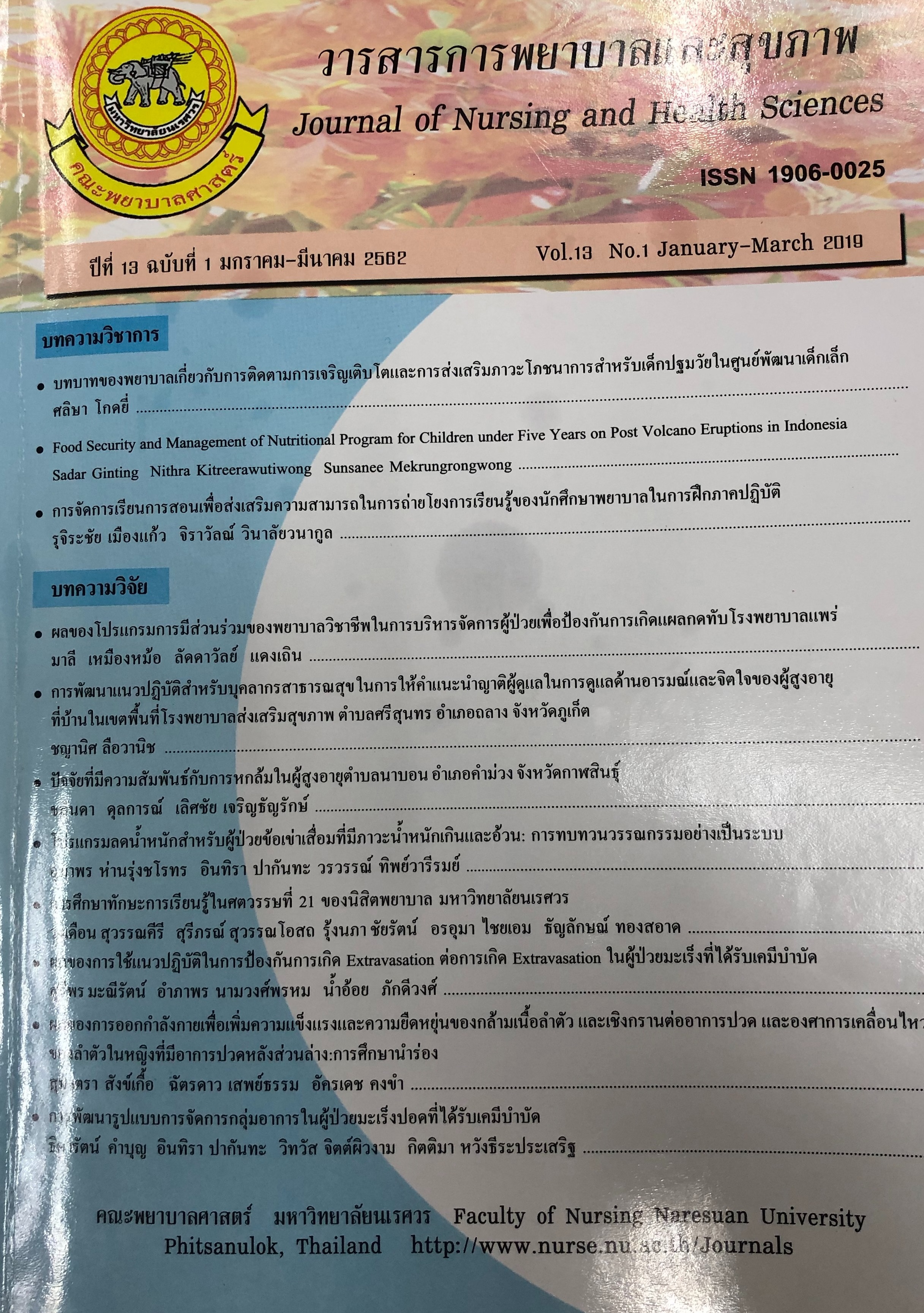
การพัฒนาแนวปฏิบัติสำหรับบุคลากรสาธารณสุขในการให้คำแนะนำญาติผู้ดูแลในการดูแล ด้านอารมณ์และ จิตใจของผู้สูงอายุที่บ้านในเขตพื้นที่โรงพยาบาลส่งเสริมสุขภาพ ตำบลศรีสุนทร อำเภอถลาง จังหวัดภูเก็ต
Article Sidebar
Main Article Content
บทคัดย่อ
การวิจัยมีวัตถุประสงค์เพื่อพัฒนาแนวปฏิบัติสำหรับบุคลากรสาธารณสุขในการให้คำแนะนำญาติ ผู้ดูแลในการดูแลด้านอารมณ์และจิตใจของผู้สูงอายุที่บ้านและศึกษาผลการนำแนวปฏิบัติไปใช้ในมุมมองของ บุคลากรสาธารณสุขและญาติผู้ดูแล พัฒนาแนวปฏิบัติตามหลักฐานเชิงประจักษ์ของศูนย์ปฏิบัติการพยาบาล ขั้นสูงในรัฐเนบลาสกา สหรัฐอเมริกา ประกอบด้วย การค้นหาปัญหาทางคลินิก การสืบค้นหลักฐานเชิงประจักษ์ ที่เกี่ยวข้องกับปัญหาทางคลินิก การสังเกตหลักฐานเชิงประจักษ์ และการปฏิบัติที่เกิดขึ้นอยู่บนหลักฐาน เชิงประจักษ์ กำหนดงานวิจัยระหว่างปี พ.ศ. 2550-2560 ได้งานตามเกณฑ์ที่กำหนด 24 เรื่องนำมาพัฒนาแนว ปฏิบัติ กลุ่มตัวอย่างประกอบด้วยบุคลากรสาธารณสุข 4 คน ผู้สูงอายุ 19 คนและญาติผู้ดูแล 19 คน เครื่องมือวิจัย ประกอบด้วยแบบประเมินความคิดเห็นและความพึงพอใจของบุคลากรสาธารณสุขในการนำแนวปฏิบัติไปใช้ แบบประเมินความพึงพอใจของญาติผู้ดูแลหลังได้รับคำแนะนำจากบุคลากรสาธารณสุขในการดูแลด้านอารมณ์ และจิตใจของผู้สูงอายุที่บ้าน แบบประเมินภาวะซึมเศร้า PHQ-9 และแบบประเมินอารมณ์ของผู้สูงอายุ วิเคราะห์ ข้อมูลด้วย ความถี่ ร้อยละ ค่าเฉลี่ย ส่วนเบี่ยงเบนมาตรฐาน Wilcoxon singed ranks test for match paired และวิเคราะห์เนื้อหา ผลการนำแนวปฏิบัติไปใช้พบว่า บุคลากรสาธารณสุขร้อยละ 100 มีความพึงพอใจต่อการ นำแนวปฏิบัติไปใช้ในระดับมาก หลังเยี่ยมผู้สูงอายุตามแนวปฏิบัติจำนวน 5 ครั้ง พบว่าคะแนนภาวะซึมเศร้า ก่อนและหลังใช้แนวปฏิบัติไม่แตกต่างกันญาติผู้ดูแลมีคะแนนเฉลี่ยความพึงพอใจก่อนและหลังใช้แนว ปฏิบัติแตกต่างกันอย่างมีนัยสำคัญที่ระดับ 0.01 และผู้สูงอายุมีคะแนนเฉลี่ยอารมณ์ก่อนและหลังใช้แนว ปฏิบัติแตกต่างกันอย่างมีนัยสำคัญที่ระดับ 0.05
Downloads
Article Details
เอกสารอ้างอิง
Bakas, T., Austin, J.K., Okonkwo, K.F., Lewis, R.R.,
& Chadwick, L. (2002). Needs concerns,
strategies, and advice of stroke caregivers
the first 6 months after discharge. Journal of
Neuroscience Nursing, 34(5), 242-251.
Bureau of Mental Health Promotion and Development.
(2017). Handbook of home visit for social, mental
caring in community-dwelling older persons.
Bangkok : National Office of Buddhism. [In Thai].
Chantharasena, N. (2011). The development of clinical
guideline for prevention risk foot ulcers in older
person with type 2 diabetes mellitus in clinic of
Nonghan District Hospital, Udonthani Province.
Master Thesis (Nursing), KhornKaen University,
KhornKaen. [In Thai].
Ducharme, F., Kergoat, M.J., Coulombe, R., Levesque,
L., Antoine, P., & Pasquier, F. (2014).
Unmet support needs of early-onset dementia
family caregivers : A mixed-design study. BMC
Nursing, 13 (1), 49-67.
Foundation of Thai Gerontology Research and
Development Institute & Institue for Population
and Social Research. (2017). Situation of the Thai
elderly 2016. Bangkok: Printery Co., Ltd. [In Thai].
Giovannetti, E.R., Wolff, J.L., Xue, Q.L., Weiss, C.O.,
Leff, B., Boult, C., Hughes, T., & Boyd,
C.M. (2011). Difficulty assisting with health care
tasks among caregivers of multimorbid older
adults. Journal of General Internal Medicine, 27
(1), 37-44.
Graham, C.L., Ivey, S.L., & Neuhauser, L. (2009).
From hospital to home :Assessing the transitional
care needs of vulnerable seniors. The Gerontologist,
(1), 23-33.
Grimmer, K., Moss, J., & Falco, J. (2004). Becoming a
care for an elderly person after discharge from an
acute hospital admission. The Internet Journal of
Allied Health Sciences and Practice, 2(4), 1-8.
Gudex, C., Horsted, C., Jensen, A.M., Kjer, M.,&
Sorensen, J. (2010). Consequences from use
of reminiscence : A randomized intervention
study in ten Danish nursing home. BMC
Geriatrics,10, 33-47.
Hirakawa, Y., Kuzuya, M., Enoki, H., & Uemura, K.
(2011). Information needs and sources of family
caregivers of home elderly patients. Archives of
Gerontology and Geriatrics, 52(2), 202-205.
Kasemkitwattana, S., & Prison, P. (2014). Chronic patients'
family caregivers :A risk group that must
not be overlooked. Thai Journal of Nursing
Council, 29(4), 22 - 31. [In Thai].
Kittikamhange, C. (2010). Implementing the individual
reminiscence program in older adults with
depression symptoms. Master Thesis (Nursing),
Mahidol University, Bangkok. [In Thai].
Lenze, E.J., Rogers, J.C., Martire, L.M., Mulsant, B.H.,
Rollman, B.L., Dew, M.A,... Reynolds, C.F.
(2001). The association of late-life depression
and anxiety with physical disability.
American Journal of Geriatric Psychiatry, 9(2),
- 135.
Lotrakul, M., Sumrithe, S., & Saipanish, R. (2008).
Reliability and validity of the Thai version of
the PHQ-9. BMC Psychiatry, 8(46),1-7.
Luevanich, C. (2016). Developing guidelines in clinical
practice for home-based health cares in emotion
and mental of elderly family caregivers at
Sisunthorn Health Promoting Hospital, Thalang,
Phuket. Phuket: Phuket Rajabhat University.
[In Thai].
Lutz, B.J., Young, M.E., Cox, K.J., Martz, C., & Creasy,
K.R. (2011). The crisis of stroke experiences of
patients and their family caregivers. Topics in
Stroke Rehabilitation,18(6), 786 - 797.
Melnyk, B.M., Fineout-Overholt, E. (2005). Evidencebased
practice in nursing and healthcare :
A guide to best practice. Philadelphia: Lippincott
Williams & Wilkins.
Melnyk, B.M., Fineout-Overholt, E., Stillwell, S.B.,
& Williamson, K. (2010). Evidenced-based
practice step by step. American Journal of
Nursing,110(1), 51 - 53.
Ministry of Public Health. (2016). The twelve national
health plan. Nonthaburi: Ministry of Public
Health. [In Thai].
Mongkong, S., Sirapo-ngam, Y., & Leelacharas, S. (2016).
The evaluation of the effectiveness of stroke
patients care and family caregivers care program
during the transition from hospital to home.
Journal of Public Health Nursing, 30(3), 84-101.
[In Thai].
National Health Security Office. (2016). Handbook for
supporting the management of long-term health
care system for dependence elders in health
security system. Bangkok: National Health
Security Office. [In Thai].
National Health Security Office. (2018). Long-term care
for Thai elderly and the security for strength in
health. Kawmai Health Insurance Journal,
(53), 4-7. [In Thai].
Phugsachart, P. (2017). Brain stimulation activities. In S.
Senadisai, (Ed.), Continuing nursing education
handbook, book 17 dementia nursing (pp.
-139). Bangkok: SiriYod Printing. [In Thai].
Polit, D.F.,& Beck, C.T. (2006). Essentials of nursing
research :Methods. Appraisal and utilization
Philadelphia: Lippincott Williams & Wilkins.
Qiu, W.Q., Dean, M., Liu, T., George, l., Gann, M., Cohen,
J., & Bruce, M.L. (2010). Physical and
mental health of the homebound elderly : An
overlooked population. Journal of the American
Geriatrics Society,58(12), 2423-2428.
Quail, J.M., Walfson, C., & Lippman, A. (2011). Unmet
need for assistance to perform activities of
daily living and psychological distress in
community -dwelling elderly woman. Canadian
Journal on Aging,30(4), 591- 602.
Rivera, D., Perrin, P.B., Senra, H., Reyes, C.J.D., Olivera,
S.L., Villasenor, T., Moreno, A., &Arango-
Lasprilla, J.C. (2013). Development of the family
needs assessment tool for caregivers of individual
with neurological conditions in Latin America.
Psicologiadesde el Caribe.Universidad del Norte,
(1),1-20.
Saelee, S., &Dajprotham, P. (2017).Criteria validity of
the Thai version of the PGQ-9 and the PHQ-2
for screening major depression in Thai elderly.
Journal of Thai Rehabilitation Medicine, 27(1),
-37. [In Thai].
Santino, O., Treanor,C., Mills, M., & Donnelly, M. (2014).
The health status and health service needs of primary
caregivers of cancer survivors :A mixed
methods approach. European Journal of Cancer
Care, 23(3), 333 - 339.
Schubart, J.R., Kinzie, M.B., & Farace, E. (2008). Caring
for the brain tumor patient :Family caregiver burden
and unmet needs. Neuro-Oncology, 10(1),
-72.
Shyu, Y.L. (2000). The needs of family caregivers of
frail elders during the transition from hospital to
home : A Taiwanese sample. Journal of
Advanced Nursing, 32(3), 619-625.
Silva, A.L., Teixeira, H.J., Teixeira, M.J.C., & Freitas, S.
(2013). The needs of informal caregivers of
elderly living at home :An integrative review.
Scandinavian Journal of Caring Sciences, 27(4),
-803.
Soukup, S.M. (2000). The center for advanced nursing
practice evidence-based practice model :
promoting the scholarship of practice. Nursing
Clinics of North America, 35(2), 301-309.
Stanley, J.T., &Isaacowitz, D.M. (2011).Age-related
difference in profiles of mood-change trajectories.
Developmental Psychology, 47(2), 318-330.
Suntrarowit, N. (2010). The reminiscence program for
the elderly with depressive disorder. Journal
of Mental Health of Thailand, 18(1), 56-64. [In Thai].
Taule, T., Strand, L.I., Skouen, J.S., & Rahaim, M.
(2015). Striving for a life worth living: Stroke
survivors' experiences of home rehabilitation.
Scandinavian Journal of Caring Sciences,
(4) :651-661.
Thai Elderly Care Systems Research Institute. (2015).
The development of the home-based care
practice guideline for elderly in Hat-Yai
Municipally Area. Songkla :Prince of Songkla
University. [In Thai].
Thongchai, C. (2005). Clinical practice guideline development.
The Thai Journal of Nursing Council,
(2), 63-76. [In Thai].
Tilokskuchai, F. (2010). Evidenced-based nursing :
Principle and method (6 th Ed.). Bangkok :
Pre One Printing. [In Thai].
Treeyawarangpunt, K. (2016). Enhancing psychological
immunity of families to elderly with chronic
conditions.Boromarajonani College of Nursing,
Uttaradit Journal, 8(2), 1-19. [In Thai].
United Nations. (2015). World population aging 2015.
New York :United Nations.
