
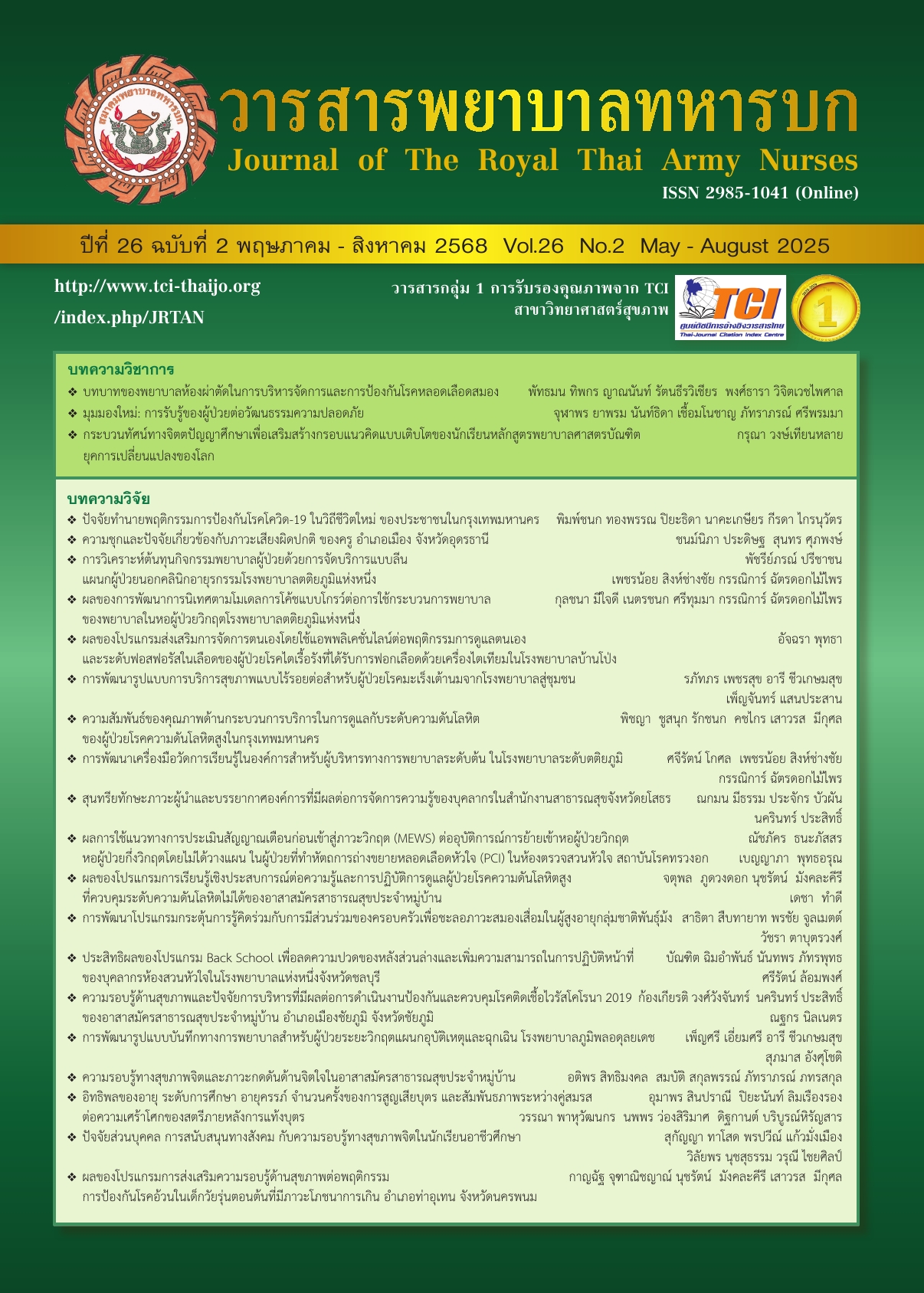
Effects of Self-Management Promotion Program using Line the Application on Self-Care Behaviors and Serum Phosphorus Levels of Patients with Chronic Kidney Disease Undergoing Hemodialysis in Ban Pong Hospital
Keywords:
Self-management, LINE application, Chronic kidney disease, Phosphorus level, HemodialysisAbstract
A quasi-experimental, one-group pre-test post-test design was conducted to investigate the effects of a self-management promotion program using a LINE application on self-care behaviors and serum phosphorus levels in patients with chronic kidney disease undergoing hemodialysis at Banpong Hospital. The sample consisted of 30 chronic kidney disease patients receiving hemodialysis at the Hemodialysis Center, Banpong Hospital, who met the specified criteria. The research instruments included: 1) a self-management promotion program using a LINE application, and 2) a self-care behavior questionnaire for phosphorus control, which had a content validity index of 0.98 and a Cronbach’s alpha coefficient of 0.86. Descriptive statistics and inferential statistics (paired t-test) were used for data analysis.
The results revealed that after participating in the program, the experimental group exhibited significantly better self-management behaviors for phosphorus control compared to before receiving the program (p < .05). Additionally, the experimental group had significantly lower serum phosphorus levels after the program compared to before (p < .05). These findings indicate that the self-management promotion program was effective in improving self-care behaviors and controlling serum phosphorus levels. Therefore, it is recommended to promote the application of this program in the care of patients with chronic kidney disease.
Downloads
References
World Health Organization. Global status report on kidney disease 2023. Geneva: WHO; 2023.
Bureau of Information, Office of the Permanent Secretary for Public Health. Report on chronic kidney disease situation in Thailand 2021. Nonthaburi: Ministry of Public Health; 2021.
The Nephrology Society of Thailand. Clinical practice guidelines for chronic kidney disease. Bangkok: The Nephrology Society of Thailand; 2021.
Damas J, & Fernandes V. Assessment of Fluid Status in Dialysis: Clinical Importance and Diagnostic Tools. Portuguese Journal of Nephrology & Hypertension. 2022;36(2): 115–20.
Rastogi A, Bhatt N, Rossetti S, & Beto, J. Management of hyperphosphatemia in hemodialysis patients. Thai Journal of Nursing Council. 2020;35(4):90-104.
Sritakaew N, Meesomsak N, Thohinung U, & Rojanaprasert P. The Effectiveness of Applications on Promoting the Growth and Development of Infants Born Prematurely after Discharge from the Hospital for Caregivers. Journal of The Royal Thai Army Nurses. 2024; 25(3):285-93. (in Thai)
Ajprajun P, Chantasiri W, & Sunthornchai S. Effects of dietary phosphorus control promotion program for chronic kidney disease patients receiving hemodialysis. Journal of Health Promotion and Environmental Health Regional Health Center 9. 2024;18(1):401-6.
Kanfer FH, & Gaelick-Buys L. Self-management methods. In: Kanfer FH, Goldstein AP, editors. Helping people change: A textbook of methods. New York: Pergaman Press; 1991.
Sa-ngrattanapiman K, Arsa K, & Khiewchaum R. The Effects of a Self-Management Program in Chronic Kidney Disease Stages 3A to 4 Patients on Knowledge, Self- Management Behaviors, and Glomerular Filtration Rate. Journal of Nursing and Public Health Research.
;4(1):1-15.
Quality Development Committee of Hemodialysis Unit, Banpong Hospital. Quality data summary of hemodialysis unit in Banpong Hospital (2020-2022) [Unpublished document]. Ratchaburi: Special Treatment Nursing Department, Nursing Mission Group, Banpong Hospital; 2022.
Gray JR, Grove SK, & Sutherland S. Burns and Grove’s the practice of nursing research: appraisal, synthesis, and generation of evidence. 8th ed. St. Louis: Elsevier; 2017.
Bloom BS. Taxonomy of educational objectives: the classification of educational goals. Handbook I: cognitive domain. New York: David McKay Company; 1975.
Downloads
Published
How to Cite
Issue
Section
License
Copyright (c) 2025 Journal of The Royal Thai Army Nurses

This work is licensed under a Creative Commons Attribution-NonCommercial-NoDerivatives 4.0 International License.
บทความหรือข้อคิดเห็นใดใดที่ปรากฏในวารสารพยาบาลทหารบกเป็นวรรณกรรมของผู้เขียน ซึ่งบรรณาธิการหรือสมาคมพยาบาลทหารบก ไม่จำเป็นต้องเห็นด้วย
บทความที่ได้รับการตีพิมพ์เป็นลิขสิทธิ์ของวารสารพยาบาลทหารบก
The ideas and opinions expressed in the Journal of The Royal Thai Army Nurses are those of the authors and not necessarily those
of the editor or Royal Thai Army Nurses Association.