
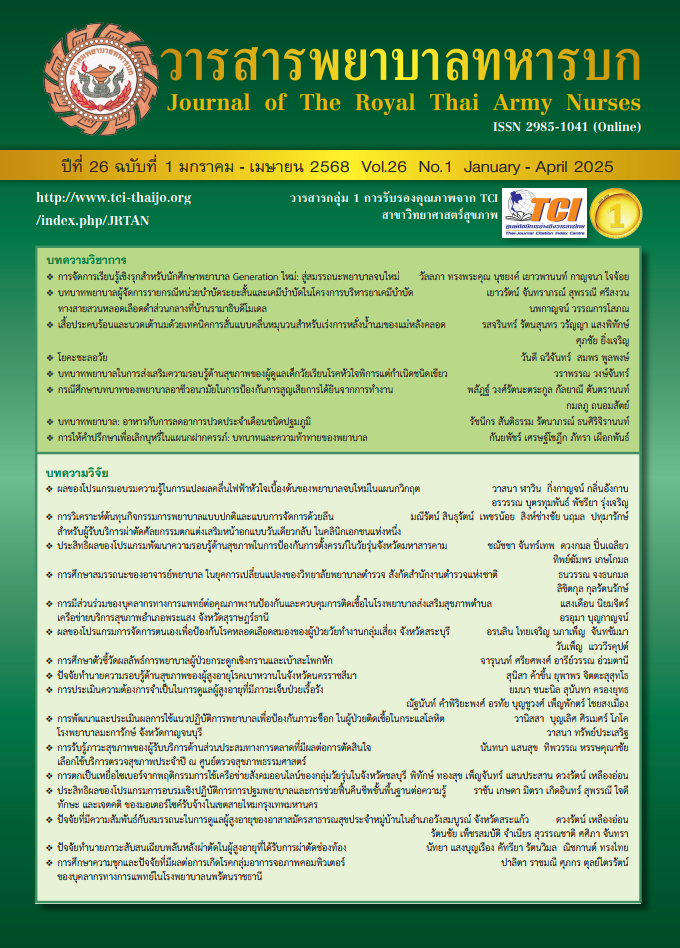
Nurse’s Role: Dietary and Relieving Primary Dysmenorrhea
Keywords:
Nurse’s role, Dietary, Primary dysmenorrhea, Women’ healthAbstract
When women enter adolescence, they begin menstruating, which represents physical development. Menstrual periods originate from the change in hormone levels, body temperature, ovum development, and endometrium each month. Women may have dysmenorrhea during the period that it is caused by uterine contractions as the result of prostaglandin, and some women may have severe pain from dysmenorrhea. Dysmenorrhea is an uncomfortable symptom, and it affects reproductive women in physical, psychosocial, and job duties. This academic article aims to present the role of nurses in managing primary dysmenorrhea in women through dietary. This includes assessing knowledge about foods related to prostaglandin synthesis and inhibition, promoting adequate nutrient intake, providing education on foods to consume and avoid, developing personalized dietary plans in conjunction with monthly menstrual pain level records, and evaluating the outcomes after implementing dietary plans. This is to enable reproductive women to effectively manage primary dysmenorrhea without medication and to promote comfort during menstruation.
Downloads
References
Draper CF, Duisters K, Weger B, Chakrabarti A, Harms AC, Brennan L, et al. Menstrual cycle rhythmicity: metabolic patterns in healthy women. Scientific Reports. 2018;8(1):1-15. doi.:10.1038/s41598-018-32647-0
Sahin N, Kasap B, Kirli U, Yeniceri N, & Topal Y. Assessment of anxiety-depression levels and perceptions of quality of life in adolescents with dysmenorrhea. Reproductive Health. 2018;15(1). doi.:10.1186/s12978-018-0453-3
Yonglitthipagon P. Diagnosis and treatment of primary dysmenorrhea. Journal of Medical Technology and Physical Therapy. 2016; 28(2):112 – 9. (in Thai)
Leaungsomnapa Y, Chadcham S, & Suntibenjakul S. The effects of a program to change pain catastrophizing and pain intensity for primary dysmenorrhea in nursing students. Journal of Nursing and Education. 2014;7(1):26–38. (in Thai)
Esan DT, Ariyo SA, Akinlolu EF, Akingbade O, Olabisi OI, Olawade DB, et al. Prevalence of dysmenorrhea and its effect on the quality of life of female undergraduate students in Nigeria. Journal of Endometriosis and Uterine Disorder. 2024;5(1):100059. doi.:10.1016/j.jeud. 2024.100059
Mizuta R, Maeda N, Tashiro T, Suzuki Y, Oda S, Komiya M, et al. Quality of life by dysmenorrhea severity in young and adult Japanese females: A web-based crosssectional study. PLoS ONE. 2023;18(3):e0283130. doi:10.1371/journal.pone.0283130
Hailemeskel S, Demissie A, & Assefa N. Primary dysmenorrhea magnitude, associated risk factors, and its effect on academic performance: Evidence from female university students in Ethiopia. International Journal of Women’s Health. 2016;8:489-96. doi:10.2147/IJWH.S112768
Critchley HOD, Maybin JA, & Armstrong GM, Williams ARW. Physiology of the endometrium and regulation of menstruation. Physiological Reviews. 2020;100(3):1149-79. doi:10.1152/ physrev.00031.2019
Murray SS, & McKinney ES. Foundations of Maternal-newborn and women’s health nursing. Elsevier Health Sciences; 2017.
Lowdermilk DL, Cashion K, Alden KR, Olshansky E, & Perry SE. Maternity and Women’s Health Care. Elsevier Health Sciences; 2023.
Itani R, Soubra L, Karout S, Rahme D, Karout L, & Khojah HMJ. Primary dysmenorrhea: Pathophysiology, diagnosis, and treatment updates. Korean Journal of Family Medicine. 2022;43(2):101–8. doi.:10.4082/kjfm.21.0103
Santhitham R. Effects of dietary program on relieving pain and discomfort among women with dysmenorrhea. Christian University Journal. 2021;27(2):62-76. (in Thai)
Payne LA, Rapkin AJ, Seidman LC, Zeltzer LK, & Tsao JC. Experimental and procedural pain responses in primary dysmenorrhea: a systematic review. Journal of Pain Research. 2017;10:2233-46. doi:10.2147/JPR.S143512
Najafi N, Khalkhali H, Tabrizi FM, & Zarrin R. Major dietary patterns in relation to menstrual pain: A nested case control study. BMC Women’s Health. 2018;18(1). doi.:10.1186/s12905- 018-0558-4
Barnard NDN. Nutrition guide for clinicians: Dysmenorrhea. Physicians Committee for Responsible Medicine; 2023.
Konthiang K, Varee A, & Niramon P. The role of holistic nurses in integrative nonpharmacological pain management. Journal of The Royal Thai Army Nurses. 2024;25(3): 73-81. (in Thai)
Wong CL, Ip WY, & Lam LW. Self-Care strategies among Chinese adolescent girls with dysmenorrhea: A qualitative study. Pain Management Nursing. 2016;17(4):262–71. doi.:10.1016/j.pmn.2016.04.001
Kartal YA, & Akyuz EY. The effect of diet on primary dysmenorrhea in university students: A randomized controlled clinical trial. Pakistan Journal of Medical Sciences. 2018;34(6):1478–82. doi.:10.12669/pjms.346. 16477
Zahra B, Zainab A, & Farnoosh M. Nutrition as a potential factor of primary dysmenorrhea: A systematic review of observational studies. Gynecologic Obstetric Investigation. 2019; 84(3):209–24. doi.:10.1159/000495408
Budyee C, & Tungsuphum N. Nutrition for Working Populations and Reproductive Women. National Food Committee; 2016.
Downloads
Published
How to Cite
Issue
Section
License
Copyright (c) 2025 Journal of The Royal Thai Army Nurses

This work is licensed under a Creative Commons Attribution-NonCommercial-NoDerivatives 4.0 International License.
บทความหรือข้อคิดเห็นใดใดที่ปรากฏในวารสารพยาบาลทหารบกเป็นวรรณกรรมของผู้เขียน ซึ่งบรรณาธิการหรือสมาคมพยาบาลทหารบก ไม่จำเป็นต้องเห็นด้วย
บทความที่ได้รับการตีพิมพ์เป็นลิขสิทธิ์ของวารสารพยาบาลทหารบก
The ideas and opinions expressed in the Journal of The Royal Thai Army Nurses are those of the authors and not necessarily those
of the editor or Royal Thai Army Nurses Association.






