
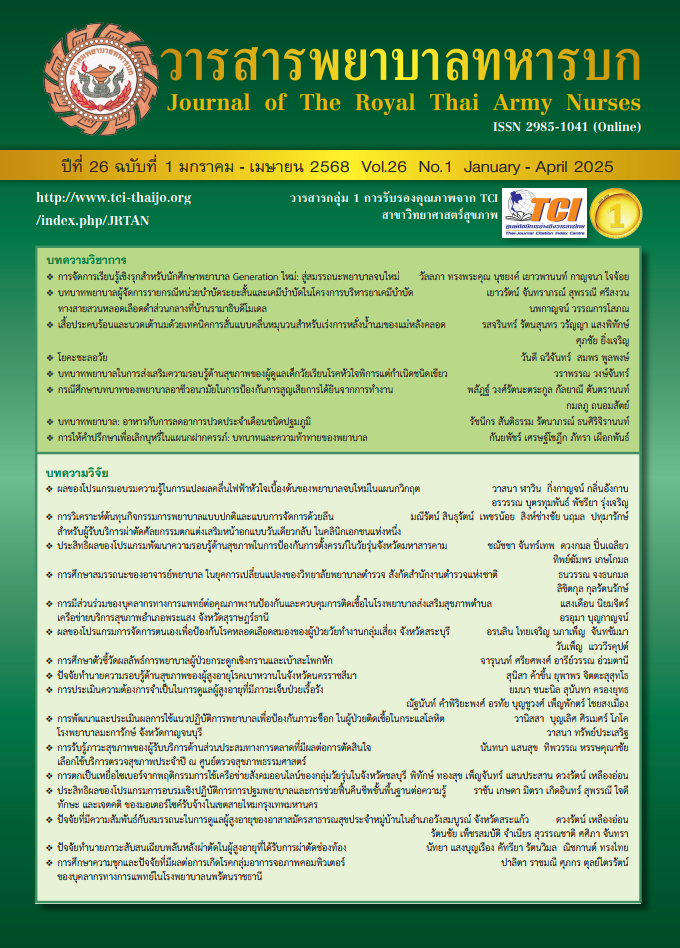
A Case Study on the Role of Occupational Health Nurses in Preventing Occupational Noise-Induced Hearing Loss
Keywords:
Occupational health nurses, Occupational Noise-Induced Hearing Loss, Case studyAbstract
Occupational noise-induced hearing loss (ONIHL) is a significant health issue affecting workers globally, particularly in industries with regular exposure to high noise levels. Prolonged exposure to sound levels exceeding 85 decibels (dBA) can cause damage to the hair cells in the inner ear responsible for transmitting sound signals, leading to permanent hearing loss. ONIHL impacts workers physically, mentally, and in terms of their work performance, as well as the overall productivity of the workplace. This article aims to present the role of occupational health nurses in preventing ONIHL through a three-level prevention approach. Primary prevention focuses on reducing noise exposure by promoting the use of hearing protection devices among workers. Secondary prevention emphasizes the surveillance and screening of hearing to prevent further deterioration. Tertiary prevention aims to rehabilitate workers’ hearing abilities and support them in performing tasks according to their full potential. The article also analyzes case studies and presents practical guidelines that align with the current workplace context to reduce the incidence of noise-induced hearing loss and enhance workers’ quality of life.
Downloads
References
Asghari M, Gorji R, Moradzadeh R, Kohansal B, Abbasinia M, & Goudarzi F. A risk model for occupational noise-induced hearing loss in workers. Work. 2024;77(3):1017–22.
Basu S, Aggarwal A, Dushyant K, & Garg S. Occupational Noise Induced Hearing Loss in India: A Systematic Review and Meta-Analysis. Indian Journal of Community Medicine. 2022; 47(2):166–71.
Suwannasit P, Wonthong T, & Songkham W. Prevalence Rate and Factors Associated with Noise-induced Hearing Loss among Workers in Chumphon Khet Udomsakdi Hospital. Journal Royal Thai Army Nurses. 2022;23(2):208-17.
Elmazoska I, Mäki-Torkko E, Granberg S, & Widén S. Associations Between Recreational Noise Exposure and Hearing Function in Adolescents and Young Adults: A Systematic Review. Journal of Speech, Language & Hearing Research. 2024;67(2):688–710.
Pimpan Silapasuwan. Occupational Health and Safety Nursing: Concepts for Practice in the Post-COVID-19 Era. Bangkok: CUPRINT; 2022.
Leso V, Fontana L, Finiello F, De Cicco L, Luigia Ercolano M, & Iavicoli I. Noise induced epigenetic effects: A systematic review. Noise & Health. 2020;22(107):77–89.
Granberg S, & Gustafsson J. Key findings about hearing loss in the working-life: a scoping review from a well-being perspective. International Journal of Audiology. 2021; 60(sup2):60-70.
Deborah Imel N, Robert Y N, Marisol C-B, & Marilyn F. The global burden of occupational noise-induced hearing loss. American Journal of Industrial Medicine. 2005;48(6):446-58.
Occupational Safety and Health Samut Prakan. Guidelines for surveillance and prevention Occupational Noise-Induced Hearing Loss. Samut Prakan: Occupational Safety and Health Samut Prakan; 2020.
Songkham W. Occupational Health Nursing: Concepts and Applications. Chiang Mai: Faculty of Nursing, Chiang Mai University; 2020.
Le TN, Straatman LV, Lea J, & Westerberg B. Current insights in noise-induced hearing loss: A literature review of the underlying mechanism, pathophysiology, asymmetry, and management options. J Otolaryngol Head Neck Surg. 2017;46(1):41.
Campo P, Lataye R, Loquet G, & Bonnet P. Combined exposure to noise and ototoxic substances: A review. Noise Health. 2019;21(98):116-29.
Masterson EA, Bushnell PT, Themann CL, & Morata TC. Hearing Impairment Among Noise-Exposed Workers — United States, 2003–2012. Morbidity and Mortality Weekly Report. 2016;65(15):389-94.
Neitzel RL, Daniell WE, Sheppard L, Davies HW, & Seixas NS. Evaluation and comparison of three exposure assessment techniques for noise-induced hearing loss studies. Epidemiology. 2011;22(1):124-31.
Rogers EM. Diffusion of Innovations. 5th ed. New York: Free Press; 2003.
Downloads
Published
How to Cite
Issue
Section
License
Copyright (c) 2025 Journal of The Royal Thai Army Nurses

This work is licensed under a Creative Commons Attribution-NonCommercial-NoDerivatives 4.0 International License.
บทความหรือข้อคิดเห็นใดใดที่ปรากฏในวารสารพยาบาลทหารบกเป็นวรรณกรรมของผู้เขียน ซึ่งบรรณาธิการหรือสมาคมพยาบาลทหารบก ไม่จำเป็นต้องเห็นด้วย
บทความที่ได้รับการตีพิมพ์เป็นลิขสิทธิ์ของวารสารพยาบาลทหารบก
The ideas and opinions expressed in the Journal of The Royal Thai Army Nurses are those of the authors and not necessarily those
of the editor or Royal Thai Army Nurses Association.






