
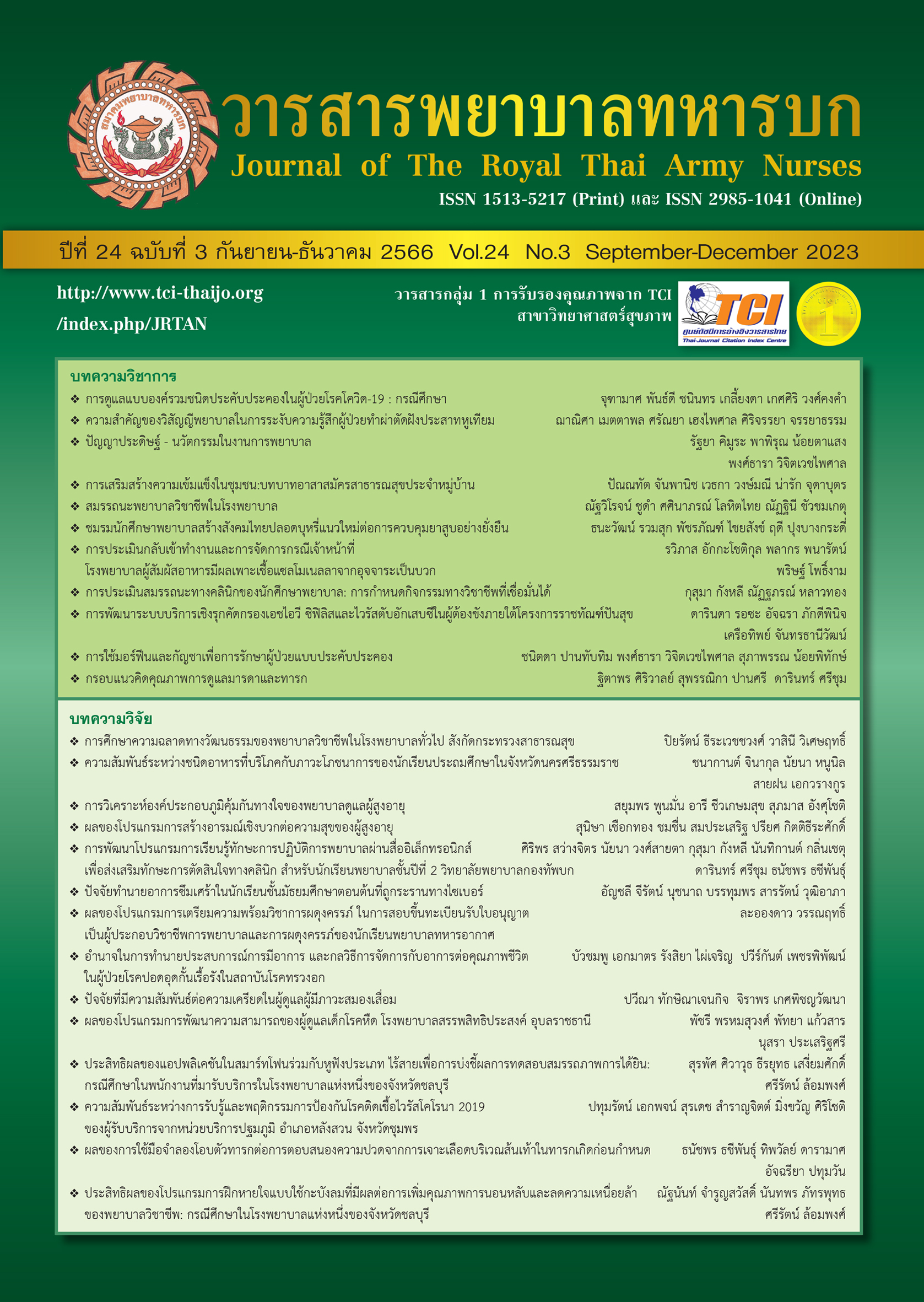
Holistic Palliative Care for Covid-19: A Case Study
Keywords:
Palliative care, Covid-19 patient, Case study, Nurse’ rolesAbstract
Coronavirus disease 2019 (COVID-19) is a life-threatening disease that emerged, spread and eventually caused a worldwide pandemic. A severe complication of the disease was found in a critical state caused by the SAR-CoV-2 virus into the lungs, causing the lungs to lose their function and cause acute respiratory distress. Including complications from viral infection entering the body, This group of patients will suffer both physically and mentally. It has severe consequences and threatens the patient’s quality of life to the end of life, where patients need palliative care. Integration of care approaches starts from the onset of the disease and progresses until it cannot be cured entirely. And provide symptomatic care until the patient enters the final stage. By the way, care must be taken to provide holistic care. To address all dimensions of patient suffering, The role of nurses in caring for patients who are in the final stages of life in providing holistic palliative care is therefore essential, which must have knowledge and understanding about the disease management of suffering. This role will help promote the quality of life for patients in the last stages of life with dignity. And the family is proud of this decision. and satisfaction with the service model
Downloads
References
Chawaphanth S, Sennun P, Tanasirijiranont R. Nurses and their ‘spirit of the second mile’ service during covid-19 pandemic. Journal of Thailand Nursing and Midwifery Council. 2021;36(1):5-17. (in Thai).
World Health Organization. Integrating palliative care and symptom relief into primary health care: a WHO guide for planners, implementers and managers. Geneva; 2018.
Sekse RJT, Hunskar I, Ellingsen S. The nurse’s role in palliative care: a qualitative meta-synthesis. Journal of Cilnical Nursing, 2018;17(1-2), 21-38.
Thanakijtummakul N. Nursing care for covid-19 patients with acute respiratory distress syndrome. Journal of Thailand Nursing and Midwifery Council. 2021;36(3):16-30. (in Thai).
Subwongcharoen N, Chintapanyakun T. Role of palliative care nurses in tertiary hospitals. Journal of The Royal Thai Army Nurses. 2020;21(1):26-34. (in Thai).
Fadul N, Elsayem AF, Bruera E. Integration of palliative care into covid-19 pandemic planning. British Medical Journal Supportive & Palliative Care. 2021;11(1):40-4.
Carpenito L. Handbook of nursing diagnosis. (15th ed.) Philadelphia: Lippincot Williams & Wilkins, 2016.
Wongrostrai Y. & Sangrujee J. The development of clinical nursing practice guideline for providing oxygen therapy to the patients infected with the coronavirus 2019 (covid-19) in the critical cohort department. Journal of The Royal Thai Army Nurses. 2023;24(1):269-78. (in Thai).
Ji W, Wang W, Zhao X, Zai J, Li X. Homologous recombination within the spike glycoprotein of the newly identified coronavirus may boost cross-species transmission from snake to human. Journal of Medical Virology. 2020;92(4):1-9
Ting R, Edmonds P, Higginson I, Sleeman K. Palliative care for patients with severe covid-19. British Medical Journal. 2020; 370(1):1-4.
Intolo S. Infection control and prevention of covid-19: roles of advanced nurse practitioners. Journal of Thailand Nursing and Midwifery Council. 2021;36(3):5-15. (in Thai).
Janssen D, Ekstrom M, Curro D, Johnson M, Maddocks M, Simonds A, et al. Covid-19: guidance on palliative care from a European respiratory society international task force. European Respiratory Journal. 2020;56(1):1-13.
Sheehan J, Ho KS, Poon J, Sarosky K, Fung JY. Palliative care in critically ill covid-19 patients: the early New York city experience. British Medical Journal Supportive & Palliative Care. 2023;13(1):107-11.
Cheng HWB. Palliative care for cancer patients with severe covid-19: the challenge of uncertainty. Support Care Cancer. 2021;29(3): 1153-5.
Pornsirirat T, Tongyoo S. Nursing care for adult patients with acute hypoxic respiratory failure receiving high flow nasal cannula. Siriraj Medical Bulletin. 2020;13(1):60-8. (in Thai).
Lerner Z, Burke R, McCall J, Leigh A, Glass M. A case report of covid-19 in new Orleans, Louisiana: highlighting the complexities of prognostication in a critically ill patient. Palliative Medicine Reports. 2020;11(1):227-31.
Hajjar L, Costa I, Rizk S, Biselli B, Gomes B, Bittar C, et al. Intensive care management of patients with covid-19: a practical approach. Annals of Intensive Care. 2021;11(36):1-17.
Herdman H, Kamitsuru S. Nursing diagnoses: definitions and classification. (11th ed.) Wiley Blackwell, 2020.
Rogers M, Meier DE, Morrison RS, Moreno J, Aldridge M. Hospital characteristics associated with palliative care program prevalence. Journal of Palliative Medicine. 2020;23(10): 1286-99.
Birkholz L, Haney T. Using a dyspnea assessment tool to improve care at the end of life. Journal of Hospice & Palliative Nursing. 2018; 20(3):219-27.
Downloads
Published
How to Cite
Issue
Section
License
Copyright (c) 2023 Journal of The Royal Thai Army Nurses

This work is licensed under a Creative Commons Attribution-NonCommercial-NoDerivatives 4.0 International License.
บทความหรือข้อคิดเห็นใดใดที่ปรากฏในวารสารพยาบาลทหารบกเป็นวรรณกรรมของผู้เขียน ซึ่งบรรณาธิการหรือสมาคมพยาบาลทหารบก ไม่จำเป็นต้องเห็นด้วย
บทความที่ได้รับการตีพิมพ์เป็นลิขสิทธิ์ของวารสารพยาบาลทหารบก
The ideas and opinions expressed in the Journal of The Royal Thai Army Nurses are those of the authors and not necessarily those
of the editor or Royal Thai Army Nurses Association.