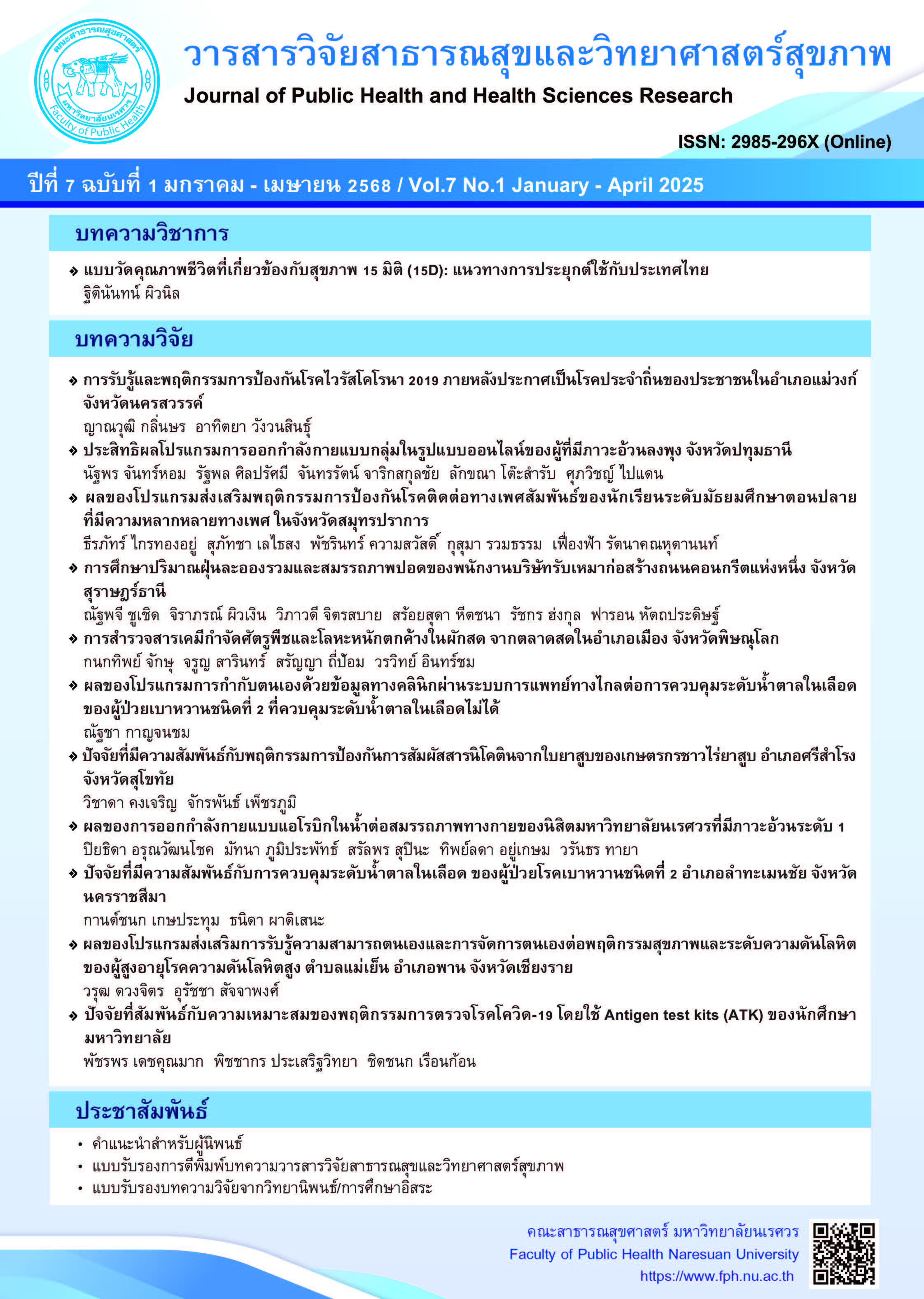
ปัจจัยที่มีความสัมพันธ์กับพฤติกรรมการป้องกันการสัมผัสสารนิโคติน จากใบยาสูบของเกษตรกรชาวไร่ยาสูบ อำเภอศรีสำโรง จังหวัดสุโขทัย
คำสำคัญ:
การสัมผัสสารนิโคตินจากใบยาสูบ, พฤติกรรมการป้องกัน, เกษตรกรชาวไร่ยาสูบบทคัดย่อ
การวิจัยเชิงพรรณนาภาคตัดขวางนี้ มีวัตถุประสงค์เพื่อศึกษาพฤติกรรมการป้องกันการสัมผัสสารนิโคตินจากใบยาสูบและปัจจัยที่เกี่ยวข้อง กลุ่มตัวอย่าง คือ เกษตรกรชาวไร่ยาสูบในอำเภอศรีสำโรง จังหวัดสุโขทัย จำนวน 361 คน สุ่มตัวอย่างแบบหลายขั้นตอน เก็บรวบรวมข้อมูลโดยใช้แบบสอบถามที่ผู้วิจัยสร้างขึ้น วิเคราะห์ข้อมูลโดยใช้สถิติเชิงพรรณนาและการวิเคราะห์ถดถอยเชิงเส้นพหุคูณที่ระดับนัยสำคัญ 0.05
ผลการศึกษาพบว่า กลุ่มตัวอย่างส่วนใหญ่มีพฤติกรรมการป้องกันการสัมผัสสารนิโคตินจากใบยาสูบอยู่ในระดับปานกลาง ร้อยละ 57.6 และพบว่าปัจจัยที่มีความสัมพันธ์กับพฤติกรรมการป้องกันการสัมผัสสารนิโคตินจากใบยาสูบของเกษตรกรชาวไร่ยาสูบ ประกอบด้วย ปัจจัยนำ ได้แก่ ระยะเวลาเป็นเกษตรกรชาวไร่ยาสูบ ระยะเวลาเก็บใบยาสูบสด
ความรู้เกี่ยวกับโรคพิษใบยาสูบสด การรับรู้ความรุนแรงของการสัมผัสสารนิโคตินจากใบยาสูบ การรับรู้ประโยชน์และการรับรู้อุปสรรคของการป้องกันการสัมผัสสารนิโคตินจากใบยาสูบ ปัจจัยเอื้อ ได้แก่ การเข้าถึงอุปกรณ์ป้องกันการสัมผัสสารนิโคตินจากใบยาสูบ ปัจจัยเสริม ได้แก่ การได้รับข้อมูลข่าวสารเกี่ยวกับโรคพิษใบยาสูบสด แรงสนับสนุนทางสังคมจากครอบครัวและบุคลากรสถานีใบยาสูบ การศึกษานี้ มีข้อเสนอแนะ คือ บุคลากรสถานีใบยาสูบควรจัดกิจกรรมเพื่อเสริมสร้างความรู้เกี่ยวกับโรคพิษใบยาสูบสด สร้างความตระหนักรู้ถึงความรุนแรงของการสัมผัสสารนิโคตินจากใบยาสูบสร้างการรับรู้ประโยชน์และลดอุปสรรคของการป้องกันการสัมผัสสารนิโคตินจากใบยาสูบ นอกจากนี้ ครอบครัวควรสนับสนุนการได้รับข้อมูลข่าวสารเกี่ยวกับโรคพิษใบยาสูบสดและการเข้าถึงอุปกรณ์ป้องกันอย่างสม่ำเสมอ เพื่อส่งเสริมให้เกษตรกรชาวไร่ยาสูบมีพฤติกรรมการป้องกันการสัมผัสสารนิโคตินจากใบยาสูบอย่างต่อเนื่อง
เอกสารอ้างอิง
Achalli, S., Shetty, S., & Gogineni, S. (2012). The green hazards: A meta-analysis of green tobacco sickness. International Journal of Occupational Safety and Health, 2, 11-14.
Arcury, T. A., Laurienti, P. J., Talton, J. W., Chen, H., Howard, T. D., Summers, P., & Quandt, S. A. (2016). Urinary cotinine levels among Latino tobacco farmworkers in North Carolina compared to Latinos not employed in agriculture. Nicotine & Tobacco Research, 18(6), 1517-1525.
Arcury, T. A., Quandt, S. A., & Preisser, J. S. (2001). Predictors of incidence and prevalence of green tobacco sickness among Latino farmworkers in North Carolina, USA. Journal of Epidemiology and Community Health, 55(11), 818-824.
Becker, M. H., & Maiman, L. A. (1975). The health belief model: Origins and correlation in psychological theory. Health Education Monography, 2, 336-385.
Best, J. K. (1977). Research in education. (3rd ed.). Engle Clift, New Jersey: Prentice-Hall.
Bloom, B. S. (1975). Taxonomy of education. New York: Avid McKay Company.
Campos, E., Costa, V. I. D., Alves, S. R., Rosa, A. C. S., Geraldino, B. R., Meira, B. D. C., et al. (2020). Occurrence of green tobacco sickness and associated factors in farmers residing in Dom Feliciano Municipality, Rio Grande do Sul State, Southern Region of Brazil. Cadernos de Saude Publica, 36(8), e00122719.
Cargnin, M., Cezar-Vaz, M. R., Getelina, C. O., & Bonow, C. A. (2019). Socio-environmental risks associated with the green tobacco sickness in farmers: A case-control study. Revista Brasileirade Enfermagem, 72(6), 1670-1676.
Daniel, W. W. (1999). Biostatistics: A foundation for analysis in the health sciences. (7th ed.). New York: John Wiley & Sons.
Department of Agricultural Extension. (2023). Agricultural production information service system. Retrieved March 3, 2023, from https://production.doae.go.th/service/site/index. (in Thai)
DeVellis, R. F. (2012). Scale development: Theory and applications. California, Thousands Oak: Sage Publications Inc.
Fassa, A. G., Faria, N. M., Meucci, R. D., Fiori, N. S., Miranda, V. I., & Facchini, L. A. (2014). Green tobacco sickness among tobacco farmers in southern Brazil. American Journal of Industrial Medicine, 57(6), 726-735.
Fotedar, S., & Fotedar, V. (2017). Green tobacco sickness: A brief review. Indian journal of occupational and environmental medicine, 21(3), 101-104.
Green, I. W., & Kreuter, M. W. (2005). Health program planning: An educational and ecological approach. (4th ed.). New York: Emily Barrosse.
Hussain, A., Altaf, Q., & Yousafzai, B. (2022). Socioeconomic and environmental impacts of tobacco farming in Khyber Pakhtunkhwa, Pakistan. The Journal of Agricultural Life and Environmental Sciences, 59, 67-79.
Manothum, A. (2019). Working conditions and occupational safety among tobacco growers in Tubpeung Subdistrict, Srisumrong District, Sukhothai Province. Journal of industrial education, 13(2), 85-94. (in Thai)
McBride, J. S., Altman, D. G., Klein, M., & White, W. (1998). Green tobacco sickness. Tobacco Control, 7(3), 294-298.
Occupational Safety and Health Administration. (2015). Green tobacco sickness. Retrieved April 3, 2023, from https://www.osha.gov/green-tobacco-sickness.
Parikh, J. R., Gokani, V. N., Doctor, P. B., Kulkarni, P. K., Shah, A. R., & Saiyed, H. N. (2005). Acute and chronic health effects due to green tobacco exposure in agricultural workers. American Journalof Industrial Medicine, 47(6), 494-499.
Park, S. J., Lim, H. S., Lee, K., & Yoo, S. J. (2018). Green tobacco sickness among tobacco harvesters in a Korean village. Safety and Health at Work, 9(1), 71-74.
Permatasari, V., Musthofa, S. B., & Prabamurti, P. N. (2020). Faktor yang berhubunganan taraperilakupencarianpengobatangejala green tobacco sickness (GTS) dengan petanitembakau di kecamatan bansarikabu paten temanggung. Jurnal Kesehatan Masyarakat, 8(2), 293-297.
Piyapongsakul, V., Lagampan, S., & Kalampakorn, S. (2014). Factors related to nicotine poisoning prevention behaviors among tobacco farmers in the Northeastern Thailand. Journal of Public Health Nursing, 28(3), 70-83. (in Thai)
Rokhmah, D., & Khoiron, K. (2014). Risk factor analysis of green tobacco sickness (GTS) and the handling method on tobacco farmers. International journal of current research and academic review, 1, 20-29.
Rokhmah, D., Khoiron, K., Imama, I., Lestari, N., Mahda, A., & Agustin, I. (2020). The preventive behavior of green tobacco sickness (GTS) syndrome at tobacco farmers: The role of health literacy. Health Sciences Research, 33, 556-563
Rokhmah, D., Ma'rufi, I., & Khoiron, K. (2019). Incidences of green tobacco sickness (GTS) on tobacco farmer and prevention efforts through social capital utilization in Indonesia. Earth and Environmental Science, 243, 012090.
Saleeon, T., Siriwong, W., Maldonado-Perez, H. L., & Robson, M. G. (2015). Green tobacco sickness among Thai traditional tobacco farmers, Thailand. International Journal of Occupational and Environmental Medicine, 6(3), 169-176.
Saleeon, T., Siriwong, W., Maldonado-Perez, H. L., & Robson, M. G. (2016). Green tobacco sickness and protective behaviors among Thai traditional tobacco farmers in northern Thailand. Journal of Health Research, 30(4), 289-295.
Schmitt, N., Schmitt, J., Kouimintzis, D., & Kirch, W. (2007). Health risks in tobacco farm workers. Journal of Public Health, 15, 255-264.
Sujoso, A. D. P., Martiana, T., & Martini, S. (2020). Risk factors of green tobacco sickness on tobacco farmers in jember Indonesia. Indian Journal of Forensic Medicine and Toxicology, 14(3), 1029-1034.
Tobacco Authority of Thailand. (2015). Tobacco and discovery. Retrieved April 4, 2023, from https://www.thaitobacco.or.th/2015/01/006812.html. (in Thai)
Yoo, S. J., Park, S. J., Kim, B. S., Lee, K., Lim, H. S., Kim, J. S., et al. (2014). Airborne nicotine concentrations in the workplaces of tobacco farmers. Journal of Preventive Medicine and Public Health, 47(3), 144-149.
ดาวน์โหลด
เผยแพร่แล้ว
รูปแบบการอ้างอิง
ฉบับ
ประเภทบทความ
สัญญาอนุญาต
ลิขสิทธิ์ (c) 2025 วารสารวิจัยสาธารณสุขและวิทยาศาสตร์สุขภาพ

อนุญาตภายใต้เงื่อนไข Creative Commons Attribution-NonCommercial-NoDerivatives 4.0 International License.
บทความที่ได้รับการตีพิมพ์เป็นลิขสิทธิ์ของวารสารวิจัยสาธารณสุขและวิทยาศาสตร์สุขภาพ
ข้อความที่ปรากฏในบทความแต่ละเรื่องบทความในวารสารวิชาการและวิจัยเล่มนี้เป็นความคิดเห็นส่วนตัวของผู้เขียนแต่ละท่านไม่เกี่ยวข้องกับมหาวิทยาลัยนเรศวร และคณาจารย์ท่านอื่นๆในมหาวิทยาลัยฯ ความรับผิดชอบเกี่ยวกับบทความแต่ละเรื่องผู้เขียนจะรับผิดชอบของตนเองแต่ละท่าน