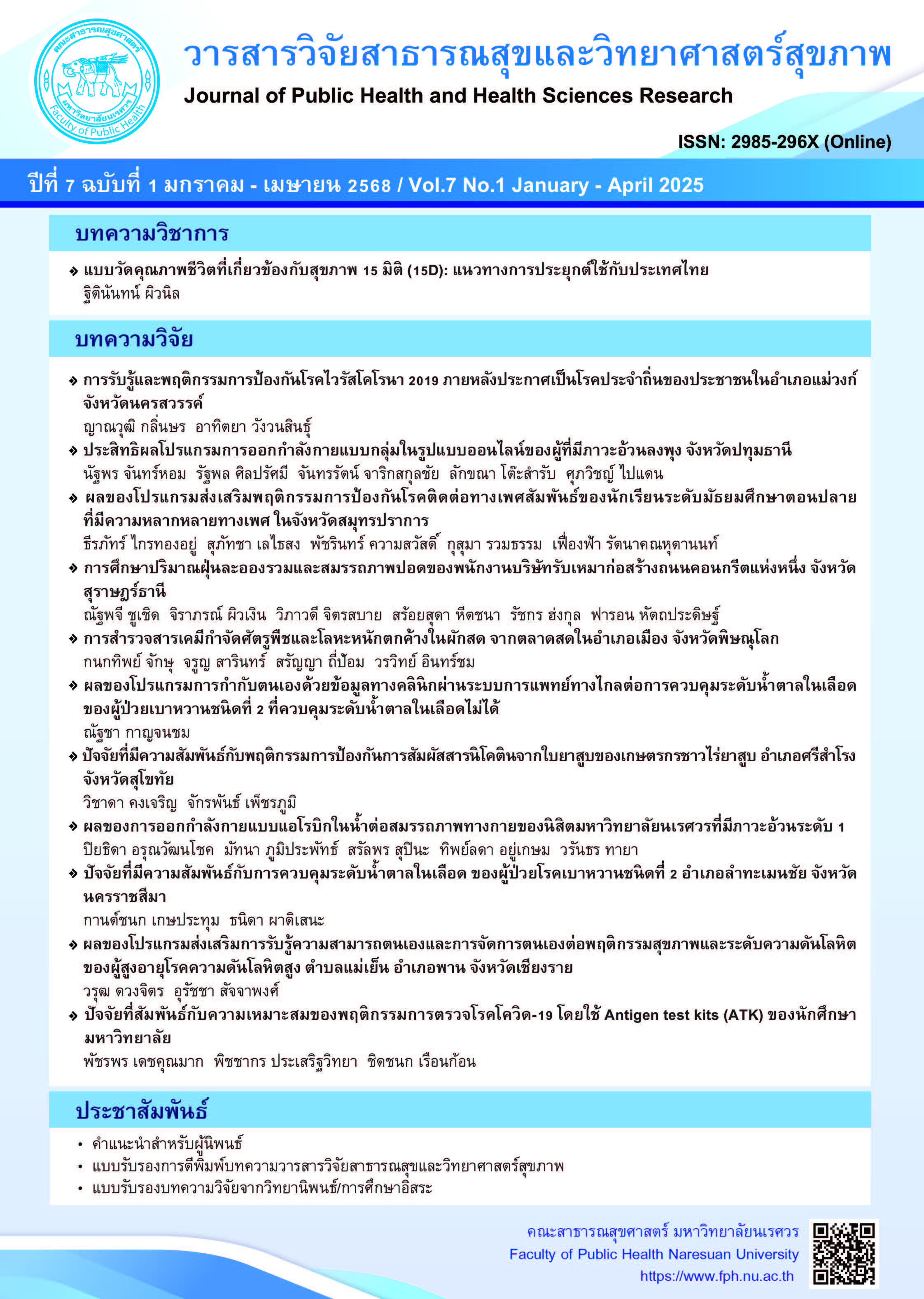
แบบวัดคุณภาพชีวิตที่เกี่ยวข้องกับสุขภาพ 15 มิติ (15D): แนวทางการประยุกต์ใช้กับประเทศไทย
คำสำคัญ:
การประเมินภาวะสุขภาพ, คุณภาพชีวิตที่เกี่ยวข้องกับสุขภาพ, แบบวัด 15Dบทคัดย่อ
แบบวัดคุณภาพชีวิตที่เกี่ยวข้องกับสุขภาพ 15 มิติ (15 Dimensions:15D) เป็นเครื่องมือที่ได้รับการพัฒนาขึ้นโดย Harri Sintonen ซึ่งเป็นที่ยอมรับในระดับสากลสำหรับใช้เพื่อการประเมินคุณภาพชีวิตที่เกี่ยวข้องกับสุขภาพ (Health-Related Quality of Life: HRQoL) บทความวิชาการนี้มีวัตถุประสงค์เพื่อนำเสนอข้อมูลเกี่ยวกับแบบวัด 15D และนำเสนอแนวทางการประยุกต์ใช้ในบริบทของประเทศไทย แบบวัด 15D ประกอบด้วยคำถาม 15 ข้อ ครอบคลุมมิติต่างๆ ของสุขภาพ ผลการศึกษาในหลายประเทศแสดงให้เห็นถึงความน่าเชื่อถือและความถูกต้องของแบบวัดนี้ โดยมีค่าสัมประสิทธิ์แอลฟาของครอนบาคอยู่ระหว่าง 0.76-0.98 อย่างไรก็ตาม แบบวัดนี้ยังมีข้อจำกัดบางประการ เช่น ความไวต่อสภาวะเฉพาะในบางโรคและผลกระทบเพดานคะแนนในผู้ที่มีสุขภาพดี สำหรับการประยุกต์ใช้ในประเทศไทย จำเป็นต้องมีการแปลและปรับให้เข้ากับบริบททางวัฒนธรรม รวมถึงการทดสอบคุณภาพเครื่องมือก่อนนำไปใช้จริง ซึ่งแบบวัด 15D มีศักยภาพที่จะนำมาประยุกต์ใช้ได้ทั้งในด้านการวิจัยทางคลินิก การศึกษาทางด้านสาธารณสุข รวมถึงการวิเคราะห์ประเมินความคุ้มค่าทางเศรษฐศาสตร์สุขภาพ ซึ่งจะเป็นประโยชน์ต่อการพัฒนานโยบายสุขภาพและการจัดสรรทรัพยากรในระบบสาธารณสุขของประเทศไทยต่อไป
เอกสารอ้างอิง
Abdul Mohit, M. (2018). Quality-of-life studies in batural and built environment: challenges and emerging issues. Asian Journal of Behavioural Studies, 3(10), 147-157. doi:10.21834/ajbes.v3i10.89
Akinci, F., Yildirim, A., Ogutman, B., Ates, M., Gozu, H., Deyneli, O., et al. (2005). Translation, cultural adaptation, initial reliability, and validation of Turkish 15D’s Version: ageneric health-related quality of life (HRQoL) Instrument. Evaluation & the Health Professions, 28(1), 53-66. doi:10.1177/0163278704273078
Alanne, S., Roine, R. P., Rasanen, P., Vainiola, T., & Sintonen, H. (2015). Estimating the minimum important change in the 15D scores. Quality of Life Research, 24(3), 599-606. doi:10.1007/s11136-014-0787-4
Aletras, V. H., Kontodimopoulos, N., Niakas, D. A., Vagia, M. G., Pelteki, H. J., Karatzoglou, G., et al. (2009). Valuation and preliminary validation of the Greek 15D in a sample of patients with coronary artery disease. Value in Health, 12(4), 574-579.doi: https://doi.org/10.1111/j.1524-4733.2008.00462.x
Aro, K., Back, L., Loimu, V., Saarilahti, K., Rogers, S., Sintonen, H., et al. (2016). Trends in the 15D health-related quality of life over the first year following diagnosis of head and neck cancer. European Archives of Oto-Rhino-Laryngology, 273(8), 2141-2150. doi:10.1007/s00405-015-3732-4
Baudino, M., Carreon, S. A., Streisand, R., Tang, T. S., Lyons, S., Mckay, S., et al. (2023). 714-P: Health-related quality of life (HRQOL) in young adults with T1D. Diabetes, 72 (Supplement_1). doi:10.2337/db23-714-P
Bujang, M. A., Lai, W. H., Ratnasingam, S., Tiong, X. T., Hon, Y. K., Yap, E. P. P., et al. (2023). Development of a quality-of-life instrument to measure current health outcomes: healthrelated quality of life with six domains (HRQ-6D). Journal of Clinical Medicine, 12(8), 2816.
Burholt, V., & Nash, P. (2011). Short form 36 (SF-36) health survey questionnaire: normative data for Wales. Journal of Public Health, 33(4), 587-603.doi: 10.1093/pubmed/fdr006
Campolina, A. G., Lopez, R. V. M., Nardi, E. P., & Ferraz, M. B. (2018). Internal consistency of the SF-6D as a health status index in the Brazilian urban population. Value Health Reg Issues, 17, 74-80. doi:10.1016/j.vhri. 2018. 02.003
Chatterji, S., Ustun, B. L., Sadana, R., Salomon, J. A., Mathers, C. D., & Murray, C. J. (2002). The conceptual basis for measuring and reporting on health. Global Programme on Evidence for Health Policy Discussion Paper, 45.
Devlin, N., Parkin, D., & Janssen, B. (2020). An introduction to EQ-5D instruments and their applications. In N. Devlin, D. Parkin, & B. Janssen (Eds.), Methods for Analysing and Reporting EQ-5D Data (pp. 1-22). Cham: Springer International Publishing.
Dian, P., Libriansyah, Gesnita, N., & Yunita, N. (2023). Translation and cultural aAdaptation of multi-attribute utility instrument (MAUI) Indonesian version of the 15D questionnaire. Jurnal Farmasi Dan Ilum Kefarma Sian Indonesia, 10(2), 162-172.doi: 10.20473/jfiki.v10i22023.162-172
Dick, B. D., Rashiq, S., Verrier, M. J., Ohinmaa, A., & Zhang, J. (2011). Symptom burden, medication detriment, and support for the use of the 15D health-related quality of life instrument in a chronic pain clinic population. Pain Research and Treatment, 2011, 809071. doi:10.1155/2011/809071
Ferreira, S., Sintonen, H., Raimundo, A., Batalha, N., Mendoza-Munoz, M., Perez-Gomez, J., & Parraca, J. A. (2023). Translation, cultural adaptation, and reliability of the 15D Portuguese version: ageneric health-related quality of life (HRQoL) instrument. Healthcare, 11(8). doi:10.3390/healthcare11081099
Heiskanen, J., Tolppanen, A.-M., Roine, R. P., Hartikainen, J., Hippelainen, M., Miettinen, H., & Martikainen, J. (2016). Comparison of EQ-5D and 15D instruments for assessing the health-related quality of life in cardiac surgery patients. European Heart Journal- Quality of Care and Clinical Outcomes, 2(3), 193-200. doi:10.1093/ehjqcco/qcw002
Horsman, J., Furlong, W., Feeny, D., & Torrance, G. (2003). The Health Utilities Index (HUI ): concepts, measurement properties and applications. Health and Quality of Life Outcomes, 1(1), 54.doi: 10.1186/1477-7525-1-54
Kangwanrattanakul, K. (2018). Health-related quality of life questionnaires. from https://ccpe.pharmacycouncil.org/index.php?option=article_detail&subpage=article_detail&id=491. (in Thai)
Kluger, N., Sintonen, H., Ranta, M., & Serlachius, M. (2017). Health-related quality of life of patients with hidradenitis suppurativa measured with the 15D instrument and comparison with the general Ppopulation and patients with psoriasis. Skin Appendage Disorders, 4(3), 131-135. doi:10.1159/000481117
Krisdapong, S., Prasertsom, P., Rattanarangsima, K., Adulyanon, S., & Sheiham, A. (2012). Setting oral health goals that include oral health-related quality of life measures: a study carried out among adolescents in Thailand. Cadernos de Saude Publica, 28.
Ledinski FiCko, S., FriganoviC, A., KovaCeviC, I., KurtoviC, B., Hosnjak, A. M., & Smrekar, M. (2023). Instruments Used in Assessment of Health-Related Quality of Life. Croatian nursing journal, 6(2), 153-159. doi:10.24141/2/6/2/6
Macran, S., Weatherly, H., & Kind, P. (2003). Measuring population health: acomparison of three generic health status measures. Medical Care, 41(2). Retrieved from https://journals.lww.com/lww-medicalcare/fulltext/2003/02000/measuring_population_health__a_comparison_of_three.4.aspx
Makrilakis, K., Liatis, S., Tsiakou, A., Stathi, C., Papachristoforou, E., Perrea, D., . . . Niakas, D. (2018). Comparison of health-related quality of Life (HRQOL) among patients with pre-diabetes, diabetes and normal glucose tolerance, using the 15D-HRQOL questionnaire in Greece: the DEPLAN study. BMC Endocrine Disorders, 18(1), 32. doi:10.1186/s12902-018-0261-3
Mazur, W., Kupiainen, H., Pitkaniemi, J., Kilpelainen, M., Sintonen, H., Lindqvist, A., et al. (2011). Comparison between the disease-specific Airways Questionnaire 20 and the generic 15D instruments in COPD. Health and Quality of Life Outcomes, 9(1), 4. doi:10. 1186/1477-7525-9-4
Michel, Y. A., Augestad, L. A., Barra, M., & Rand, K. (2019). A Norwegian 15D value algorithm: proposing a new procedure to estimate 15D value algorithms. Quality of Life Research, 28(5), 1129-1143. doi:10.1007/s11136-018-2043-9
Miettinen, H. J. A., Makirinne-Kallio, N., Kroger, H., & Miettinen, S. S. A. (2021). Health-related quality of Llife after hip and knee arthroplasty operations. Scandinavian Journal of Surgery, 110(3), 427-433. doi:10.1177/1457496920952232
Okafor, C. N., Akosile, C. O., Nkechi, C. E., Okonkwo, U. P., Nwankwo, C. M., Okoronkwo, I. L., et al. (2023). Effect of educational intervention programme on the health-related quality of life (HRQOL) of individuals with type 2 diabetes mellitus in South-East, Nigeria. BMC Endocrine Disorders, 23(1), 75.doi: 10.1186/s12902-023-01329-y
Okamoto, N., Hisashige, A., Tanaka, Y., & Kurumatani, N. (2013). Development of the Japanese 15D instrument of health-related quality of life: verification of reliability and validity among elderly people. PLOS ONE, 8(4), e61721. doi:10.1371/journal.pone.0061721
Pattanaphesaj, J., & Thavorncharoensap, M. (2017). Quality of lLife questionnaire EQ-5D-5L (Thai version). Retrieved from https://www.hitap.net/wp-content/uploads/2014/11/Thai5L_brief_Aug2017.pdf
Ryhanen, E. M., Heiskanen, I., Sintonen, H., Valimaki, M. J., Roine, R. P., & Schalin-Jantti, C. (2015). Health-related quality of life is impaired in primary hyperparathyroidism and significantly improves after surgery: a prospective study using the 15D instrument. Endocrine Connections, 4(3), 179-186. doi:10.1530/EC-15-0053
Sevak, S., & Balamurugan, G. (2023). Quality of life: concepts, needs, psychometric measurement, factors associated and treatment responsiveness in depression disorder. International Journal Of Community Medicine And Public Health, 10(2), 887-892. doi:10.18203/2394-6040.ijcmph20230250
Sintonen, H. (2001). The 15D instrument of healthrelated quality of life: properties and applications. Annals of Medicine, 33(5), 328-336. doi:10.3109/07853890109002086
Sintonen, H. (2017a). The 15-D measure of health related quality of life: II feasibility, reliability and validity of its valuation system. doi:10.4225/03/5938f98b8c5fb
Sintonen, H. (2017b). The 15-D measure of health related quality of life: reliability, validity and sensitivity of its health state descriptive system. doi:10.4225/03/59389bbded953
Sintonen, H. (2024). 15D The health-related quality of life (HRQoL) instrument. Retrieved from https://www.15d-instrument.net/15d/
Sintonen, H., & Pekurinen, M. (1993). A fifteendimensional measure of health-related quality of life (15D) and its applications. In S. R. Walker & R. M. Rosser (Eds.), Quality of life assessment: Key issues in the 1990s (pp. 185-195). Dordrecht: Springer Netherlands.
Techakehakij, W. (2018). Assessing health-related quality of life and utility in health research. Chiang Mai: Chiang Mai University Press.
Vahedi, S. (2010). World Health Organization Quality-of-Life Scale (WHOQOL-BREF): analyses of their Iitem response theory properties based on the graded responses model. Iranian Journal of Psychiatry, 5(4), 140-153.
Vartiainen, P., Heiskanen, T., Sintonen, H., Roine, R. P., & Kalso, E. (2016). Health-related quality of life and burden of disease in chronic pain measured with the 15D instrument. PAIN, 157(10), 2269-2276. doi:10.1097/j.pain.0000000000000641
Yuksel, S., Elhan, A. H., Gokmen, D., Kucukdeveci, A. A., & Kutlay, S. (2018). Analyzing differential item functioning of the Nottingham health profile by Mixed Rasch Model Turkish Journal of Physical Medicine and Rehabilitation, 64(4), 300-307.doi: 10.5606/tftrd.2018.2796
ดาวน์โหลด
เผยแพร่แล้ว
รูปแบบการอ้างอิง
ฉบับ
ประเภทบทความ
สัญญาอนุญาต
ลิขสิทธิ์ (c) 2025 วารสารวิจัยสาธารณสุขและวิทยาศาสตร์สุขภาพ

อนุญาตภายใต้เงื่อนไข Creative Commons Attribution-NonCommercial-NoDerivatives 4.0 International License.
บทความที่ได้รับการตีพิมพ์เป็นลิขสิทธิ์ของวารสารวิจัยสาธารณสุขและวิทยาศาสตร์สุขภาพ
ข้อความที่ปรากฏในบทความแต่ละเรื่องบทความในวารสารวิชาการและวิจัยเล่มนี้เป็นความคิดเห็นส่วนตัวของผู้เขียนแต่ละท่านไม่เกี่ยวข้องกับมหาวิทยาลัยนเรศวร และคณาจารย์ท่านอื่นๆในมหาวิทยาลัยฯ ความรับผิดชอบเกี่ยวกับบทความแต่ละเรื่องผู้เขียนจะรับผิดชอบของตนเองแต่ละท่าน