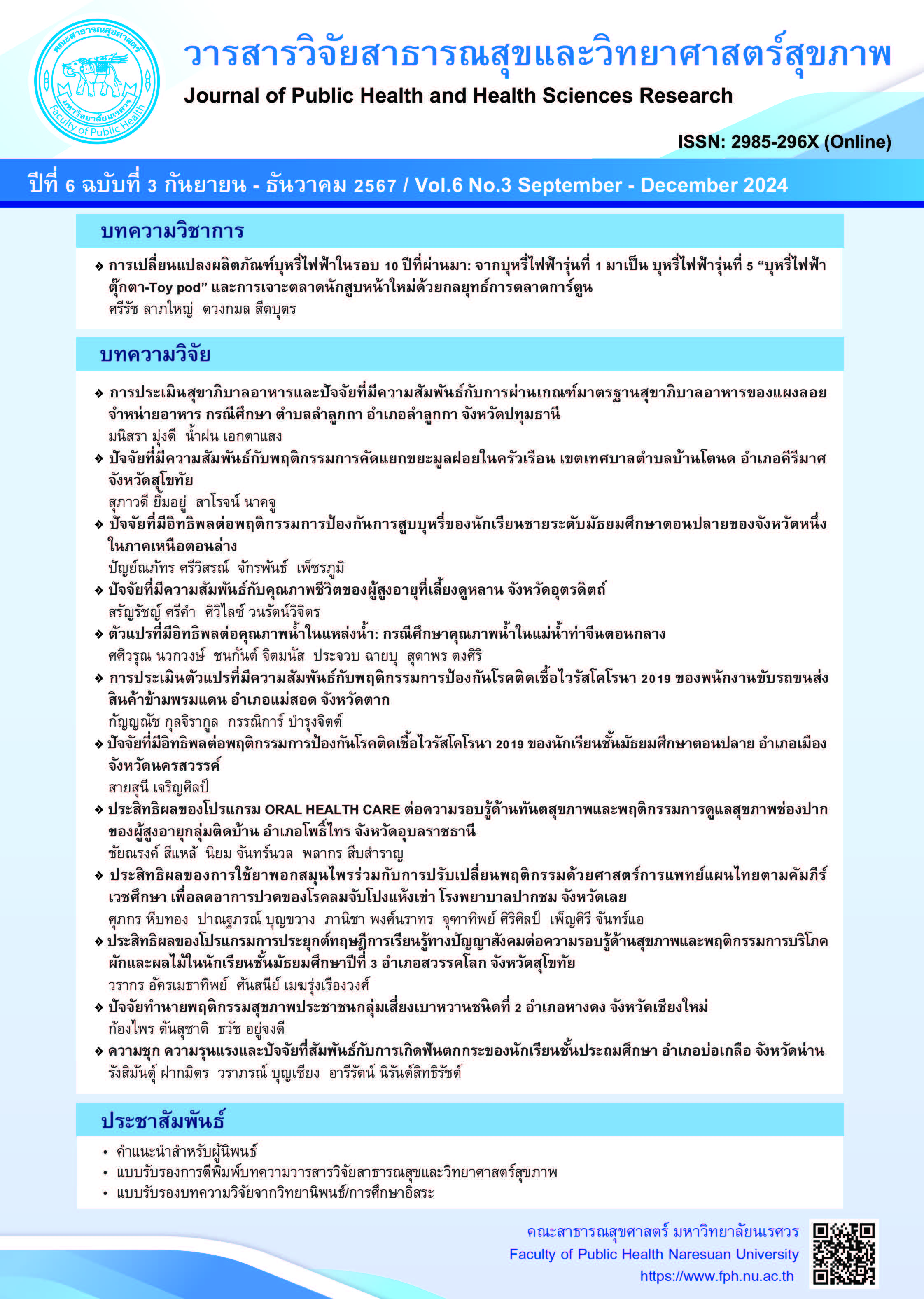
ประสิทธิผลของโปรแกรมการประยุกต์ทฤษฎีการเรียนรู้ทางปัญญาสังคม ต่อความรอบรู้ด้านสุขภาพและพฤติกรรมการบริโภคผักและผลไม้ ในนักเรียนชั้นมัธยมศึกษาปีที่ 3 อำเภอสวรรคโลก จังหวัดสุโขทัย
คำสำคัญ:
การรับรู้ความสามารถตนเอง, ความรอบรู้ด้านสุขภาพในการบริโภคผักและผลไม้, ทฤษฎีการเรียนรู้ทาง ปัญญาสังคม, พฤติกรรมการบริโภคผักและผลไม้บทคัดย่อ
การวิจัยครั้งนี้ เป็นการวิจัยกึ่งทดลองแบบวัดสองกลุ่ม เพื่อศึกษาประสิทธิผลของโปรแกรมการประยุกต์ทฤษฎีการเรียนรู้ทางปัญญาสังคมในการส่งเสริมความรอบรู้ด้านสุขภาพและพฤติกรรมการบริโภคผักและผลไม้กลุ่มตัวอย่าง ได้แก่ นักเรียนชั้นมัธยมศึกษาปที ี่ 3 จำนวน 70 คน แบง่ เปน็ กลุม่ ทดลองและกลุม่ ควบคุม กลุม่ ละ 35 คน โดยกลุ่มทดลองจะได้รับโปรแกรมฯ จำนวน 7 ครั้ง เป็นระยะเวลา 12 สัปดาห์ ส่วนกลุ่มควบคุมได้รับการเรียนการสอนปกติ เครื่องมือที่ใช้ในการวิจัย คือ โปรแกรมการประยุกต์การเรียนรู้ทางปัญญาสังคมฯ แบบสอบถามการรับรู้ความสามารถตนเอง แบบสอบถามความรอบรู้ด้านสุขภาพในการบริโภคผักและผลไม้ และแบบสอบถามพฤติกรรมการบริโภคผักและผลไม้ ผ่านการตรวจสอบคุณภาพของเครื่องมือ ได้ค่าสัมประสิทธิ์แอลฟาของครอนบาค เท่ากับ 0.86 0.95 และ 0.88 ตามลำดับ วิเคราะห์ข้อมูลด้วย ร้อยละ ค่าเฉลี่ย ส่วนเบี่ยงเบนมาตรฐานIndependent sample t-test และ Paired sample t-test โดยกำหนดระดับนัยสำคัญทางสถิติ 0.05
ผลการวิจัย พบว่า ภายหลังการทดลอง กลุ่มทดลองมีค่าคะแนนเฉลี่ยการรับรู้ความสามารถตนเอง ความรอบรู้ด้านสุขภาพในการบริโภคผักและผลไม้ และพฤติกรรมการบริโภคผักและผลไม้ สูงกว่าก่อนการทดลอง และกลุ่มทดลองมีคะแนนหลังการทดลองสูงกว่ากลุ่มควบคุม อย่างมีนัยสำคัญทางสถิติ (p-value < 0.05) ดังนั้น หน่วยงานที่เกี่ยวข้องควรจัดกิจกรรมส่งเสริมโดยใช้ทฤษฎีการเรียนรู้ทางปัญญาสังคม เพื่อให้นักเรียนสามารถรับรู้ความสามารถตนเอง พัฒนาทักษะความรอบรู้ด้านสุขภาพเกี่ยวกับการบริโภคผักและผลไม้ และปรับเปลี่ยนพฤติกรรมการบริโภคผักและผลไม้ให้ดีขึ้นในนักเรียนกลุ่มอื่น ๆ ต่อไป
เอกสารอ้างอิง
Aekplakorn, W. (2021). Report on the Thai people's health survey by physical examination, No. 6, B.E. 2019-2020. (1st ed.). Bangkok: Graphic Font and Design Publishing House. (in Thai)
Bandura, A. (1986). Social foundations of thought and action: A social cognitive theory. New Jersey: Prentice-Hall.
Best, J. W. (1997). Research in education. (3rd ed.) Englewood Cliffs, New Jersey: Prentice Hall.
Food and Drug Administration. (2018). Healthier Choice. Retrieved April 19, 2024, from https://oryor.com/media/infoGraphic/media_printing/1534?ref=search. (in Thai)
Health Center 5 Ratchaburi Province. (2019). Model for solving obesity problems in school children aged 6-15 years, using the participation process of network partners. Retrieved January 15, 2024, from https://hpc.go.th/km/training/selfstudy/child.pdf (in Thai)
Health Data Center. (2023). The percentage of children aged 6-14 years is proportionately tall. Retrieved January 15, 2024, from https://hdcservice.moph.go.th/hdc/reports/report.php?source=pformated/format1.php&cat_id=46522b5bd1e06d24a5bd81917257a93c&id=e28682b2718e6cc82b8dbb3e00f2e28e. (in Thai)
Kaeodumkoeng, K. (2018). Health literacy: access, understand and application. (2nd ed.). Bangkok: Amarin Publishing House. (in Thai)
Natsit, P., Junprasert, S., & Krungkraipetch, N. (2019). Factors influencing fruit and vegetable consumption among Grade 6 primary school students in Bangkok Metropolitan. Journal of Health and Nursing Research, 35(2),1-13. (in Thai)
Nudla, P., Jittanoon, P., & Balthip, K. (2017). Impact of an internet-mediated over-consumption self-reminding programme on the body weight and consumption behaviour of overnutrition adolescents. Thai Journal of Nursing Council, 32(1), 32-46. (in Thai)
Numpoon, J. (2015). School age child with obesity: the role of community nurse practitioner for health promotion. Thai Red Cross Nursing Journal, 8(2), 1-12. (in Thai)
Nongrak, J. (2021). Health behavior and health knowledge of school-age children, Health Area 5 In the model sub-district integrated health promotion for 5 age groups and environmental health. Retrieved January 15, 2024, from https://hpc.go.th/rcenter/_fulltext/20210716183439_4557/20210716184438_4325.pdf (in Thai)
Phongsakchat, P., Areesophonpichet, S., & Navicharern, R. (2019). The effect of health literacy development program and 3E health behaviors based on local wisdom among nursing students in Praboromarajchanok Institute for health workforce development, Ministry of Public Health. Journal of Health and Nursing Research, 35(2), 199-209. (in Thai)
Puttapunyo, S., Toontom, N., & Putthanachote, N. (2016). Effectiveness of a health behavior development program on health literacy, weight loss behavior and weight of overweight personnel in Roi Et Hospital, Mueang District, Roi Et Province, Thailand. Journal of Nursing and Education, 9(4), 42-59. (in Thai)
Schlesselman, J. J. (1982). Case-control studies design, conduct analysis. New York: Oxford University.
Supasri, S., Wungrath, J., & Boonchieng, W. (2021). Effects of a health promotion program on perceived self-efficacy and outcome expectations on self-care among elderly with hypertension, Chiang Rai Province, Thailand. Thai Journal of Public Health, 5(1), 33-42. (in Thai)
Thai Health Foundation. (2023). Worried about Thai children being the 3rd most obese in ASEAN. Retrieved January 15, 2024, from https://www.thaihealth.or.th/?p=329971. (in Thai)
World Health Organization. (2023). Increasing fruit and vegetable consumption to reduce the risk of noncommunicable diseases. Retrieved January 15, 2024, from https://www.who.int/tools/elena/interventions/fruitvegetables-ncds
ดาวน์โหลด
เผยแพร่แล้ว
รูปแบบการอ้างอิง
ฉบับ
ประเภทบทความ
สัญญาอนุญาต
ลิขสิทธิ์ (c) 2024 วารสารวิจัยสาธารณสุขและวิทยาศาสตร์สุขภาพ

อนุญาตภายใต้เงื่อนไข Creative Commons Attribution-NonCommercial-NoDerivatives 4.0 International License.
บทความที่ได้รับการตีพิมพ์เป็นลิขสิทธิ์ของวารสารวิจัยสาธารณสุขและวิทยาศาสตร์สุขภาพ
ข้อความที่ปรากฏในบทความแต่ละเรื่องบทความในวารสารวิชาการและวิจัยเล่มนี้เป็นความคิดเห็นส่วนตัวของผู้เขียนแต่ละท่านไม่เกี่ยวข้องกับมหาวิทยาลัยนเรศวร และคณาจารย์ท่านอื่นๆในมหาวิทยาลัยฯ ความรับผิดชอบเกี่ยวกับบทความแต่ละเรื่องผู้เขียนจะรับผิดชอบของตนเองแต่ละท่าน