
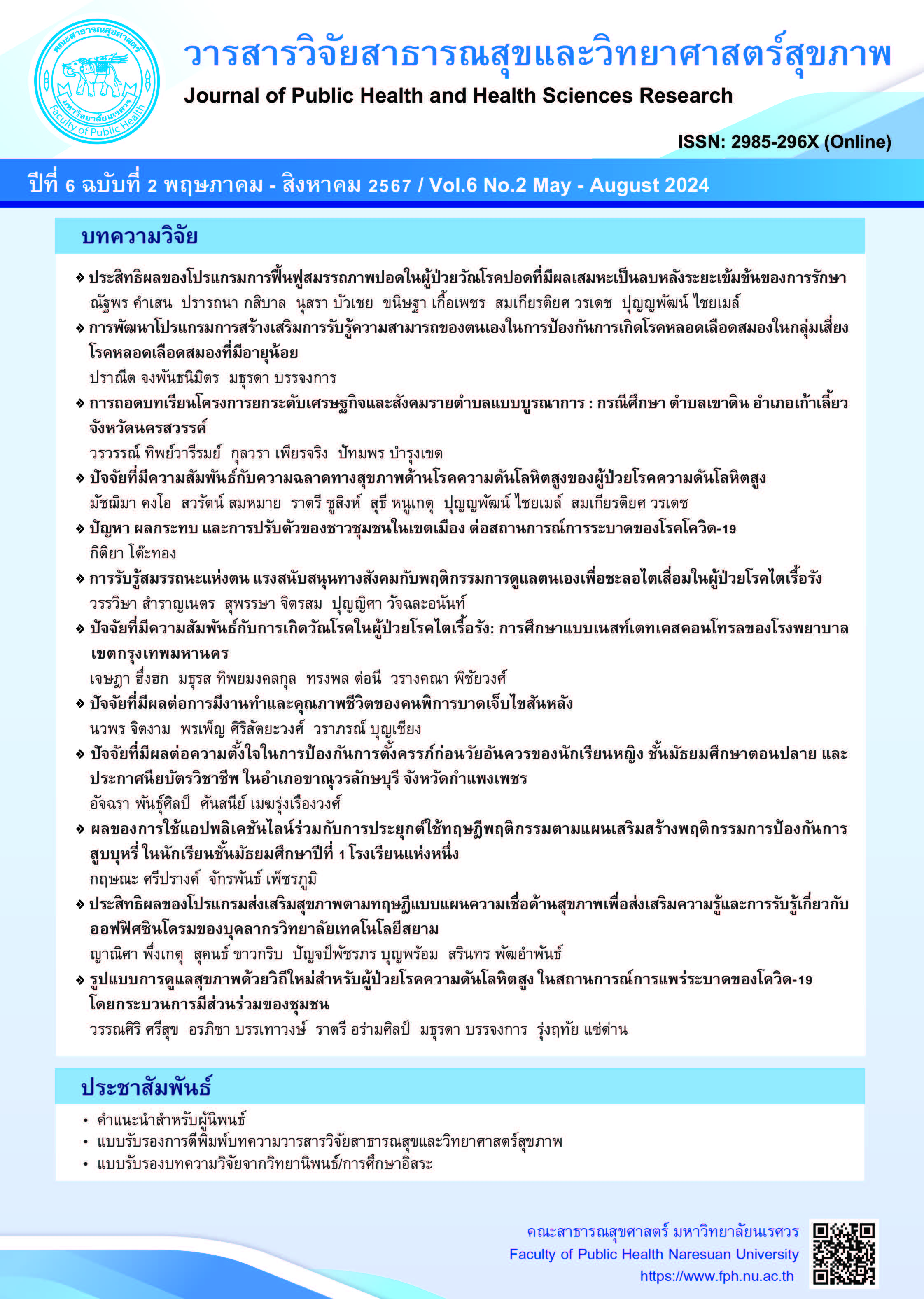
Factors influencing employment and quality of life in individuals with spinal cord injury
Keywords:
Spinal cord injury, Return to work, Quality of lifeAbstract
This mixed-methods research aimed at studying employment rates and factors affecting employment among individuals with spinal cord injuries, as well as comparing the quality of life between employed and
unemployed individuals with spinal cord injuries. The study was conducted on 71 individuals who received services at the Department of Rehabilitation Medicine, Faculty of Medicine, Chiang Mai University from January 2021 to March 2022. Data were collected using personal questionnaires, work status information, the Spinal Cord Independence Measure Version III (SCIM III), and the Quality of Life Basic Data Set (QoL-BDS) questionnaire. The data were analyzed using descriptive statistics, including the Chi-square test, Mann-Whitney U test, Fisher's exact test, as well as inferential statistics such as logistic regression analysis.
The result found that the majority of participants were male (73.2%), with an average age of 41.70 ± 10.76 years. Of these, 67.6% were employed, with the majority working asmerchant and business owners (33.3%), followed by government employees (25.0%). The study identified that factors influencing employment included the ability to drive, which increased the chance of employment by 8.17 times (p-value = 0.002; 95% CI = 2.19-30.42), and receiving financial support, which reduced the chance of employment by 0.19 times (p-value = 0.007; 95% CI = 0.06-0.63). Furthermore, the study found a statistically significant difference in quality of life between employed and unemployed individuals, with the median scores of the employed group being higher than the unemployed group, indicating that the employed group had a higher level of life satisfaction.
References
Chaisena, C. & Kharmwan, S. (2022). The prevalence of social-media related working in patients with spinal cord injury. Medical Journal, 37(3), 234-243.
Choochart, N., Vichiansiri, R., Arayawichanon, P., & Manimmanakorn, N. (2015). Quality of life of traumatic spinal cord injured patients in North-East region of Thailand. Journal of Thai Rehabilitation Medicine, 25(1), 15-21. (in Thai)
Empowerment of Persons with Disabilities Act, B.E. 2550. (2007a). Retrieved January 17, 2023, from http://web1.dep.go.th/sites/default/files/files/news/2.pdf (in Thai)
Empowerment of persons with disabilities act, B.E. 2550. No.2 (2013b). Retrieved January 17, 2023, from http://web1.dep.go.th/sites/default/files/files/law/191.pdf (in Thai)
Huang I, C. (2017). Employment outcomes following spinal cord injury in Taiwan. International Journal of Rehabilitation Research, 40(1), 84-90.
Kang, E. N., Shin, H. I., & Kim, H. R. (2014). Factors that influence employment after spinal cord injury in South Korea. Annalsof Rehabilitation Medicine, 38(1), 38-45.
Kovindha, A. (2017). People with spinal cord injury in Thailand. American Journal of Physical Medicine & Rehabilitation, 96(2 suppl), S120-S123.
Nongthong, T. & Kachondham, P. (2017). Quality of life severe disabled severe physical disabled. Journal of Social Development and Management Strategy, 19(2), 113-131. (in Thai)
Panharaj, S., Manimnakorn, N., & Kharmwan, S. (2006). Factors correlated return to work ability of spinal cord injured patients after rehabilitation in Srinagarind Hospital during 1997-2001. ASEAN Journal of Rehabilitation Medicine, 16(1), 44-51. (in Thai)
Pattanakuhar, S., Suttinoon, L., Wongpakaran, T., & Tongprasert, S. (2020). The reliability and validity of the International Spinal Cord Injury Quality of Life Basic Data set in people with spinal cord injuries from a middle-income country: A psychometric study of the Thai version. Spinal Cord, 58(9), 1015-1021.
Ramakrishnan, K., Chung, T. Y., Hasnan, N., & Abdullah, S. J. (2011). Return to work after spinal cord injury in Malaysia. Spinal Cord, 49(7), 812-816.
Sirindhorn National Medical Rehabilitation Institute (SNMRC). (2013). Practical guidelines for the rehabilitation of spinal cord injured people with disabilities. (1st ed.). Nonthaburi: Sahamitr Printing and Publishing Company Limited. (in Thai)
Rovinelli, R. J., & Hambleton, R. K. (1977). On the use of content specialists in the assessment of criterion-referenced test item validity. Dutch Journal of Educational Research, 1(2), 49-60.
Sturm, C., Bokel A., Korallus, C., Geng, V., Kalke, Y., Abel, et al., (2020) Promoting factors and barriers to participation in working life for people with spinal cord injury. Journal of Occupational Medicine and Taxicology, 15(1), 1-12.
Vongpakorn P. & Kovindha. A. (2014). Employment rate of Thais with spinal cord injury and predictive factors. Journal of Thai Rehabilitation Medicine, 24(1), 28-36. (in Thai)
Wannapakhe, J., Saensook, W., Keawjoho, C., & Amatachaya, S. (2016). Reliability and discriminative ability of the spinal cord independence measure III (Thai version). Spinal Cord, 54(3), 213-220.
Wayne, W. D. (1995). Biostatistics: A foundation of analysis in the health sciences (6th ed.). New York: John Wiley & Sons, Inc.
Downloads
Published
How to Cite
Issue
Section
License
Copyright (c) 2024 Journal of Public Health and Health Sciences Research

This work is licensed under a Creative Commons Attribution-NonCommercial-NoDerivatives 4.0 International License.
The published article is copyrighted by the Journal of Public Health and Health Sciences Research.
The statements that appear in each article in this academic and research journal are the personal opinions of each author and are not related to Naresuan University and other faculty members in the university. Responsibilities regarding each article are the responsibility of each author.


