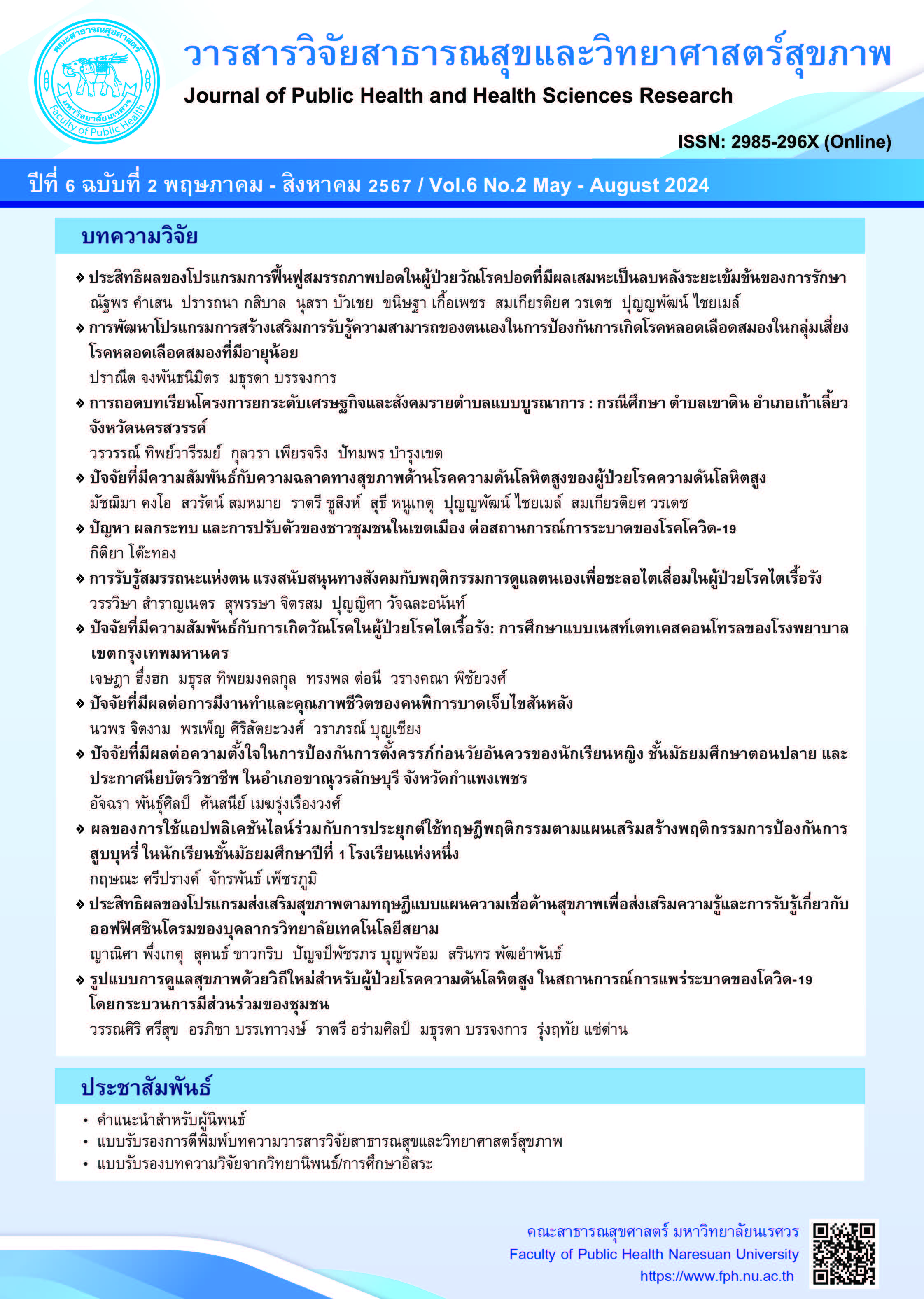
ปัจจัยที่มีความสัมพันธ์กับการเกิดวัณโรคในผู้ป่วยโรคไตเรื้อรัง: การศึกษาแบบเนสท์เตทเคสคอนโทรลของโรงพยาบาลเขตกรุงเทพมหานคร
คำสำคัญ:
การฟอกไต, โรคไตเรื้อรัง, วัณโรคบทคัดย่อ
การศึกษานี้ มีวัตถุประสงค์เพื่อศึกษาปัจจัยที่มีความสัมพันธ์กับการเกิดวัณโรคในผู้ป่วยโรคไตเรื้อรังรูปแบบการศึกษา Matched nested case-control เก็บข้อมูลจากโรงพยาบาลสังกัดสำนักการแพทย์กรุงเทพมหานคร จำนวน 8 แห่ง จากทะเบียนผู้ป่วยโรคไตเรื้อรังอายุ 18 ปีขึ้นไป และไม่ได้เป็นวัณโรค โดยกลุ่มโรคที่เป็นกลุ่มศึกษา จำนวน 171 คน คือ ผู้ป่วยโรคไตเรื้อรังที่ได้รับการวินิจฉัยเป็นวัณโรคหลังจากขึ้นทะเบียนรักษา ไตเรื้อรัง และ กลุ่มควบคุมคัดเลือกจาก Risk-set ของผู้ป่วยโรคไตเรื้อรังที่ขึ้นทะเบียนรักษาในปีเดียวกับกลุ่มศึกษาและมารับการตรวจรักษาในวันที่กลุ่มศึกษาได้รับการวินิจฉัย จับคู่ระหว่างคนที่เป็นโรคและกลุ่มควบคุมด้วยอายุและเพศ อัตราส่วน 1 ต่อ 1 เคส และคอนโทรล จำนวน 171 คู่ การวิเคราะห์สถิติเชิงพรรณนาด้วยความถี่ ร้อยละ Chi-square และวิเคราะห์ความสัมพันธ์ปัจจัยด้วย Conditional logistic regression นำเสนอด้วยค่า Adjusted Odds Ratio (ORadj) และช่วงความเชื่อมั่นที่ร้อยละ 95.0
ผลการศึกษา พบว่า ปัจจัยที่มีความสัมพันธ์กับการเกิดวัณโรคในผู้ป่วยโรคไตเรื้อรัง ได้แก่ ความรุนแรง ของโรคไตเรื้อรังระยะที่ 3-5 (ORadj = 8.40, 95% CI = 3.32-21.23) ระยะเวลาการป่วยโรคไตเรื้อรังจนถึงการวินิจฉัยวัณโรค 2-24 เดือน (ORadj = 7.99, 95% CI = 3.85-16.61) และการฟอกไต (ORadj = 5.08, 95% CI = 1.42-18.21) ดังนั้น ผู้ป่วยโรคไตเรื้อรังควรได้รับการตรวจคัดกรองวัณโรคอย่างสม่ำเสมอ โดยเฉพาะผู้ป่วยฟอกไตและผู้ป่วยโรคไตเรื้อรังที่ขึ้นทะเบียนรักษาในระยะ 1 ปี 6 เดือน เพื่อป้องกันการระบาดของวัณโรคในคลินิกโรคไตเรื้อรัง
เอกสารอ้างอิง
Al-Efraij, K., Mota, L., Lunny, C., Schachter, M., Cook, V., & Johnston, J. (2015). Risk of active tuberculosis in chronic kidney disease: Asystematic review and meta-analysis. International Journal of Tuberculos is Lung Disease,19(12), 1493-1499. doi:10.5588/ijtld.15.0081
Ali, M., Dosani, D., Corbett, R., Johansson, L., Charif, R., Kon, O. M., et al. (2022). Diagnosis of tuberculosis in dialysis and kidney transplant patients. Hemodialysis International, 26(3), 361-368. doi:10.1111/hdi.13010
Bandiara, R., Indrasari, A., Dewi Rengganis, A., Sukesi, L., Afiatin, A., & Santoso, P. (2022). Risk factors of latent tuberculosis among chronic kidney disease with routine haemodialysis patients. Journal of Clinical Tuberculosis and Other Mycobacterial Diseases, 27, 100302. doi:https://doi.org/10.1016/j.jctube.2022.100302
Bikbov, B., Purcell, C., Levey, A., Smith, M., Abdoli, A., Abebe, M., et al. (2020). Global, regional, and national burden of chronic kidney disease, 1990-2017: A systematic analysis for the Global Burden of Disease Study 2017. The Lancet, 395, 709-733. doi:10.1016/S0140-6736(20)30045-3
Castro, K. G. (1995). Tuberculosis as an opportunistic disease in persons infected with human immunodeficiency virus. Clinical Infectious Disease, 21 (Supplement_1), S66-S71. doi:10.1093/clinids/21.Supplement_1.S66
Cheng, K. C., Liao, K. F., Lin, C. L., Liu, C. S., & Lai, S. W. (2018). Chronic kidney disease correlates with increased risk of pulmonary tuberculosis before initiating renal replacement therapy: A cohort study in Taiwan. Medicine, 97(39), e12550-e12550. doi:10.1097/MD. 0000000000012550
Cheng, P., Wang, L., & Gong, W. (2022). Cellular immunity of patients with tuberculosis combined with diabetes. Journal of Immunology Research, 2022, 6837745. doi:10.1155/2022/6837745
Fleiss, J., Levin, B., & Paik, M. C. (2013). Statistical methods for rates and proportions (3rd ed.). Wiley. Retrieved from https://www.perlego.com/book/1010158/statistical-methodsfor-rates-and-proportions-pdf (Original work published 2013)
Igari, H., Imasawa, T., Noguchi, N., Nagayoshi, M., Mizuno, S., Ishikawa, S., et al. (2015). Advanced stage of chronic kidney disease is risk of poor treatment outcome for smear-positive pulmonary tuberculosis. Journal of Infectious and Chemotherapy, 21(8), 559-563.doi:10.1016/j.jiac.2015.04. 008
Kanjanabuch, T., & Takkavatakarn, K. (2020). Global dialysis perspective: Thailand. Kidney 360, 1(7), 671. doi:10.34067/KID.0000762020
Lamarche, C., Iliuta, I. A., & Kitzler, T. (2019). Infectious disease risk in dialysis patients: A transdisciplinary approach. Canadian Journal of Kidney Health and Disease, 6, 2054358119839080. doi:10.1177/2054358 119839080
Lv, J. C., & Zhang, L. X. (2019). Prevalence and disease burden of chronic kidney disease. Advances in experimental medicine and biology, 1165, 3-15. doi:10.1007/978-981-13-8871-2_1
Min, J., Kwon, S. K., Jeong, H. W., Han, J. H., Kim, Y. J., Kang, M., et al. (2018). End-stage renal disease and risk of active tuberculosis: Anationwide population-based cohort study. Journal of Korean medical science, 33(53), e341. doi:10.3346/jkms.2018.33.e341
Ministry of Public Health (2018). National tuberculosis control programme guidelines, Thailand, 2018. Nonthaburi.
Moran, E., Baharani, J., Dedicoat, M., Robinson, E., Smith, G., Bhomra, P., et al. (2018). Risk factors associated with the development of active tuberculosis among patients with advanced chronic kidney disease. The Journal of infection, 77(4), 291-295. doi:10. 1016/j.jinf.2018.06.003
Ndamase, S., Okpechi, I., Carrara, H., Black, J., Calligaro, G., & Freercks, R. (2020). Tuberculosis burden in stage 5 chronic kidney disease patients undergoing dialysis therapy at Livingstone Hospital, Port Elizabeth, South Africa. South Africa. South African medical journal,110(5), 422-426. doi:10.7196/SAMJ.2020.v110i5.14035
Ostermann, M., Palchaudhuri, P., Riding, A., Begum, P., & Milburn, H. J. (2016). Incidence of tuberculosis is high in chronic kidney disease patients in South East England and drug resistance common. Renal Failure, 38(2), 256-261. doi:10.3109/0886022x.2015. 1128290
Pahl, M. V., & Vaziri, N. D. (2015). Chapter 24-immune function in chronic kidney disease. In P. L. Kimmel & M. E. Rosenberg (Eds.), Chronic Kidney Disease (pp. 285-297). San Diego: Academic Press.
Park, S., Lee, S., Kim, Y., Lee, Y., Kang, M. W., Cho, S., et al. (2019). Association of CKD with incident tuberculosis. Clinical journal of the American Society of Nephrology: Clinical journal of the American Society of Nephrology, 14(7), 1002-1010. doi:10.2215/cjn.14471218
Romanowski, K., Clark, E. G., Levin, A., Cook, V. J., & Johnston, J. C. (2016). Tuberculosis and chronic kidney disease: An emerging global syndemic. Kidney International, 90(1), 34-40. doi:https://doi.org/10.1016/j.kint.2016.01.034
Ruangkanchanasetr, P., Natejumnong, C., Kitpanich, S., Chaiprasert, A., Luesutthiviboon, L., & Supaporn, T. (2008). Prevalence and manifestations of tuberculosis in renal transplant recipients: A single-center experience in Thailand. Transplantation proceedings, 40(7), 2380- 2381.doi:10.1016/j.transproceed.2008. 06.020
Ruzangi, J., Iwagami, M., Smeeth, L., Mangtani, P., & Nitsch, D. (2020). The association between chronic kidney disease and tuberculosis; A comparative cohort study in England. BMC Nephrology, 21(1), 420. doi:10.1186/s12882-020-02065-4
Semilan, H. M., Abugad, H. A., Mashat, H. M., & Abdel Wahab, M. M. (2021). Epidemiology of tuberculosis among different occupational groups in Makkah region, Saudi Arabia. Scientific Reports,11(1), 12764. doi:10.1038/s41598-021-91879-9
Shu, C. C., Hsu, C. L., Lee, C. Y., Wang, J. Y., Wu, V. C., Yang, F. J., et al. (2015). Comparison of the prevalence of latent tuberculosis infection among non-dialysis patients with severe chronic kidney disease, patients receiving dialysis, and the dialysis-unit staff: A cross-sectional study. PLoS One, 10(4), e0124104. doi:10.1371/journal.pone. 0124104
Tornee, S., Kaewkungwal, J., Fungladda, W., Silachamroon, U., Akarasewi, P., & Sunakorn, P. (2004). Risk factors for tuberculosis infection among household contacts in Bangkok, Thailand. Southeast Asian Journal of Tropical Medicine and Public Health, 35(2), 375-383.
Vikrant, S. (2019). Tuberculosis in dialysis: Clinical spectrum and outcome from an endemic region. Hemodialysis International, 23(1), 88-92. doi:10.1111/hdi.12693
Yan, M., Puyat, J. H., Shulha, H. P., Clark, E. G., Levin, A., & Johnston, J. C. (2022). Risk of tuberculosis associated with chronic kidney disease: A population-based analysis. Nephrology Dialysis Transplantation, 37(1), 197-198. doi:10.1093/ndt/gfab222
ดาวน์โหลด
เผยแพร่แล้ว
รูปแบบการอ้างอิง
ฉบับ
ประเภทบทความ
สัญญาอนุญาต
ลิขสิทธิ์ (c) 2024 วารสารวิจัยสาธารณสุขและวิทยาศาสตร์สุขภาพ

อนุญาตภายใต้เงื่อนไข Creative Commons Attribution-NonCommercial-NoDerivatives 4.0 International License.
บทความที่ได้รับการตีพิมพ์เป็นลิขสิทธิ์ของวารสารวิจัยสาธารณสุขและวิทยาศาสตร์สุขภาพ
ข้อความที่ปรากฏในบทความแต่ละเรื่องบทความในวารสารวิชาการและวิจัยเล่มนี้เป็นความคิดเห็นส่วนตัวของผู้เขียนแต่ละท่านไม่เกี่ยวข้องกับมหาวิทยาลัยนเรศวร และคณาจารย์ท่านอื่นๆในมหาวิทยาลัยฯ ความรับผิดชอบเกี่ยวกับบทความแต่ละเรื่องผู้เขียนจะรับผิดชอบของตนเองแต่ละท่าน