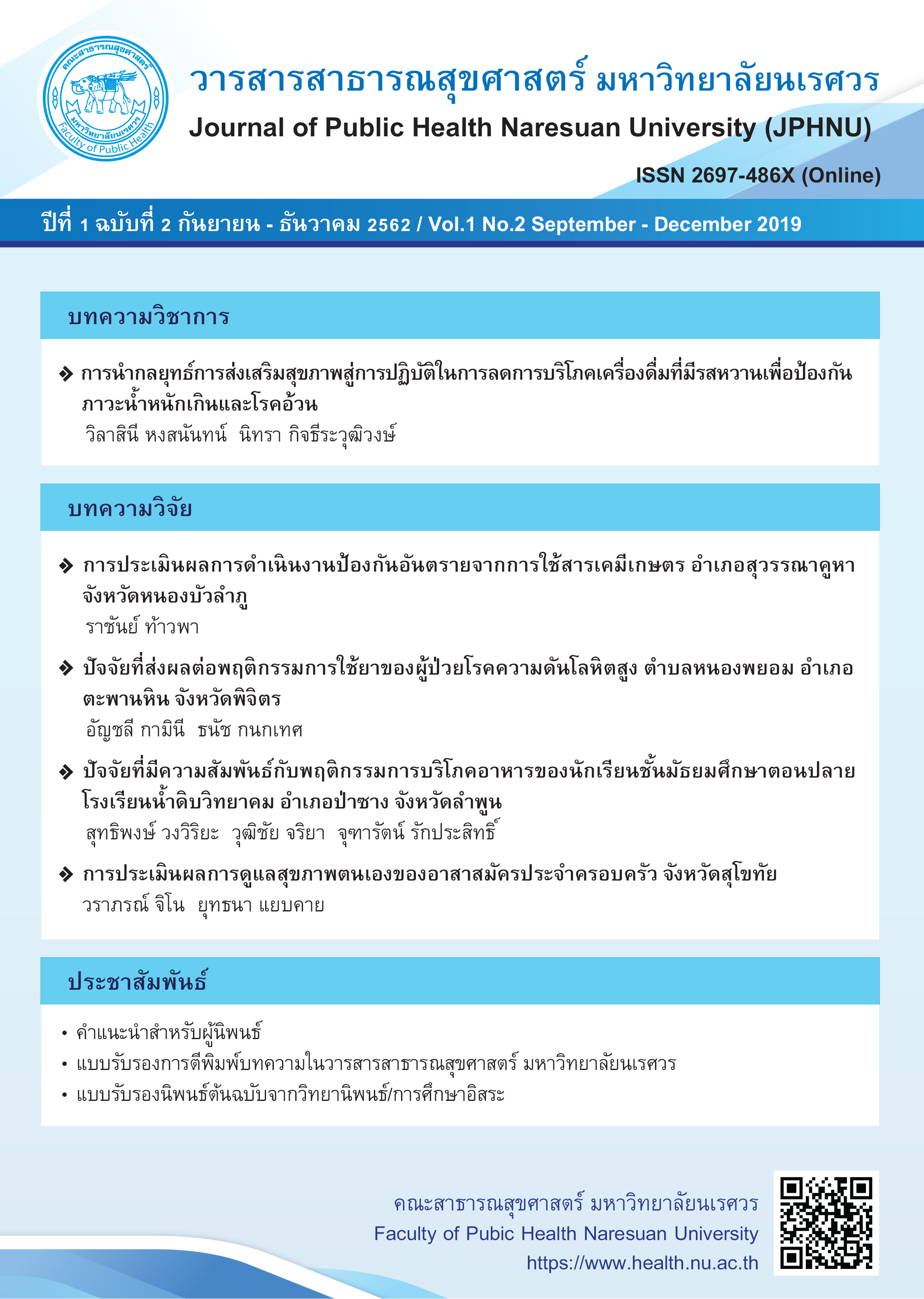
ปัจจัยที่ส่งผลต่อพฤติกรรมการใช้ยาของผู้ป่วยโรคความดันโลหิตสูง ตำบลหนองพยอม อำเภอตะพานหิน จังหวัดพิจิตร
คำสำคัญ:
ผู้ป่วย, พฤติกรรมการใช้ยา, โรคความดันโลหิตสูงบทคัดย่อ
การวิจัยเชิงพรรณนาครั้งนี้ มีวัตถุประสงค์เพื่อศึกษาปัจจัยที่ส่งผลต่อพฤติกรรมการใช้ยารักษาโรคความดันโลหิตสูงของผู้ป่วย ตำบลหนองพยอม อำเภอตะพานหิน จังหวัดพิจิตร กลุ่มตัวอย่างที่ใช้ในการวิจัยครั้งนี้ คือ กลุ่มผู้ป่วยโรคความดันโลหิตสูงที่รับบริการในคลินิกโรคเรื้อรังโรงพยาบาลส่งเสริมสุขภาพตำบลหนองพยอม อำเภอตะพานหิน จังหวัดพิจิตร จำนวน 131 คน จัดเก็บทั้งหมดที่ขึ้นทะเบียนรับบริการ เครื่องมือที่ใช้ในการเก็บรวบรวมข้อมูลเป็นแบบสอบถาม วิเคราะห์ข้อมูลด้วยสถิติเชิงพรรณนา และสถิติวิเคราะห์ถดถอยพหุคูณแบบขั้นตอน
ผลการวิจัยพบว่า ผู้ป่วยโรคความดันโลหิตสูงส่วนใหญ่มีพฤติกรรมการใช้ยารักษาโรคอยู่ในระดับปานกลาง และตัวแปรที่มีความสัมพันธ์กับพฤติกรรมการใช้ยารักษาโรคความดันโลหิตสูง ได้แก่ การเข้าถึงบริการคลินิกโรคเรื้อรัง (Beta=0.192) การสนับสนุนจากบุคคลในครอบครัว (Beta=0.531) และทัศนคติต่อการรักษา(Beta=0.185) สามารถอธิบายการเปลี่ยนแปลงของตัวแปรตามได้ ร้อยละ 53.40 ได้อย่างมีนัยสำคัญทางสถิติ (p-value < 0.05) ผลที่ได้ควรพัฒนาแผนงานโครงการสร้างเสริมสุขภาพในระดับปฐมภูมิโดยมุ่งเน้นการเสริมสร้างทัศนคติที่ดีถูกต้องเกี่ยวกับการใช้ยาในการรักษาโรคความดันโลหิตสูง การพัฒนาระบบบริการของหน่วยบริการสาธารณสุขปฐมภูมิให้มีศักยภาพในการดูแลผู้ป่วยโรคความดันโลหิตสูงได้อย่างมีคุณภาพ รวมถึงการเสริมสร้างความสามารถให้กับครอบครัว เพื่อน และอาสาสมัครสาธารณสุขในการมีส่วนร่วมสนับสนุนให้ผู้ป่วยโรคความดันโลหิตสูงมีการใช้ยาที่ถูกต้องเหมาะสม และควรพัฒนางานวิจัยที่มุ่งการปรับเปลี่ยนพฤติกรรมการใช้ยารักษาโรคความดันโลหิตสูง
เอกสารอ้างอิง
Bloom, B. S. (1956). Taxonomy of Educational Objectives, Handbook: The Cognitive Domain. New York: David McKay.
Bureau of Non-Communicable Disease, Ministry of Public Health. (2018). Situation on NCDs Prevention and Control in Thailand. Nonthaburi: Bureau of Non-Communicable Disease. (in Thai).
Chaipermsak, P. (2002). The role of family support in the control of hypertension. Master of Public Health, Graduate School,Mahidol University, Nakhon Pathom. (in Thai).
Doulougou, B., Gomez, F., Alvarado, B., Guerra, R. O., Ylli, A., Guralnik et al. (2016). Factors associated with hypertension prevalence,awareness, treatment and control among participants in the International Mobility in Aging Study (IMIAS). Journal of human hypertension, 30(2), 112-119.
Fagard, R. H. (2002). Epidemiology of hypertension in the elderly. The American journal of geriatric cardiology, 11(1), 23-28.
Gielen, A. C., McDonald, E. M., Gary, T. L., & Bone, L. (2008). Using the PRECEDE/PROCEED model to apply health behavior theories. In K. Glanz, B. K. Rimer, & F. M. Lewis (Eds.), Health behavior and health education (4th ed., pp. 407-434). San Francisco, CA: Jossey-Bass.
Glanz, K., Rimer, B. K., & Viswanath, K. (Eds.). (2015). Health behavior: Theory, research, and practice.San Francisco, CA: John Wiley & Sons.
Green, L. W., & Kreuter, M. W. (1999). Health Promotion Planning: An Educational and Ecological Approach. Mountain View, CA: Mayfield Publishing.
Green, L. W., & Kreuter, M. W. (2005). Health Program Planning: An Educational and Ecological Approach. New York: McGraw-Hill.
Khorsandi, M., Fekrizadeh, Z., & Roozbahani, N.(2017). Investigation of the effect of education based on the health belief model on the adoption of hypertension-controlling behaviors in the elderly. Clinical interventions in aging, 12, 233-240.
Limchareon, S., Masingboon, K., & Kunsonkeit, W.(2007). Factors related to adherence to treatment among essential hypertensive patients. The Journal of Faculty of Nursing Burapha University, 15(1), 63-79. (in Thai).
Lippke, S., & Ziegelmann, J. P. (2008). Theory based health behavior change: Developing, testing, and applying theories for evidence based interventions. Applied Psychology, 57(4), 698-716.
Maddux, J. E., & Rogers, R. W.(1983). Protection motivation and self-efficacy: A revised theory of fear appeals and attitude change. Journal of experimental social psychology, 19(5), 469-479.
Meekusol, S. (2018). A casual model of adherence to hypertensive treatment among women with hypertension in Bangkok. Master of Public Health, Graduate School, Mahidol University, Nakhon Pathom. (in Thai).
Qaseem, A., Wilt, T. J., Rich, R., Humphrey, L. L., Frost, J., & Forciea, M. A. (2017). Pharmacologic treatment of hypertension in adults aged 60 years or older to higher versus lower blood pressure targets: a clinical practice guideline from the American College of Physicians and the American Academy of Family Physicians. Annals of internal medicine, 166(6), 430-437.
Sallis, J. F., Owen, N., & Fisher, E. (2015). Ecological models of health behavior. Health behavior: Theory, research, and practice, 5, 43-64.
Sharma, M. (2015). Multi-theory model (MTM) for health behavior change.WebmedCentral BEHAVIOUR, 6(9): WMC004982. Retrieved June 10, 2019, from webmedcentral.com/article_view/4982
Sowapak, P. (2006). Factors related to drug adherence among elders with hypertension. Master of Public Health, Graduate School, Prince of Songkla University, Songkla. (in Thai).
Taengsakha, K., Maneesriwongul, W. & Putawatana, P. (2019). Factors Related to Adherence to Treatment in Essential Hypertensive Patients with Early Renal Insufficiency. Rama Nurse Journal, 25(1), 87-101. (in Thai).
Tepsuriyanont, S. (2017). Medication adherence behavior among hypertensive adult patients. Journal of The Royal Thai Army Nurses, 18(3), 115-122. (in Thai).
Tepsuriyanont, S., Jirapaet, V., Luangamornlert, S., & Praditsuwan, R. (2011). Relationship between regimen complexity and medication adherence behavior in Thai elderly with hypertension. Chulalongkorn Medical Journal, 55(5), 457-472. (in Thai).
Vaughan, C. P., Endeshaw, Y., Nagamia, Z., Ouslander, J. G., & Johnson, T. M. (2009). A multicomponent behavioural and drug intervention for nocturia in elderly men:rationale and pilot results. BJU international, 104(1), 69-74.
Wangthanakorn, S., Phatidumrongkul, C., & Khomchan, P. (2008). Factors affecting medication taking behaviors in hypertensive patients. Songklanagarind Medical Journal, 26(6), 539-547. (in Thai).
ดาวน์โหลด
เผยแพร่แล้ว
รูปแบบการอ้างอิง
ฉบับ
ประเภทบทความ
สัญญาอนุญาต
บทความที่ได้รับการตีพิมพ์เป็นลิขสิทธิ์ของวารสารวิจัยสาธารณสุขและวิทยาศาสตร์สุขภาพ
ข้อความที่ปรากฏในบทความแต่ละเรื่องบทความในวารสารวิชาการและวิจัยเล่มนี้เป็นความคิดเห็นส่วนตัวของผู้เขียนแต่ละท่านไม่เกี่ยวข้องกับมหาวิทยาลัยนเรศวร และคณาจารย์ท่านอื่นๆในมหาวิทยาลัยฯ ความรับผิดชอบเกี่ยวกับบทความแต่ละเรื่องผู้เขียนจะรับผิดชอบของตนเองแต่ละท่าน