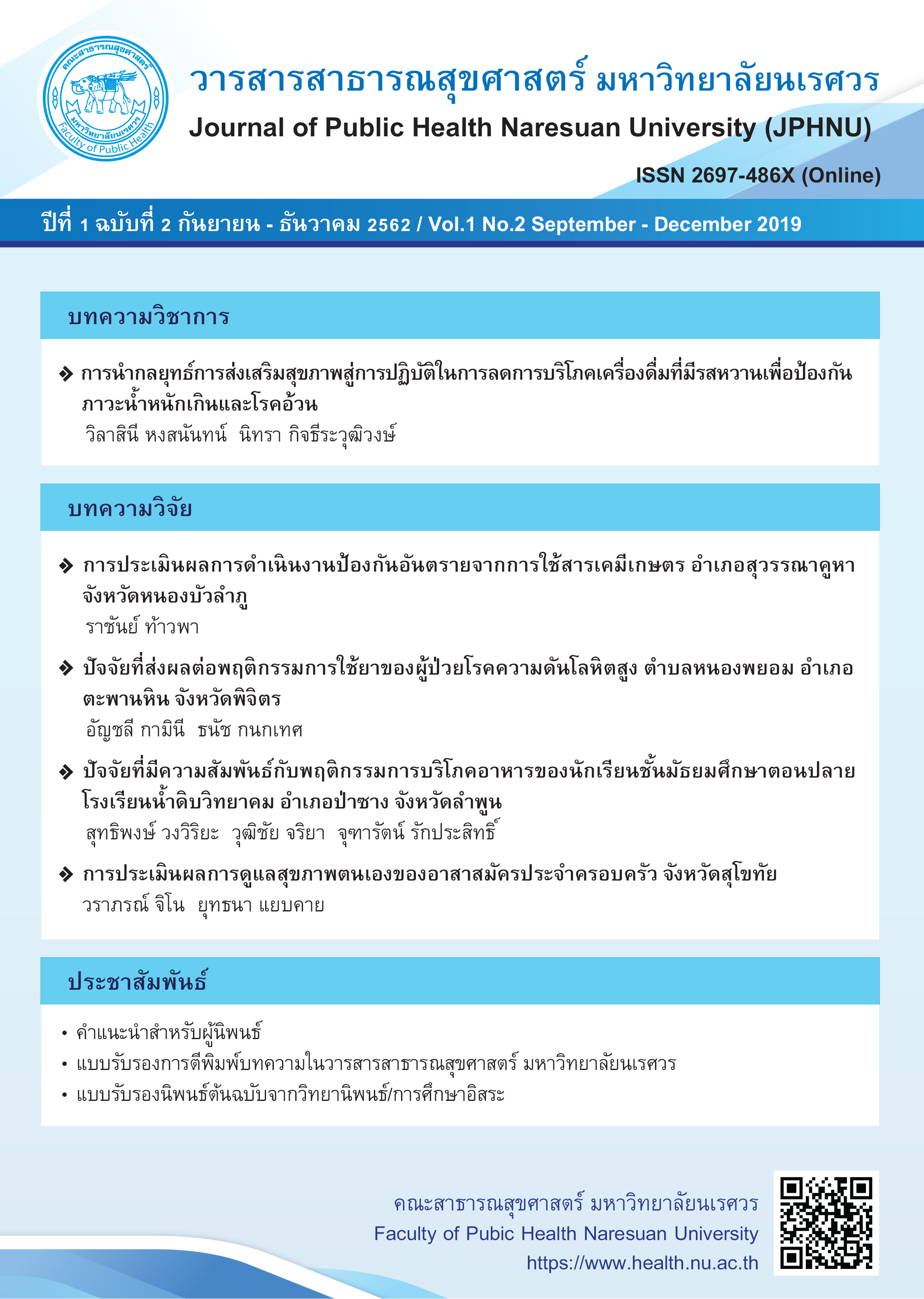
ปัจจัยที่มีความสัมพันธ์กับพฤติกรรมการบริโภคอาหารของนักเรียน ชั้นมัธยมศึกษาตอนปลาย โรงเรียนน้ำดิบวิทยาคม อำเภอป่าซาง จังหวัดลำพูน
คำสำคัญ:
พฤติกรรมการบริโภคอาหาร, นักเรียนมัธยมศึกษา, แบบจำลอง PRECEDE-PROCEED modelบทคัดย่อ
การวิจัยเชิงสำรวจครั้งนี้มีวัตถุประสงค์เพื่อศึกษาพฤติกรรมการบริโภคอาหาร และปัจจัยที่มีความสัมพันธ์กับพฤติกรรมการบริโภคอาหารของนักเรียนชั้นมัธยมศึกษาตอนปลาย โรงเรียนน้ำดิบวิทยาคม อำเภอป่าซาง จังหวัดลำพูน โดยใช้แบบจำลอง PRECEDE-PROCEED model เป็นกรอบแนวคิดในการวิจัย กลุ่มตัวอย่าง คือ นักเรียนชั้นมัธยมศึกษาตอนปลาย จำนวน 113 คน เก็บข้อมูลโดยใช้แบบสอบถาม แบ่งเป็น 5 ส่วน ได้แก่ 1) แบบสอบถามเกี่ยวกับข้อมูลทั่วไปของนักเรียน 2) ความรู้ในการบริโภคอาหาร 3) เจตคติในการบริโภคอาหาร 4) อิทธิพลสื่อและโฆษณา และ 5) พฤติกรรมการบริโภคอาหาร ตรวจสอบความตรงของเครื่องมือด้วยค่าดัชนีความตรงเชิงเนื้อหา ได้ค่า 0.67-1.00 ส่วนค่าดัชนีความเที่ยงของแบบสอบถามส่วนที่ 2 ได้ค่า KR-20 = 0.74 แบบสอบถามส่วน 3-5 ได้ค่าสัมประสิทธิ์แอลฟาระหว่าง 0.72-0.78 วิเคราะห์ข้อมูลโดยใช้สถิติ Eta Coefficient และ Pearson's Correlation Coefficient กำหนดนัยสำคัญที่ระดับ 0.05
ผลการศึกษา พบว่า พฤติกรรมการบริโภคอาหารของกลุ่มตัวอย่างส่วนใหญ่ อยู่ในระดับปานกลาง(คะแนนเฉลี่ย 2.34-3.66) ร้อยละ 69.90 และปัจจัยที่มีความสัมพันธ์กับพฤติกรรมการบริโภคอาหารอย่าง มีนัยสำคัญทางสถิติ (p-value < 0.05) ของกลุ่มตัวอย่าง มี 3 ปัจจัย ได้แก่ ความรู้เกี่ยวกับการบริโภคอาหาร (r = 0.186, p-value = 0.048) เจตคติเกี่ยวกับการบริโภคอาหาร (r = 0.269, p-value = 0.004) ระดับการศึกษาของผู้ปกครอง (F = 2.453, p-value = 0.001) ดังนั้น จึงควรมีการพัฒนาความรู้และเจตคติเกี่ยวกับการบริโภคอาหารที่ถูกต้องเพื่อส่งเสริมให้นักเรียนมีพฤติกรรมการบริโภคอาหารที่เหมาะสม
เอกสารอ้างอิง
Best, J. W. (1970). Research in Education. Englewood Cliffs, New Jersey: Printice-Hall.
Bloom, B. S. (1971). Handbook on formative and summative evaluation learning. New York: Megraw–Hill.
Choopayak, C. (2009). The Knowledge, Attitudes and Behaviors in Food Consumption of Upper-Secondary School Students at the Demonstration Schools under the Ministry of University Affairs in Bangkok Metropolis. Faculty of Education, Ramkhamhaeng University, Bangkok. (in Thai).
Green, L. W., & Kreuter, M. W. (2005). Health Program Planning an Educational and Ecological Approach. New York: Quebecor World Fairfield.
Mendonça, R. D. D., Pimenta, A. M., Gea, A., de la Fuente-Arrillaga, C., Martinez-Gonzalez, M. A., Lopes, A. C. S., & Bes-Rastrollo, M. (2016). Ultraprocessed food consumption and risk of overweight and obesity: The University of Navarra Follow-Up (SUN) cohort study. The American journal of clinical nutrition, 104(5), 1433-1440.
Ministry of Public Health. (2018). Percentage of normal weight and height rage among teenagers aged between 15-18 years old. Retrieved October 17, 2018, from https://hdcservice.moph.go.th/hdc/reports/report.php?source=pformated/format1.php&cat_id=46522b5bd1e06d24a5bd81917257a93c&id=9b019d9cc12576000e6e84acfb9ad7f0. (in Thai).
Ministry of Public Health. (2019). Percentage of normal weight and height rage among school-age students. Retrieved November 28, 2019, from https://hdcservice.moph.go.th/hdc/reports/report_kpi.php?flag_kpi_level=1&flag_kpi_year=2019&source=pformated/format1.php&id=e28682b2718e6cc82b8dbb3e00f2e28e. (in Thai).
Moohummud, S. (2001). Factors affecting food consuming of mathayomsuksa III students in school under the Department of General Education in Khet Dusit, Bangkok Metropolitan. Master of Education degree in Health Education, Graduate School, Srinakharinwirot University. (in Thai).
National Statistical Office. (2014). National Survey of Food Consumption Behaviors. Statistics Newsletter, 25(1), 7. (in Thai).
Nithitantiwat, P., & Udomsapaya, W. (2017). Food consumption behavior among Thai adolescents, impacts, and solutions. Journal of Phrapokklao Nursing College, 28(1), 122-128. (in Thai).
Ruangying, J. (2016). Food consumption behavior of adolescents in Songkhla Province: Synthesis of literacy and factors influencing food consumption behavior. Doctoral degree in Applied Behavioral Science Research, Srinakharinwirot University, Bangkok. (in Thai).
Wayne, W. D. (1995). Biostatistics: A Foundation of Analysis in the Health Sciences (6th ed.). New York-Chichester-Brisbane-Toronto-Singapore: John Wiley & Sons, Inc., 177-178.
ดาวน์โหลด
เผยแพร่แล้ว
รูปแบบการอ้างอิง
ฉบับ
ประเภทบทความ
สัญญาอนุญาต
บทความที่ได้รับการตีพิมพ์เป็นลิขสิทธิ์ของวารสารวิจัยสาธารณสุขและวิทยาศาสตร์สุขภาพ
ข้อความที่ปรากฏในบทความแต่ละเรื่องบทความในวารสารวิชาการและวิจัยเล่มนี้เป็นความคิดเห็นส่วนตัวของผู้เขียนแต่ละท่านไม่เกี่ยวข้องกับมหาวิทยาลัยนเรศวร และคณาจารย์ท่านอื่นๆในมหาวิทยาลัยฯ ความรับผิดชอบเกี่ยวกับบทความแต่ละเรื่องผู้เขียนจะรับผิดชอบของตนเองแต่ละท่าน