
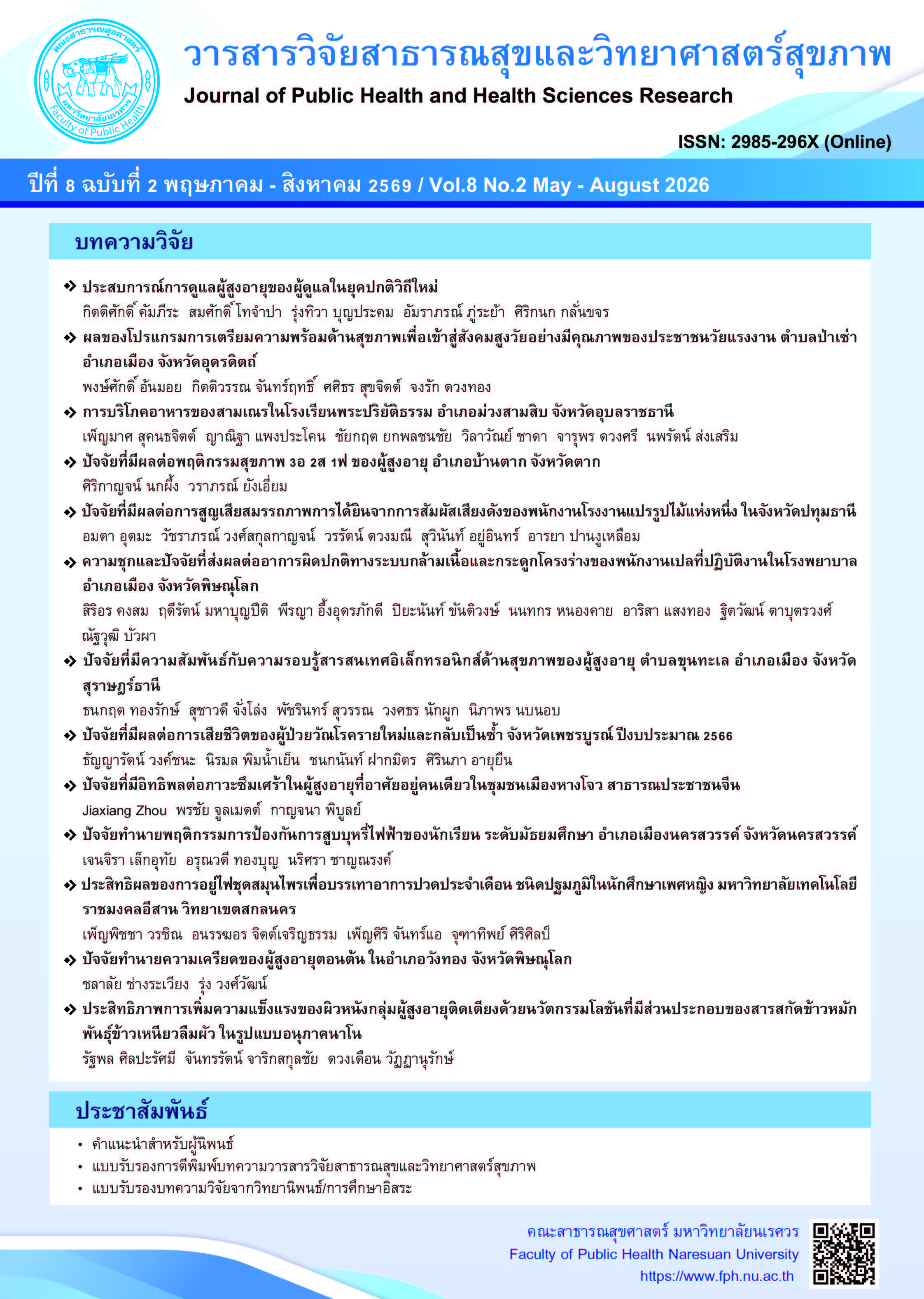
Dietary intake of Buddhist novices in a Phrapariyattidhamma school, Muang Sam Sip District, Ubon Ratchathani Province
Keywords:
Dietary behaviors, Nutritional status, Adolescent nutrition, Phrapariyattidhamma school, Buddhist novicesAbstract
This cross-sectional descriptive study aimed to describe the dietary intake behaviors of Buddhist novices and to compare their energy and nutrient intake with nutritional status and Thai Dietary Reference Intakes (DRIs). A total of 114 novices from a Phrapariyattidhamma school in Muang Sam Sip District, Ubon Ratchathani Province, were selected through simple random sampling. Research instruments
included a general information questionnaire, a Food Frequency Questionnaire (FFQ), and a 24-hour dietary recall interview. Data were analyzed using descriptive statistics and the Kruskal-Wallis H test.
The results revealed that novices primarily consumed rice-based foods, with median frequencies of sticky rice and steamed rice consumption of three and four days per week, respectively. Frequent consumption of bread was observed (median five days per week), along with regular intake of fried foods and sweetened beverages (median 4-5 days per week). Comparison of energy and nutrient intake across nutritional statuses showed statistically significant differences between the underweight, normal, and overweight/obese groups (p-value < 0.001). The underweight group received calcium and iron significantly below the criteria (398.71 mg/day and 5.85 mg/day, respectively). Meanwhile, the overweight group had the highest energy intake (median 2,745.83 kcal/day), fat (120.60 g/day), and sugar (166.68 g/day). The average sodium intake was 6,503.29 mg/day and cholesterol was 734.63 mg/day, both exceeding Thai reference standards. These findings indicate imbalanced dietary patterns
among Buddhist novices, characterized by insufficient intake of essential nutrients among those with undernutrition and excessive intake of energy-dense foods among those with overnutrition. The study highlights the importance of culturally tailored, targeted nutritional promotion strategies to promote healthy eating behaviors and long-term well-being among this monastic population.
References
Centers for Disease Control and Prevention. (2024a, June 28). Child and teen BMI categories. Retrieved November 16, 2024, from https://www.cdc.gov/bmi/child-teen-calculator/bmi-categories.html
Centers for Disease Control and Prevention. (2024b, June 17). BMI-for-age as a screening measure. Retrieved November 16, 2024, from https://www.cdc.gov/growth-chart-training/hcp/using-bmi/screening-measure.html
Centers for Disease Control and Prevention. (2024c, January 11). Fast facts: Sugar-sweetened beverage consumption. Retrieved October 19, 2025, from https://www.cdc.gov/nutrition/php/data-research/sugar-sweetened-beverages.html
Centers for Disease Control and Prevention. (2024d, January 5). Get the facts: Added sugars. Retrieved October 19, 2025, from https://www.cdc.gov/nutrition/php/data-research/added-sugars.html
Cochran, W. G. (1977). Sampling techniques. (3rd ed.). New York, NY: John Wiley & Sons.
Department of Health, Ministry of Public Health. (2020). Dietary reference intakes for Thais 2020. Retrieved October 23, 2025, from https://nutrition2.anamai.moph.go.th/th/dri (in Thai)
Gie, S. M., Nguyen, P. H., Bergeron, G., Tran, L. M., Hoang, N. T., & Knight, F. (2023). Locally relevant food-based recommendations could increase iron and calcium intake for adolescent girls in Vietnam. Annals of the New York Academy of Sciences, 1527(1), 97-106.
Health Region 10 Office. (2024). Health report of Health Region 10, fiscal year 2024. Retrieved October 23, 2025, from https://healthregion10.moph.go.th/ (in Thai)
Hu, H., Song, J., MacGregor, G. A., & He, F. J. (2023). Consumption of soft drinks and overweight and obesity among adolescents in 107 countries and regions. JAMA Network Open, 6(7), e2325158. https://doi.org/10.1001/jamanetworkopen.2023.25158
Institute of Nutrition, Mahidol University. (2014). INMUCAL-Nutrients Program Version 3.0. Nakhon Pathom: Mahidol University. (in Thai)
Jaisaard, R., Maleewong, U., Sanchaisuriya, K., & Sanchaisuriya, P. (2021). Consumption of calcium and knowledge about calcium among early adolescents in Northeast Thailand. Risk Management and Healthcare Policy, 14, 3829-3840. https://doi.org/10.2147/RMHP.S312264
Ko-amornsup, W., Pannoi, R., Kamsa-ard, S., & Wongsa, A. (2024). Health survey of monks residing in urban areas: The Bangkok Noi model. Siriraj Medical Journal, 76(Suppl.), S44-S55.
Kunset, P., Punsawad, C., Petsirasan, R., Suwanbamrung, C., Shohaimi, S., Narkkul, U., & Noonil, N. (2023). Unhealthy dietary patterns and their associations with sociodemographic factors as predictors among underweight and overweight adolescents in Southern Thailand. International Journal of Environmental Research and Public Health, 20, 6703. https://doi.org/10.3390/ijerph20176703
Moosan, P. C., Kumut, S., Siri-amornpun, S., & Panya, R. (2025). Buddhist ordination as a culturally embedded model for lifestyle change: Effects on dietary intake, body composition, and sleep among newly ordained Thai monks. Scientific Reports, 15, 25353. https://doi.org/10.1038/s41598-025-11309-y
National Office of Buddhism. (2023, June 10). Statistical report of general education monastic schools. Retrieved October 23, 2025, from https://deb.onab.go.th/th/content/category/detail/id/1472/iid/58848 (in Thai)
Office of Buddhism, Ubon Ratchathani Province. (2023). Field inspection and certification report on the student statistics of general education monastic schools, Academic Year 2023. (1st round). Retrieved October 23, 2025, from https://ubn.onab.go.th/th/content/page/index/id/50440 (in Thai)
Panyachit, S. (2025). Barefoot health: The healthy lifestyle path of monks in Thailand. Journal of Population and Social Studies, 34, 236-252.
Sahiledengle, B., & Mwanri, L. (2024). Unveiling the crisis of the double burden of malnutrition. The Lancet Global Health, 12(3), e348e349. doi: 10.1016/S2214-109X(24)00001-9.
Siviroj, P., Bunnag, K., & Lerttrakarnnon, P. (2024). Associated factors of dietary patterns among adolescents in Thailand. Healthcare, 12(12), 1215. https://doi.org/10.3390/healthcare12121215
Thompson, F. E., & Subar, A. F. (2017). Dietary assessment methodology. In A. M. Coulston, C. J. Boushey, M. G. Ferruzzi, & L. M. Delahanty (Eds.), Nutrition in the prevention and treatment of disease. (4th ed., pp. 5-48). San Diego, CA: Academic Press.
Willett, W. C. (2013). Nutritional epidemiology. (3rd ed.). New York, NY: Oxford University Press.
World Health Organization. (2023a). Double burden of malnutrition. Retrieved October 25, 2025, from https://www.who.int/publications/i/item/WHO-NMH-NHD-17.3
World Health Organization. (2023b). Anaemia. Retrieved October 25, 2025, from https://www.who.int/news-room/fact-sheets/detail/anaemia
Downloads
Published
How to Cite
Issue
Section
License
Copyright (c) 2026 Journal of Public Health and Health Sciences Research

This work is licensed under a Creative Commons Attribution-NonCommercial-NoDerivatives 4.0 International License.
The published article is copyrighted by the Journal of Public Health and Health Sciences Research.
The statements that appear in each article in this academic and research journal are the personal opinions of each author and are not related to Naresuan University and other faculty members in the university. Responsibilities regarding each article are the responsibility of each author.


