
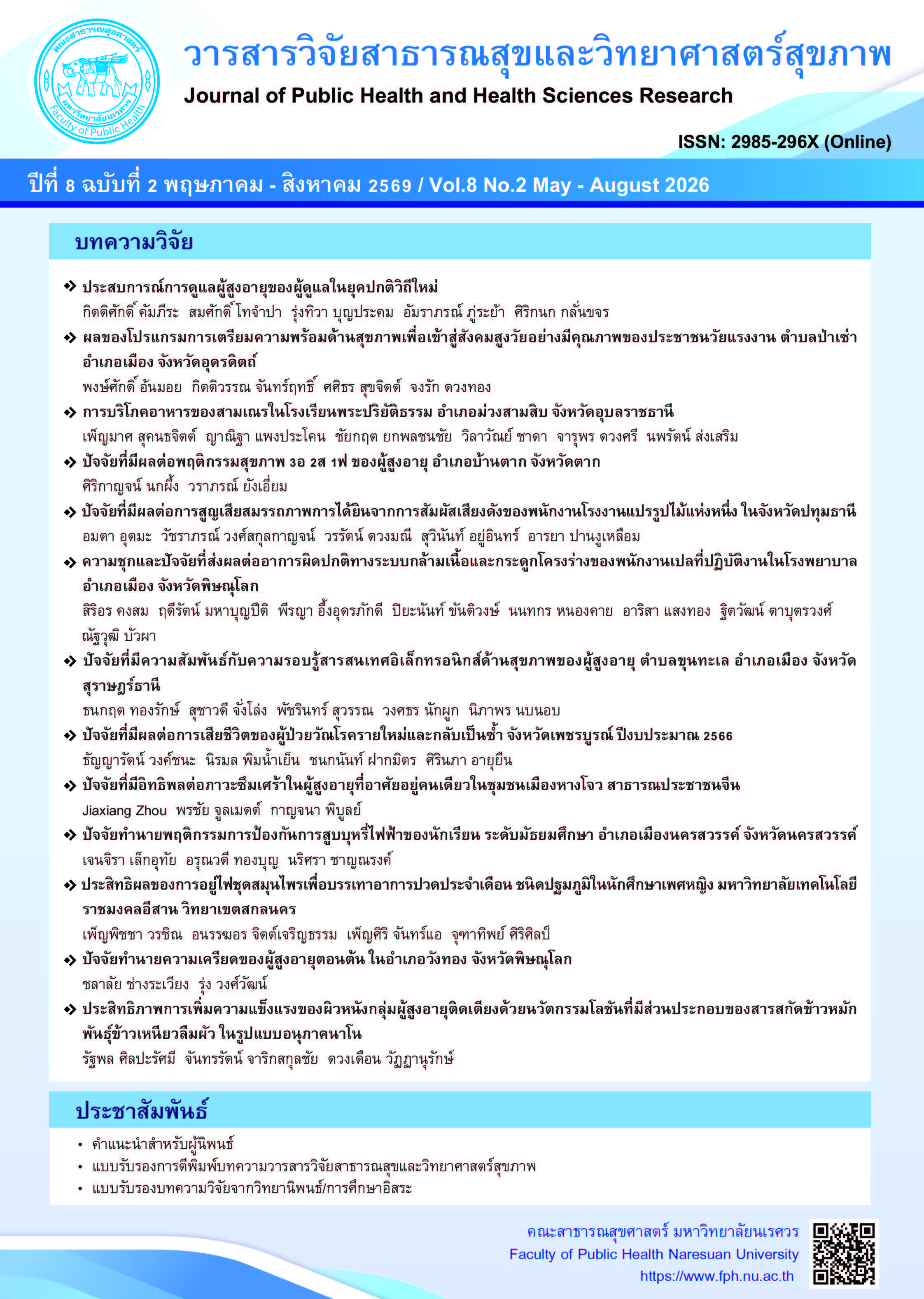
Efficacy of an innovative lotion containing nanoparticle-formulated fermented rice extract from Lueam Pua glutinous rice variety in enhancing skin integrity among bedridden elderly
Keywords:
Skin integrity, Bedridden elderly, Fermented rice extract, Lueam Pua glutinous riceAbstract
This research aimed to develop and study the efficiency of increasing skin barrier enhancement in bedridden older adults by using an innovative lotion containing fermented Luam Phua glutinous rice extract in nanoparticle form. The study was conducted in two phases: Phase 1 involved the development of the innovative lotion with antioxidant activity by extracting active compounds from fermented Luam Phua glutinous rice in nanoparticle form, studying the antioxidant efficacy, and developing it into a lotion product. Phase 2 focused on evaluating the efficacy of innovation. The participants consisted of 60 bedridden older adults divided into an experimental group of 30 individuals who received the innovation for 8 weeks, and a control group of 30 individuals who received standard care. The instruments used for data collection were a personal information questionnaire, a trans epidermal water loss assessment device, and a skin hydration assessment device. Data were analyzed using descriptive statistics and inferential statistics, specifically the independent t-test and paired t-test, at a 95% confidence level.
The findings revealed that: 1) the fermented rice extract demonstrated antioxidant activity with an value of 3.14, and the innovative lotion showed no phase separation with good stability, and 2) the experimental group showed statistically significant improved mean skin strength of the skin barrier and skin hydration after using the innovation (p-value = 0.001 and 0.019, respectively). Based on these findings, the innovative lotion with antioxidant properties has proven effective in enhancing skin strength and can be utilized as a guideline for improving the quality of life among patients.
References
Alderden, J., Rondinelli, J., Pepper, G., Cummins, M., & Whitney, J. (2017). Risk factors for pressure injuries among critical care patients: A systematic review. International Journal of Nursing Studies, 71, 97-114.
Alja’afreh, M., & Mosleh, S.M. (2013). Pressure ulcers in Jordan: A snapshot survey of a tertiary public hospital. British Journal of Nursing, 22 (20): 10-6.
Cox, J. (2012). Predictive power of the braden scale for pressure sore risk in adult critical care patients. Journal of Wound Ostomy and Continence Nurses Society, 39(6), 613-621.
Donaldson, N., Bolton, L.B., & Aydin, C. (2005). Impact of California’s licensed nurse-patient ratios on unit-level nurse staffing and patient outcomes. Policy, Politics, and Nursing Practice, 6(3):198-210.
Gedamu, H., Abate, T., Ayalew, E., Tegenaw, A., Birhanu, M. & Tafere, Y. (2021). Level of nurses’ knowledge on pressure ulcer prevention: A systematic review and meta-analysis study in Ethiopia. Heliyon, 7(7) e07648. https://doi.org/10.1016/j.heliyon.2021.e07648.
Gray, M., Black, J. M., Baharestani, M. M., Bliss, D. Z., Colwell, J. C., Goldberg, R. (2011). Moisture-associated skin damage. Journal of Wound Ostomy and Continence Nurses Society, 38(3), 233-241.
International Health Policy Program, Thailand. (2015). Health insurance systems in Thailand: Current situation and future challenges. Ministry of Public Health.
Jaricksakulchai, J., Sillaparassamee, R., Kittip, S., Srinuan, W., Koedchaeng, T., & Chanchuphol, P. (2021). Skin moisturizing effect of bath bomb containing natural essential moisturizing for improving skin health. EAU Heritage Journal Science and Technology, 15(2), 205-219. (in Thai)
Li, Z., Lin, F., Thalib, L., Chaboyer, W. (2020). Global prevalence and incidence of pressure injuries in hospitalised adult patients: A systematic review and meta-analysis. International Journal of Nursing Studies, 105, 103546. https://doi.org/10.1016/j.ijnurstu.2020.103546.
Lim, K.M. (2021). Skin epidermis and barrier Function. International Journal of Molecular Sciences 22(6), 3035 https://doi.org/10.3390/ijms22063035.
Mattioli, R., Francioso, A., Mosca, L., & Silva, P. (2020). Anthocyanins: A comprehensive review of their chemical properties and health effects on cardiovascular and Neurodegenerative diseases. Molecules, 25 (17) 3809. https://doi.org/10.3390/molecules25173809.
Office of Health Workforce Research and Development. (2020). Long-term care for quality dependency in Thai society. Nonthaburi: Image Printing. (In Thai)
Panan, C. & Suntarawirat, B. (2021). Long-term care system for dependent elderly: service provider perspectives. Public Health Academic Journal, Ministry of Public Health, 30(Supplement), 87-101. (In Thai)
Panyadee, U., Phongsirisaen, H., Sidthilaw, S. & Intayos, H. (2021). Reflection on lesson learned from care of the abandoned bedridden patient with pressure ulcer grade 3-4 complication. Journal of Phrae Public Health for Development, 1(1) 63-76. (in Thai)
Ramazani, E., Akaberi, M., Ahmad, S., & Tayarani-Najaran, Z. (2021). Biological and pharmacological effects of gammaoryzanol: an updated review of the molecular mechanisms. Current Pharmaceutical Design, (19) 2299-2316. https://doi.org/10.2174/1381612826666201102101428.
Rhoda Winner, E., (2023). Analysis of the novel drug delivery system registration process for the previously registered methotrexate. Chulalongkorn University Theses and Dissertations (Chula ETD). 12369. https://digital.car.chula.ac.th/chulaetd/12369.
Sillaparassamee, R., Jaricksakulchai, J., Techa, T., Panomkhet, D., & Plounglumjeak, C. (2022). Evaluation of skin moisturizer with lotion containing Ganoderma lucidum extract in people with dry skin problems. EAU Heritage Journal Science and Technology, 16(2), 119-134. (in Thai)
Yang, F., Hu, Y., Wu, M., Guo, M., & Wang, H. (2025). Biologically active Components and skincare benefits of rice fermentation products: A Review. Cosmetics, 12(1), 29 https://doi.org/10.3390/cosmetics12010029
Downloads
Published
How to Cite
Issue
Section
License
Copyright (c) 2026 Journal of Public Health and Health Sciences Research

This work is licensed under a Creative Commons Attribution-NonCommercial-NoDerivatives 4.0 International License.
The published article is copyrighted by the Journal of Public Health and Health Sciences Research.
The statements that appear in each article in this academic and research journal are the personal opinions of each author and are not related to Naresuan University and other faculty members in the university. Responsibilities regarding each article are the responsibility of each author.


