
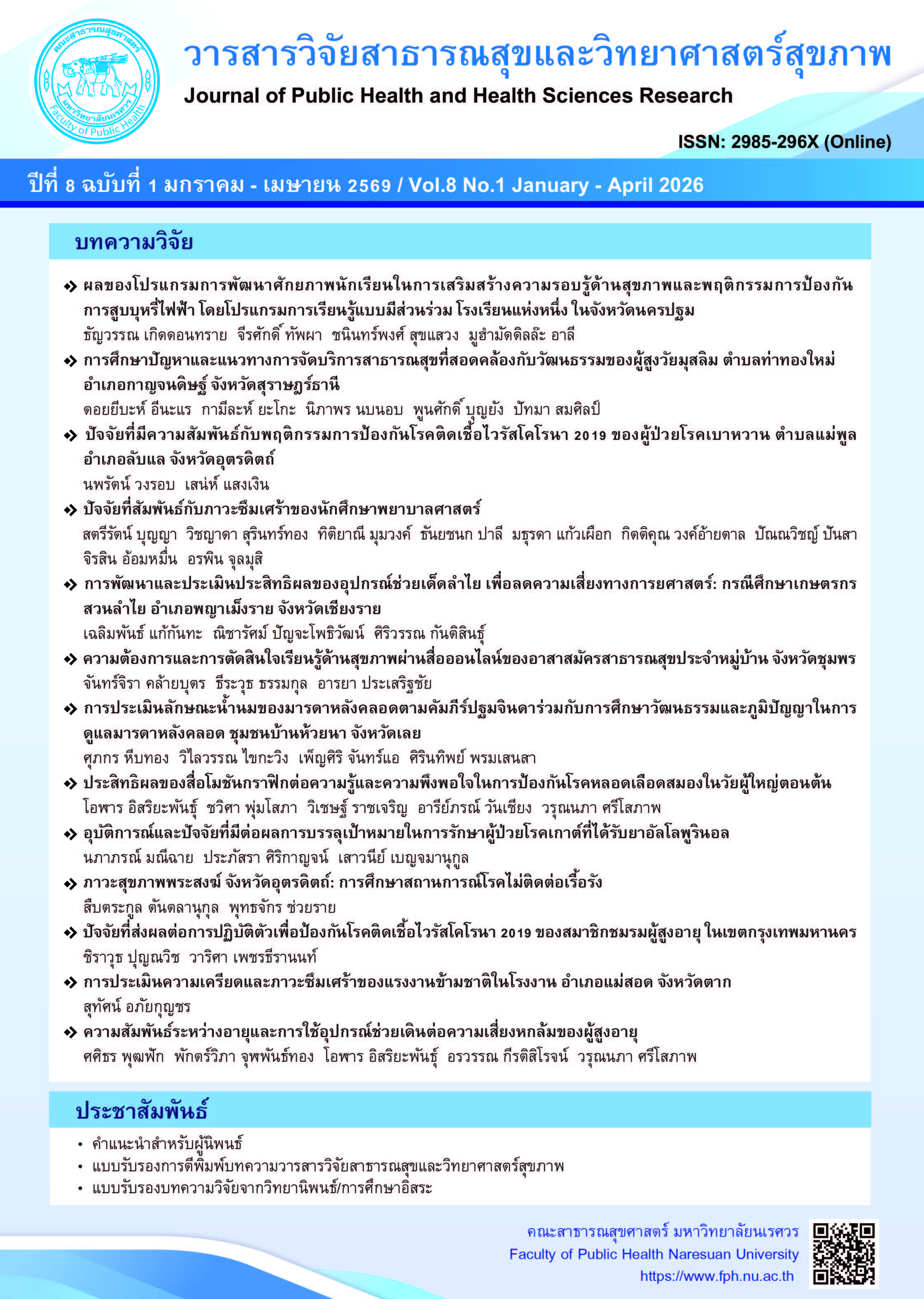
Needs and decision - making on health learning through online media of village health volunteers, Chumphon Province
Keywords:
Decision-making, Technology acceptance, Need, Health promotion programme, Online mediaAbstract
This cross-sectional study aimed to examine the needs and decision-making processes regarding online health learning, as well as the influencing factors, among Village Health Volunteers (VHVs) in Chumphon Province. The target population consisted of 12,795 VHVs aged 18–59 years.
A sample of 373 participants was selected using multistage sampling. The research instrument was a researcher-developed questionnaire, which demonstrated a total Cronbach’s alpha coefficient of 0.96. Data were analysed using descriptive statistics and multiple linear regression analysis.
The results showed that needs and decision-making regarding online health learning were at a high level (81.6%; Mean = 81.95, S.D. = 2.60). Smartphone literacy was at a moderate level (50.1%, Mean = 7.09, S.D. = 1.11). Most VHVs had more than 15 years of experience (30.2%; Mean = 11.33, S.D. = 9.27) and were able to access the internet independently (70.2%; Mean = 6.82, S.D. = 1.30). Regarding technology acceptance, perceived usefulness had the highest mean score, followed by perceived ease of use. Analysis of factors influencing needs and decision-making in online health learning revealed that education level, years of work experience, smartphone literacy, internet access, and all components of technology acceptance significantly affected online health learning needs and decisions at the 0.05 level, collectively explaining 73.0% of the variance.
References
Al-Ghuribi, N., Abu-Naser, S. S., & Al-Hindi, H. A. (2018). The role of social influence on technology adoption by healthcare workers. International Journal of Social Sciences and Humanity Studies, 5(2), 55-68.
Alrashed, S. N., Ahmad, M. M., & Almurdi, A. K. (2024). Impact of E-learning technology on medical students in Africa: A case study. Journal of Medical Education and Research, 38(1), 45-59.
Chaiyakulwat, N. (2018). Applying the unified theory of acceptance and use of technology to understand the adoption of virtual investment communities by retail investors. Independent Study of Master of Business Administration, Bangkok University, Pathum Thani. (in Thai)
Chansuwan, P., Pornprasertsook, A., & Thanjitt, V. (2024). The influence of digital literacy and work experience on the adoption of online media by public health personnel. Journal of Information Technology, 5(2), 120-135. (in Thai)
Charan, J., & Biswas, T. (2013). How to calculate sample size for different study designs in medical research? Indian Journal of Psychological Medicine, 35(2), 121-126. (in Thai)
Choochom, O., Sucaromana, U., Chavanovanich, J., & Tellegen, P. (2019). Model of selfdevelopment for enhancing psychological immunity of the elderly. The Journal of Behavioral Science, 14(1), 84-96. (in Thai)
Chotprom, W., & Sawatsichai, K. (2022). Effect of an elderly health promotion program using the 3A 2S concept and LINE application on health behaviors of the elderly in an urban community. Journal of Nursing and Education, 15(2), 1-14. (in Thai)
Chumphon Provincial Public Health Office. (2024). Health statistical data from the Health Data Center (HDC) system for the fiscal year 2567. Retrieved October 2, 2025, from https://hdc.moph.go.th/center/public/main (in Thai)
Cohen, J. (1988). Statistical power analysis for the behavioral sciences. (2nd ed.). New Jersey: Lawrence Erlbaum Associates.
Davis, F. D. (1989). Perceived usefulness, perceived ease of use, and user acceptance of information technology. MIS Quarterly, 13(3), 319-340.
Department of Disease Control. (2021). Manual on health literacy for disease and health hazard prevention and control. Bangkok: Bureau of Risk Communication and Health Behavior Development, Ministry of Public Health. (in Thai)
Djubair, H., & Ming, H. T. (2022). The application of AIDA model in user experience design and communication in technology. Journal of Digital Communication and Media, 15(3), 112-125.
Farhady, M., Haghdoost, A. A., & Bakhshi, M. (2020). Factors affecting the adoption of eHealth services among rural populations: A systematic review. International Journal of Medical Informatics, 134, 104036. https://pmc.ncbi.nlm.nih.gov/articles/PMC8417094/
Fu, M., Ma, J., Wang, S., & Wu, X. (2018). Determinants of user satisfaction with health information systems: A UTAUT-based study. Journal of Medical Systems, 42(10), 1-9.
Health Promotion Monitoring and Evaluation System for Health Region 11. (2024). Report on the results of body mass index (BMI) screening for the working-age population aged 1959 years. Retrieved October 2, 2025, from https://hpc11.go.th/me-working-age/ (in Thai)
Hosmer, D. W., Jr., & Lemeshow, S. (2000). Applied logistic regression. (2nd ed.). New Jersey: John Wiley & Sons.
Indech, Y., Pimolmas, J., & Phatthraphong, C. (2023). Development of mental health and behavioral skills in a group of high school youth through online activities. Journal of Psychology and Mental Health Studies, 10(2), 50-65. (in Thai)
Kazaure, G. C., Emenike, R. C., & Nwafor, S. O. (2022). Multimedia-based instruction and student learning outcomes in a developing country. Journal of Educational Technology Development and Exchange, 15(1), 1-15.
Mali, K., & Buanaak, P. (2023). Effects of a health promotion program for the elderly on health. Journal of Elderly Health, 10(1), 55-68. (in Thai)
Ministry of Public Health. (2023). Digital health service action plan B. E. 2566-2570. Nonthaburi: Ministry of Public Health. (in Thai)
Philippi, M., Klerings, I., & Gartlehner, G. (2021). UTAUT model and its application in health technology acceptance: A systematic review. International Journal of Healthcare Technology Management, 22(3), 254-278.
Pratiwi, N. E., Maman, U., Danapriatna, N., Mukri, R., & Hejazziey, D. (2021). AIDA model and consumer decision making on health products. International Journal of Marketing, 12(1), 54-68.
Rana, N. P., & Dwivedi, Y. K. (2015). A study on the factors affecting the adoption of e-health services in developing countries. Information Technology & People, 28(4), 861-880.
Rovinelli, R. J., & Hambleton, R. K. (1977). On the use of content experts for item selection during scale development. Applied Psychological Measurement, 1(2), 241-253.
Sae-lee, K., Vongsaisuwon, W., & Charoenpong, P. (2023). Workout logging through an mHealth app for weight reduction among different generations: Secondary analysis of the MED PSU×ThaiSook Healthier Challenge. JMIR Formative Research, 7(1), e45298. https://pubmed.ncbi.nlm.nih.gov/37389918/
Somying, S., & Supaporn, W. (2018). Factors of attitude and trust affecting the use of financial transaction applications. Journal of Business Administration, 15(2), 110-125. (in Thai)
Song, J., Lee, J. K., & Kang, J. (2021). Applying AIDA model to health communication on social media. Journal of Public Health, 39(1), 45-60.
Srijumpa, R., & Panyaud, L. (2018). Response behavior with the AIDA model on social media in choosing fishing equipment. Independent Study of Master of Business Administration, Burapha University, Chonburi. (in Thai)
Strudwick, G. (2015). Evaluating the effectiveness of digital health interventions for patient education. International Journal of Medical Informatics, 84(9), 675-684.
Suksri, C., Yingsuksan, W., & Chantima, C. (2023). Effects of a digital health literacy promotion program via Zoom on health literacy and health behaviors of a group at risk for non-communicable diseases. Journal of Health Systems Research and Development, 20(2), 115-130. (in Thai)
Sullivan, J. (2025, September 5). Thailand’s digital transformation: Challenges and opportunities. Retrieved October 2, 2025, from https://forbesasiacustom.com/thailand-harnessing-opportunities-for-growth/
The Village Health Volunteer Cremation Association of Thailand, Chumphon Province. (2024). Statistical data of village health volunteers in Chumphon Province B.E. 2567. Chumphon: The Village Health Volunteer Cremation Association of Thailand, Chumphon Province. (in Thai)
Vantamay, N. (2024). Determinants of mHealth literacy among Thai working-age adults: A structural equation modeling analysis. Journal of Public Health and Development, 22(1), 1-14.
Veerachai, W. (2019). Analysis of the impact of data security concerns on online shopping behaviour. Journal of Management Science, 10(1), 30-45. (in Thai)
Venkatesh, V., Morris, M. G., Davis, G. B., & Davis, F. D. (2003). User acceptance of information technology: Toward a unified view. MIS Quarterly, 27(3), 425-478.
Yuenyong, S., Ungcharoensuk, W., & Saktongteerakun, J. (2024). Digital literacy and health application usage of village health volunteers in Thailand. Journal of Health Science Research, 18(2), 45-57. (in Thai)
Zikmund, W. G., Babin, B. J., Carr, J. C., & Griffin, M. (2010). Business research methods. (8th ed.). Mason, Ohio: South-Western Cengage Learning
Downloads
Published
How to Cite
Issue
Section
License
Copyright (c) 2026 Journal of Public Health and Health Sciences Research

This work is licensed under a Creative Commons Attribution-NonCommercial-NoDerivatives 4.0 International License.
The published article is copyrighted by the Journal of Public Health and Health Sciences Research.
The statements that appear in each article in this academic and research journal are the personal opinions of each author and are not related to Naresuan University and other faculty members in the university. Responsibilities regarding each article are the responsibility of each author.


