
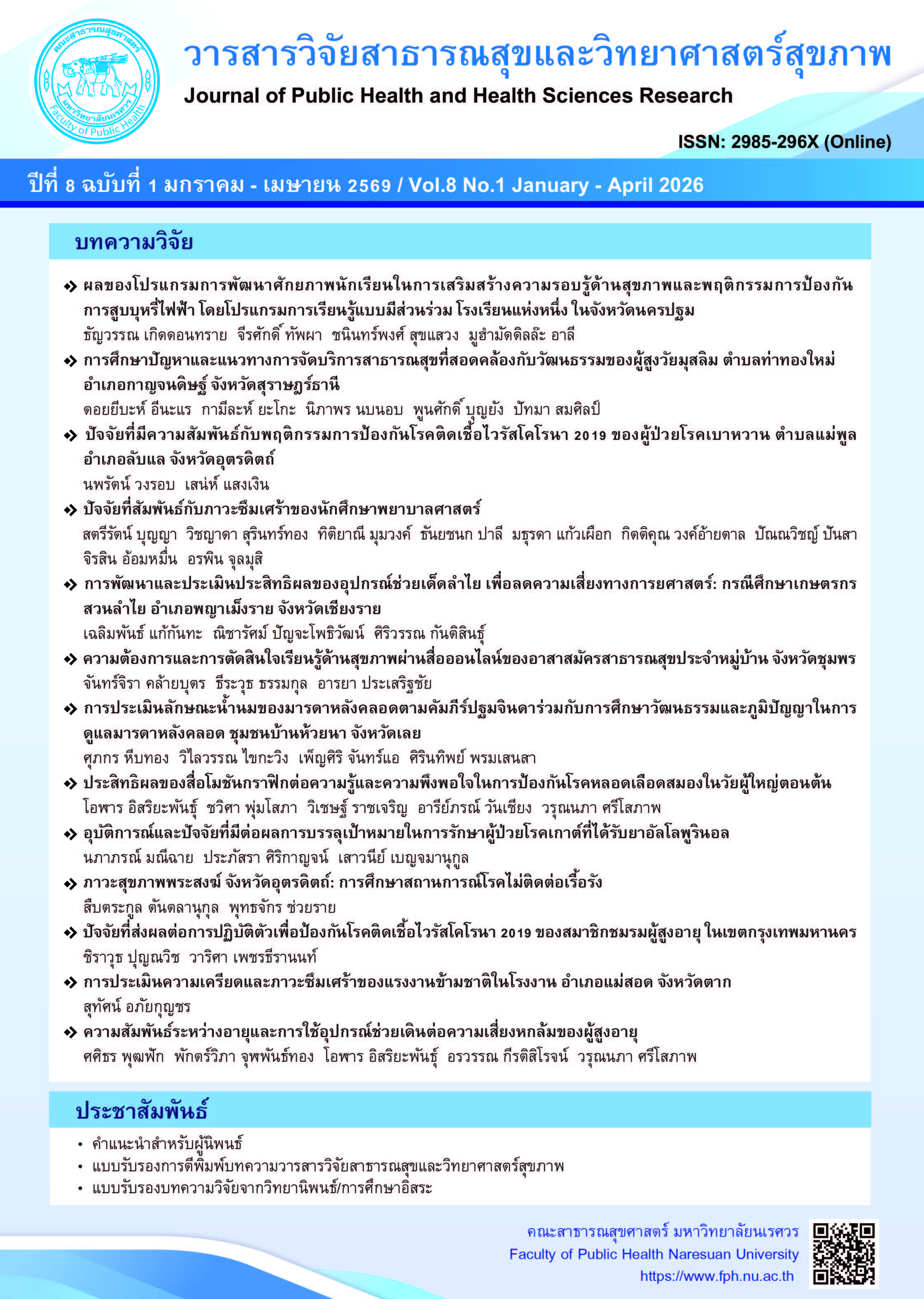
A study of problems and guidelines for culturally sensitive public health services for elderly muslims in Tha Thong Mai Subdistrict, Kanchanadit District, Surat Thani Province
Keywords:
Cultural sensitivity, Public health services, Elderly muslimsAbstract
This study was qualitative research with the objective of exploring problems and barriers in accessing public health services and identifying approaches to improve health service delivery in ways that are culturally appropriate for older Muslim adults in Tha Thong Mai Subdistrict, Kanchanadit District, Surat Thani Province. The key informants consisted of 10 older adults with experience receiving health services at Kanchanadit Hospital, 5 community and religious leaders, and 5 public health personnel from the hospital, selected by purposive sampling. Data were collected through in-depth interviews and contextual surveys
The findings revealed that the main problem in accessing healthcare services included the lack of separate kitchen facilities for halal and non-halal food in inpatient services, insufficient knowledge and understanding of halal food among health personnel, and inadequate facilities for religious practices. From the synthesis of culturally appropriate health service approaches, it was found that the capacity of health personnel should be developed to enhance their understanding of Islamic culture. Health service design should take into account the cultural practices of Muslims. The role of religious leaders, community leaders, and Muslim health volunteers should be strengthened to actively participate in health planning and activities. Additionally, long-term care systems and home visits for older adults should incorporate consideration of Muslim faith and lifestyle, with interdisciplinary teams receiving training on Islamic culture and religion. This study can be applied to develop culturally sensitive public health service systems that are appropriate to the local context and contribute to improving the quality of life of older adults in Muslim communities in a sustainable way.
References
Department of Religious Affairs. (2017). The way of life of adherents of the five religions in Thailand. (3rd ed.). Bangkok: Mahachulalongkornrajavidyalaya University Press. (in Thai)
Health and Fitness Service Center. (2025). Fundamental principles of Halal product standards. Retrieved September 1, 2025, from https://kb.psu.ac.th/psukb/bitstream/2553/5426/9/ch3.pdf. (in Thai)
Japakiya, I. (2012). Patient handbook and care management based on Islamic principles. Retrieved May 14, 2025, from https://www.muslim-library.com/dl/books/th3467.pdf. (in Thai)
Ministry of Public Health. (2025). Kanchanadit District information report. Retrieved March 10, 2025, from https://3doctor.hss.moph.go.th/main/rp_tambon?region=11&prov=OQ=&provn=4Liq4Li44Lij4Liy4Lip4LiO4Lij4Lm-M4LiY4Liy4LiZ4Li1&id=8402&n=4LiB4Liy4LiN4LiI4LiZ4LiU4Li04Lip4LiQ4LmM. (in Thai)
National Statistical Office. (2020). The 2018 survey on conditions of society, culture and mental health. Retrieved July 18, 2024, from https://www.nso.go.th/nsoweb/storage/survey_dtail/2023/20230501053015_16851.pdf. (in Thai)
National Statistical Office. (2024). The 2024 survey of the older persons in Thailand. Retrieved December 22, 2024, from https://www.nso.go.th/nsoweb/storage/survey_dtail/2025/20241209145003_88327.pdf. (in Thai)
Matichon online. (2017). Trang Muslims urge government agencies to provide proper prayer facilities, noting that the prayer room at the hospital is too small and inadequate. Retrieved January 30, 2025, from https://www.matichon.co.th/region/news_605945. (in Thai)
Pichayapaiboon, S. (2018). Muslim way of life and relationship to the Islamic principles and Islamic law enforcement: Case study of Suanluang 1 community. Journal of Graduate School, Pitchayatat, 13(2), 233-243. (in Thai)
Quran. (2025). Al-’Ankabut. Retrieved May 2, 2025, from https://quran.com/th/al-ankabut/45
Sakdaadisai, P., & Dankittikul, C. (2016). The use of spaces for religious activities: A case of Tha-It mosque, Nonthaburi. Veridian E-Journal, Silpakorn University, 9, 1717-1729. (in Thai)
Thailand Nursing and Midwifery Council. (2019). National Health Security Act, B.E. 2002. Retrieved July 4, 2025, from https://www.tnmc.or.th/images/userfiles/files/B001.pdf. (in Thai)
The Central Islamic Council of Thailand. (2016). The Central Islamic Council of Thailand on the implementation of entrepreneur certification and product certification and Fees B.E. 2559. Retrieved May 13, 2025, from https://www.cicot.or.th/storages/contents/attachments/Product_certification_and_Fees_B.E._2559_TH.pdf. (in Thai)
The Islamic Committee of Surat Thani. (2025). The mosque and the righteous man. Retrieved January 16, 2025, from https://masjidthai.com/sni/masjid/?amphur=oSE3HuJiOeY7b-DGAc14cDFDPBGdCLWNzAGBqP0KKDa0. (in Thai)
Totong, K., Wongsangiem N. T., & Wongsangiem, M. (2018). Problems and needs of Thai Muslim for health service based on Islamic ways. The Public Health Journal of Burapha University, 13(2), 102-116. (in Thai)
Totong, K., Wongsangiem, N. T., & Wongsangiem, M. (2019). Knowledge and understanding for health service in Islamic ways. Journal of Chandrakasemsarn, 25, 126-140. (in Thai)
Downloads
Published
How to Cite
Issue
Section
License
Copyright (c) 2026 Journal of Public Health and Health Sciences Research

This work is licensed under a Creative Commons Attribution-NonCommercial-NoDerivatives 4.0 International License.
The published article is copyrighted by the Journal of Public Health and Health Sciences Research.
The statements that appear in each article in this academic and research journal are the personal opinions of each author and are not related to Naresuan University and other faculty members in the university. Responsibilities regarding each article are the responsibility of each author.


