
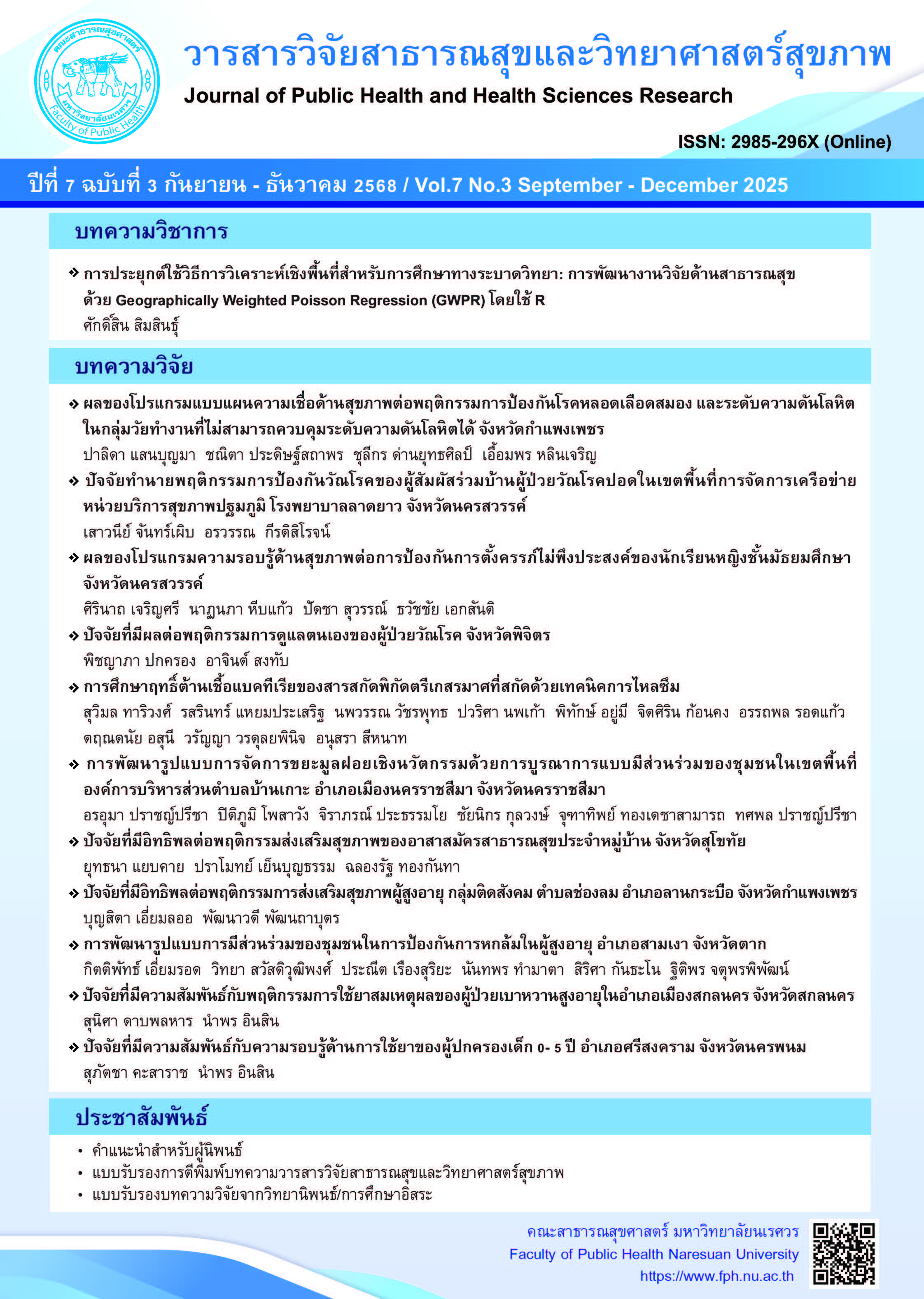
Factors related with medication literacy among parents of children aged 0–5 years in Si Songkhram District, Nakhon Phanom Province
Keywords:
Medication literacy, Rational drug use, Parents of children aged 0-5 yearsAbstract
This descriptive cross-sectional study aimed to examine the level of medication literacy use and identify factors related to medication literacy among parents of children aged 0-5 years in Si Songkhram District, Nakhon Phanom Province. The sample consisted of 327 parents of children aged 0-5 years, selected through stratified random sampling by subdistricts within Si Songkhram District. Data was collected using a questionnaire and analyzed using descriptive statistics and chi-square statistics to identify the factors related to medication literacy, at significant level 0.05.
The findings revealed that most parents had a moderate level of medication literacy (52.0%), followed by a high (35.2%) and a low level (12.8%). Factors significantly related to medication literacy included gender, education level, income, health service facility, experience in caring for a sick child, technology skills for searching, concerns about caring for a sick child, acceptance of community practices when children are ill, and awareness of information provided by medical personnel. Based on these findings, public health agencies can design strategies for enhancing medication literacy among parents. These strategies should consider individual, community, and healthcare-related factors
influencing medication literacy. Additionally, promoting the use of technology for information searching and ensuring access to appropriate information from healthcare professionals according to parents’ need
are recommended.
References
Arjmak, T. (2024). Health literacy of caregivers of children receiving treatment for respiratory diseases. Journal of Health Promotion and Environmental Health, 14, 261-270. (In Thai)
Bloom, B. S. (1971). Handbook on formative and summative evaluation of student learning. New York: McGraw-Hill Book Company.
Champlin, S., Mackert, M., Glowacki, E. M. & Donovan, E. (2017). Toward a Better Understanding of Patient Health Literacy: A Focus on the Skills Patients Need to Find Health Information. Qualitative health research, 27(8), 1160-1176.
Centers for Disease Control and Prevention. (2019). Antibiotic resistance threats in the United States, 2019. U.S. Department of Health and Human Services. Retrieved March 28, 2025, from https://www.cdc.gov/antimicrobial-resistance/media/pdfs/2019-ar-threats-report-508.pdf
Center for Health Care Strategies. (2013, October; updated March 2024). Health literacy and the role of culture. Retrieved June 23, 2025, from https://www.chcs.org/media/Health_Literacy_Role_of_Culture.pdf
Center for Drug System Surveillance and Development. (2020). Yavipak: News bulletin of the drug information center, 11 (45, June-August). Faculty of Pharmaceutical Sciences, Chulalongkorn University. from https://www.thaidrugwatch.org/download/series/series45.pdf (in Thai)
Faculty of Medicine, Ramathibodi Hospital. (2020, January 13). Common diseases in children include upper respiratory tract infections and diarrhea. Faculty of Medicine, Ramathibodi Hospital, Retrieved March 28, 2025, from https://www.rama.mahidol.ac.th/th/knowledge_awareness_health/13jan2020-1423 (in Thai)
Ketrain, P. (2020). Health literacy in early child rearing among primary caregivers: A case study of four districts. Thailand Journal of Health Promotion and Environmental Health, 46(1), 45-57.
Kwannate, C., & Tachasuksri, T. (2019). Factors influencing parents’ behavior regarding antibiotic use for school-aged children. The Journal of Faculty of Nursing, Burapha University, 27(4), 77-88. (in Thai)
Lewandowska, A., Lewandowski, T., Bartosiewicz, A., Papp, K., Zrubcová, D., Šupínová, M., Stryjkowska-Góra, A., Laskowska, B., Joniec, G., & Apay, S. E. (2024). Prevalence of anxiety and depression among parents of children with cancer—A preliminary study. Children, 11, 1227, https://doi.org/10.3390/children11101227
Nakhon Phanom Provincial Public Health Office. (2023). Mid-year population data of 2023, Si Songkhram District. Geographic Information System Health Data, Nakhon Phanom Province, Retrieved March 28, 2025 from https://npm.moph.go.th/giscenter/pop.php (In Thai)
Ponyon, N. (2023). Health literacy among village health volunteers. Journal of Research and Development Health System, 16(3), 333-347, from https://he02.tci-thaijo.org/index.php/RDHSJ/article/view/264271. (in Thai)
Phakaew, P., Kaladee, K., & Chankong, W. (2025). Factors related to rational drug use literacy of personnel in the office of the court of justice. Srinagarind Medical Journal, 40(1), 59-69. (in Thai)
Rungrueang, K., Chaimay, B., & Woradet, S. (2023). Factors associated with oral health care behaviors of preschool children’s parents in child development centers, Phawong Sub-district, Muang District, Songkhla Province. Journal of Public Health Science, 5(2), 59-70. (in Thai)
Shahin, W., Kennedy, G. A., & Stupans, I. (2019). The impact of personal and cultural beliefs on medication adherence of patients with chronic illnesses: A systematic review. Patient Preference and Adherence, 13, 1019-1035.
Si Songkhram District Primary Health Care Unit, Nakhon Phanom Province. (2023). Report on the operations of the Si Songkhram District Primary Health Care Unit for the fiscal year 2023. Nakhon Phanom Province. (in Thai)
Sorensen, K., Van den Broucke, S., Fullam, J., Doyle, G., Pelikan, J., Slonska, Z., et al. (2012). Health literacy and public health: A systematic review and integration of definitions and models. BMC Public Health, 12(1), 1-1.
Suwanwaiphatthana, W., Muangmaithong, R., Kaokokgreod, R., Seanpima, L., & Pachernjai, S. (2016). Challenging: The role of the nurse in the prevention of recurrent pneumonia in children. The Journal of Boromarajonani College of Nursing, Nakhonratchasima, 22(1), 121-130. (in Thai)
Uakarn, C., Chaokromthong, K., & Sintao, N. (2021). Sample size estimation using Yamane and Cochran, Krejcie and Morgan, and Green formulas, and Cohen statistical power analysis by G*Power with comparisons. APHEIT International Journal, 10(2), 76-88.
World Health Organization. (2023). The selection and use of essential medicines 2023: Executive summary of the report of the 24th WHO Expert Committee on Selection and Use of Essential Medicines. World Health Organization. Retrieved March 28, 2025, from https://www.who.int/publications/i/item/WHO-MHP-HPS-EML-2023.01
Wicha, T., Chailangka, W., Somboon, L., Kaewkajorn, S. & Aryuyuen, B. (2023). Health literacy and care behaviors in preventing respiratory infection diseases among parents of preschool children in child development centers. Nursing Journal CMU, 50(2), 195-206. (in Thai)
Yalman, F., Yıldız, M. S. & Vural, N. (2022). The effect of health literacy on rational drug use behavior. İnönü Üniversitesi Sağlık Hizmetleri Meslek Yüksekokulu Dergisi, 10(2), 475-487.
Downloads
Published
How to Cite
Issue
Section
License
Copyright (c) 2025 Journal of Public Health and Health Sciences Research

This work is licensed under a Creative Commons Attribution-NonCommercial-NoDerivatives 4.0 International License.
The published article is copyrighted by the Journal of Public Health and Health Sciences Research.
The statements that appear in each article in this academic and research journal are the personal opinions of each author and are not related to Naresuan University and other faculty members in the university. Responsibilities regarding each article are the responsibility of each author.


