
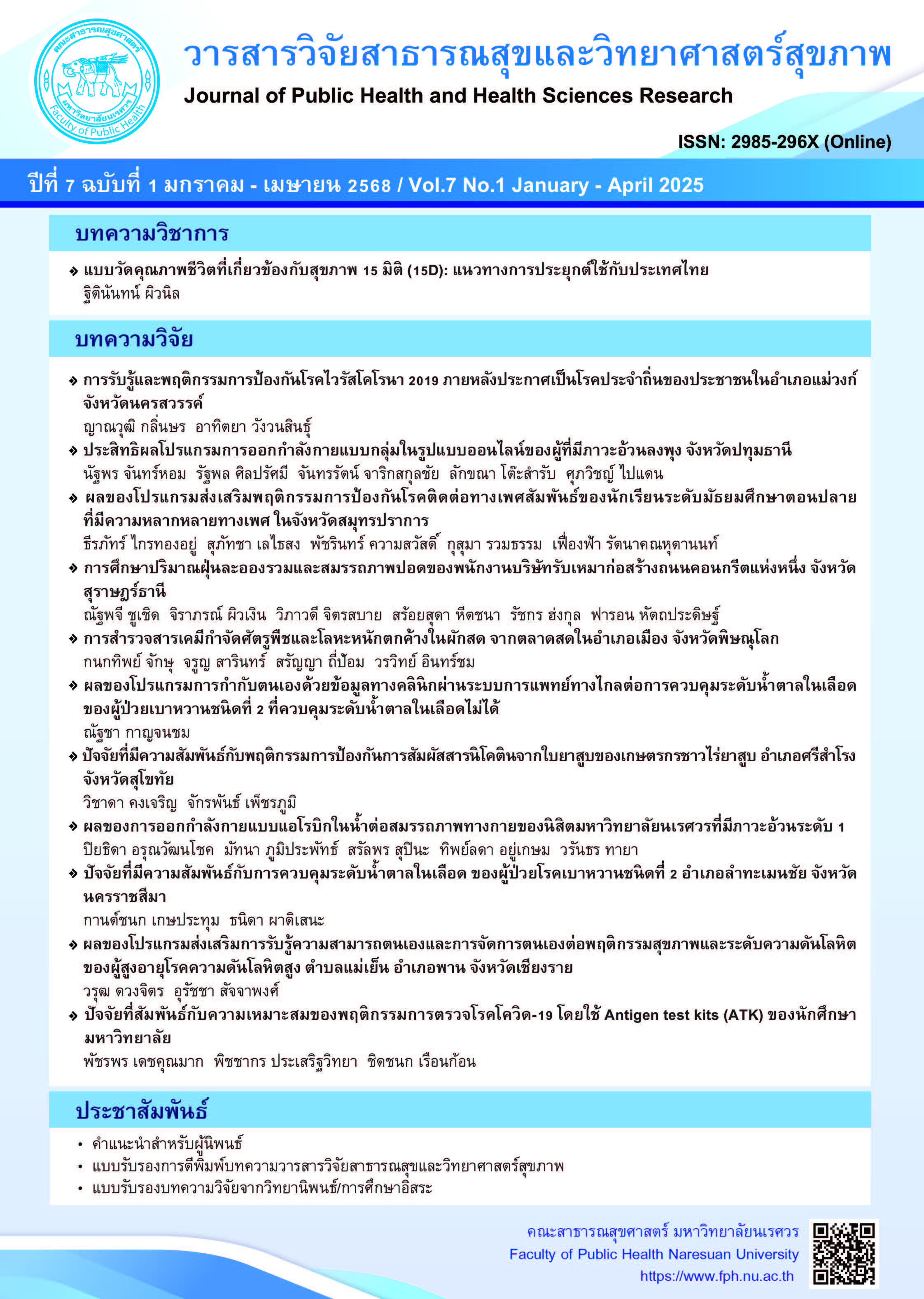
The 15-Dimensional health-related quality of life measure (15D): Application guidelines for Thailand
Keywords:
Health assessment, Health-related quality of life, 15D measureAbstract
The 15-Dimensional health-related quality of life measure (15D) instrument, developed by Harri Sintonen, is an internationally recognized tool for assessing health-related quality of life. This article aims to provide information about the 15D instrument and propose guidelines for its application in the context of Thailand. The 15D consists of 15 questions covering various dimensions of health. Studies conducted in multiple countries have demonstrated the reliability and validity of this instrument, with Cronbach's alpha coefficients ranging from 0.76 to 0.98. However, certain limitations remain, such as sensitivity to specific conditions in certain diseases and ceiling effects among healthy individuals. For its application in Thailand, it is essential to translate and adapt the instrument to the cultural context and conduct psychometric testing before its actual implementation. The 15D instrument has the potential to be applied in clinical research, public health studies, and health economic evaluations. Its implementation is expected to contribute significantly to the development of health policies and efficient resource allocation in Thailand's public health system.
References
Abdul Mohit, M. (2018). Quality-of-life studies in batural and built environment: challenges and emerging issues. Asian Journal of Behavioural Studies, 3(10), 147-157. doi:10.21834/ajbes.v3i10.89
Akinci, F., Yildirim, A., Ogutman, B., Ates, M., Gozu, H., Deyneli, O., et al. (2005). Translation, cultural adaptation, initial reliability, and validation of Turkish 15D’s Version: ageneric health-related quality of life (HRQoL) Instrument. Evaluation & the Health Professions, 28(1), 53-66. doi:10.1177/0163278704273078
Alanne, S., Roine, R. P., Rasanen, P., Vainiola, T., & Sintonen, H. (2015). Estimating the minimum important change in the 15D scores. Quality of Life Research, 24(3), 599-606. doi:10.1007/s11136-014-0787-4
Aletras, V. H., Kontodimopoulos, N., Niakas, D. A., Vagia, M. G., Pelteki, H. J., Karatzoglou, G., et al. (2009). Valuation and preliminary validation of the Greek 15D in a sample of patients with coronary artery disease. Value in Health, 12(4), 574-579.doi: https://doi.org/10.1111/j.1524-4733.2008.00462.x
Aro, K., Back, L., Loimu, V., Saarilahti, K., Rogers, S., Sintonen, H., et al. (2016). Trends in the 15D health-related quality of life over the first year following diagnosis of head and neck cancer. European Archives of Oto-Rhino-Laryngology, 273(8), 2141-2150. doi:10.1007/s00405-015-3732-4
Baudino, M., Carreon, S. A., Streisand, R., Tang, T. S., Lyons, S., Mckay, S., et al. (2023). 714-P: Health-related quality of life (HRQOL) in young adults with T1D. Diabetes, 72 (Supplement_1). doi:10.2337/db23-714-P
Bujang, M. A., Lai, W. H., Ratnasingam, S., Tiong, X. T., Hon, Y. K., Yap, E. P. P., et al. (2023). Development of a quality-of-life instrument to measure current health outcomes: healthrelated quality of life with six domains (HRQ-6D). Journal of Clinical Medicine, 12(8), 2816.
Burholt, V., & Nash, P. (2011). Short form 36 (SF-36) health survey questionnaire: normative data for Wales. Journal of Public Health, 33(4), 587-603.doi: 10.1093/pubmed/fdr006
Campolina, A. G., Lopez, R. V. M., Nardi, E. P., & Ferraz, M. B. (2018). Internal consistency of the SF-6D as a health status index in the Brazilian urban population. Value Health Reg Issues, 17, 74-80. doi:10.1016/j.vhri. 2018. 02.003
Chatterji, S., Ustun, B. L., Sadana, R., Salomon, J. A., Mathers, C. D., & Murray, C. J. (2002). The conceptual basis for measuring and reporting on health. Global Programme on Evidence for Health Policy Discussion Paper, 45.
Devlin, N., Parkin, D., & Janssen, B. (2020). An introduction to EQ-5D instruments and their applications. In N. Devlin, D. Parkin, & B. Janssen (Eds.), Methods for Analysing and Reporting EQ-5D Data (pp. 1-22). Cham: Springer International Publishing.
Dian, P., Libriansyah, Gesnita, N., & Yunita, N. (2023). Translation and cultural aAdaptation of multi-attribute utility instrument (MAUI) Indonesian version of the 15D questionnaire. Jurnal Farmasi Dan Ilum Kefarma Sian Indonesia, 10(2), 162-172.doi: 10.20473/jfiki.v10i22023.162-172
Dick, B. D., Rashiq, S., Verrier, M. J., Ohinmaa, A., & Zhang, J. (2011). Symptom burden, medication detriment, and support for the use of the 15D health-related quality of life instrument in a chronic pain clinic population. Pain Research and Treatment, 2011, 809071. doi:10.1155/2011/809071
Ferreira, S., Sintonen, H., Raimundo, A., Batalha, N., Mendoza-Munoz, M., Perez-Gomez, J., & Parraca, J. A. (2023). Translation, cultural adaptation, and reliability of the 15D Portuguese version: ageneric health-related quality of life (HRQoL) instrument. Healthcare, 11(8). doi:10.3390/healthcare11081099
Heiskanen, J., Tolppanen, A.-M., Roine, R. P., Hartikainen, J., Hippelainen, M., Miettinen, H., & Martikainen, J. (2016). Comparison of EQ-5D and 15D instruments for assessing the health-related quality of life in cardiac surgery patients. European Heart Journal- Quality of Care and Clinical Outcomes, 2(3), 193-200. doi:10.1093/ehjqcco/qcw002
Horsman, J., Furlong, W., Feeny, D., & Torrance, G. (2003). The Health Utilities Index (HUI ): concepts, measurement properties and applications. Health and Quality of Life Outcomes, 1(1), 54.doi: 10.1186/1477-7525-1-54
Kangwanrattanakul, K. (2018). Health-related quality of life questionnaires. from https://ccpe.pharmacycouncil.org/index.php?option=article_detail&subpage=article_detail&id=491. (in Thai)
Kluger, N., Sintonen, H., Ranta, M., & Serlachius, M. (2017). Health-related quality of life of patients with hidradenitis suppurativa measured with the 15D instrument and comparison with the general Ppopulation and patients with psoriasis. Skin Appendage Disorders, 4(3), 131-135. doi:10.1159/000481117
Krisdapong, S., Prasertsom, P., Rattanarangsima, K., Adulyanon, S., & Sheiham, A. (2012). Setting oral health goals that include oral health-related quality of life measures: a study carried out among adolescents in Thailand. Cadernos de Saude Publica, 28.
Ledinski FiCko, S., FriganoviC, A., KovaCeviC, I., KurtoviC, B., Hosnjak, A. M., & Smrekar, M. (2023). Instruments Used in Assessment of Health-Related Quality of Life. Croatian nursing journal, 6(2), 153-159. doi:10.24141/2/6/2/6
Macran, S., Weatherly, H., & Kind, P. (2003). Measuring population health: acomparison of three generic health status measures. Medical Care, 41(2). Retrieved from https://journals.lww.com/lww-medicalcare/fulltext/2003/02000/measuring_population_health__a_comparison_of_three.4.aspx
Makrilakis, K., Liatis, S., Tsiakou, A., Stathi, C., Papachristoforou, E., Perrea, D., . . . Niakas, D. (2018). Comparison of health-related quality of Life (HRQOL) among patients with pre-diabetes, diabetes and normal glucose tolerance, using the 15D-HRQOL questionnaire in Greece: the DEPLAN study. BMC Endocrine Disorders, 18(1), 32. doi:10.1186/s12902-018-0261-3
Mazur, W., Kupiainen, H., Pitkaniemi, J., Kilpelainen, M., Sintonen, H., Lindqvist, A., et al. (2011). Comparison between the disease-specific Airways Questionnaire 20 and the generic 15D instruments in COPD. Health and Quality of Life Outcomes, 9(1), 4. doi:10. 1186/1477-7525-9-4
Michel, Y. A., Augestad, L. A., Barra, M., & Rand, K. (2019). A Norwegian 15D value algorithm: proposing a new procedure to estimate 15D value algorithms. Quality of Life Research, 28(5), 1129-1143. doi:10.1007/s11136-018-2043-9
Miettinen, H. J. A., Makirinne-Kallio, N., Kroger, H., & Miettinen, S. S. A. (2021). Health-related quality of Llife after hip and knee arthroplasty operations. Scandinavian Journal of Surgery, 110(3), 427-433. doi:10.1177/1457496920952232
Okafor, C. N., Akosile, C. O., Nkechi, C. E., Okonkwo, U. P., Nwankwo, C. M., Okoronkwo, I. L., et al. (2023). Effect of educational intervention programme on the health-related quality of life (HRQOL) of individuals with type 2 diabetes mellitus in South-East, Nigeria. BMC Endocrine Disorders, 23(1), 75.doi: 10.1186/s12902-023-01329-y
Okamoto, N., Hisashige, A., Tanaka, Y., & Kurumatani, N. (2013). Development of the Japanese 15D instrument of health-related quality of life: verification of reliability and validity among elderly people. PLOS ONE, 8(4), e61721. doi:10.1371/journal.pone.0061721
Pattanaphesaj, J., & Thavorncharoensap, M. (2017). Quality of lLife questionnaire EQ-5D-5L (Thai version). Retrieved from https://www.hitap.net/wp-content/uploads/2014/11/Thai5L_brief_Aug2017.pdf
Ryhanen, E. M., Heiskanen, I., Sintonen, H., Valimaki, M. J., Roine, R. P., & Schalin-Jantti, C. (2015). Health-related quality of life is impaired in primary hyperparathyroidism and significantly improves after surgery: a prospective study using the 15D instrument. Endocrine Connections, 4(3), 179-186. doi:10.1530/EC-15-0053
Sevak, S., & Balamurugan, G. (2023). Quality of life: concepts, needs, psychometric measurement, factors associated and treatment responsiveness in depression disorder. International Journal Of Community Medicine And Public Health, 10(2), 887-892. doi:10.18203/2394-6040.ijcmph20230250
Sintonen, H. (2001). The 15D instrument of healthrelated quality of life: properties and applications. Annals of Medicine, 33(5), 328-336. doi:10.3109/07853890109002086
Sintonen, H. (2017a). The 15-D measure of health related quality of life: II feasibility, reliability and validity of its valuation system. doi:10.4225/03/5938f98b8c5fb
Sintonen, H. (2017b). The 15-D measure of health related quality of life: reliability, validity and sensitivity of its health state descriptive system. doi:10.4225/03/59389bbded953
Sintonen, H. (2024). 15D The health-related quality of life (HRQoL) instrument. Retrieved from https://www.15d-instrument.net/15d/
Sintonen, H., & Pekurinen, M. (1993). A fifteendimensional measure of health-related quality of life (15D) and its applications. In S. R. Walker & R. M. Rosser (Eds.), Quality of life assessment: Key issues in the 1990s (pp. 185-195). Dordrecht: Springer Netherlands.
Techakehakij, W. (2018). Assessing health-related quality of life and utility in health research. Chiang Mai: Chiang Mai University Press.
Vahedi, S. (2010). World Health Organization Quality-of-Life Scale (WHOQOL-BREF): analyses of their Iitem response theory properties based on the graded responses model. Iranian Journal of Psychiatry, 5(4), 140-153.
Vartiainen, P., Heiskanen, T., Sintonen, H., Roine, R. P., & Kalso, E. (2016). Health-related quality of life and burden of disease in chronic pain measured with the 15D instrument. PAIN, 157(10), 2269-2276. doi:10.1097/j.pain.0000000000000641
Yuksel, S., Elhan, A. H., Gokmen, D., Kucukdeveci, A. A., & Kutlay, S. (2018). Analyzing differential item functioning of the Nottingham health profile by Mixed Rasch Model Turkish Journal of Physical Medicine and Rehabilitation, 64(4), 300-307.doi: 10.5606/tftrd.2018.2796
Downloads
Published
How to Cite
Issue
Section
License
Copyright (c) 2025 Journal of Public Health and Health Sciences Research

This work is licensed under a Creative Commons Attribution-NonCommercial-NoDerivatives 4.0 International License.
The published article is copyrighted by the Journal of Public Health and Health Sciences Research.
The statements that appear in each article in this academic and research journal are the personal opinions of each author and are not related to Naresuan University and other faculty members in the university. Responsibilities regarding each article are the responsibility of each author.


