
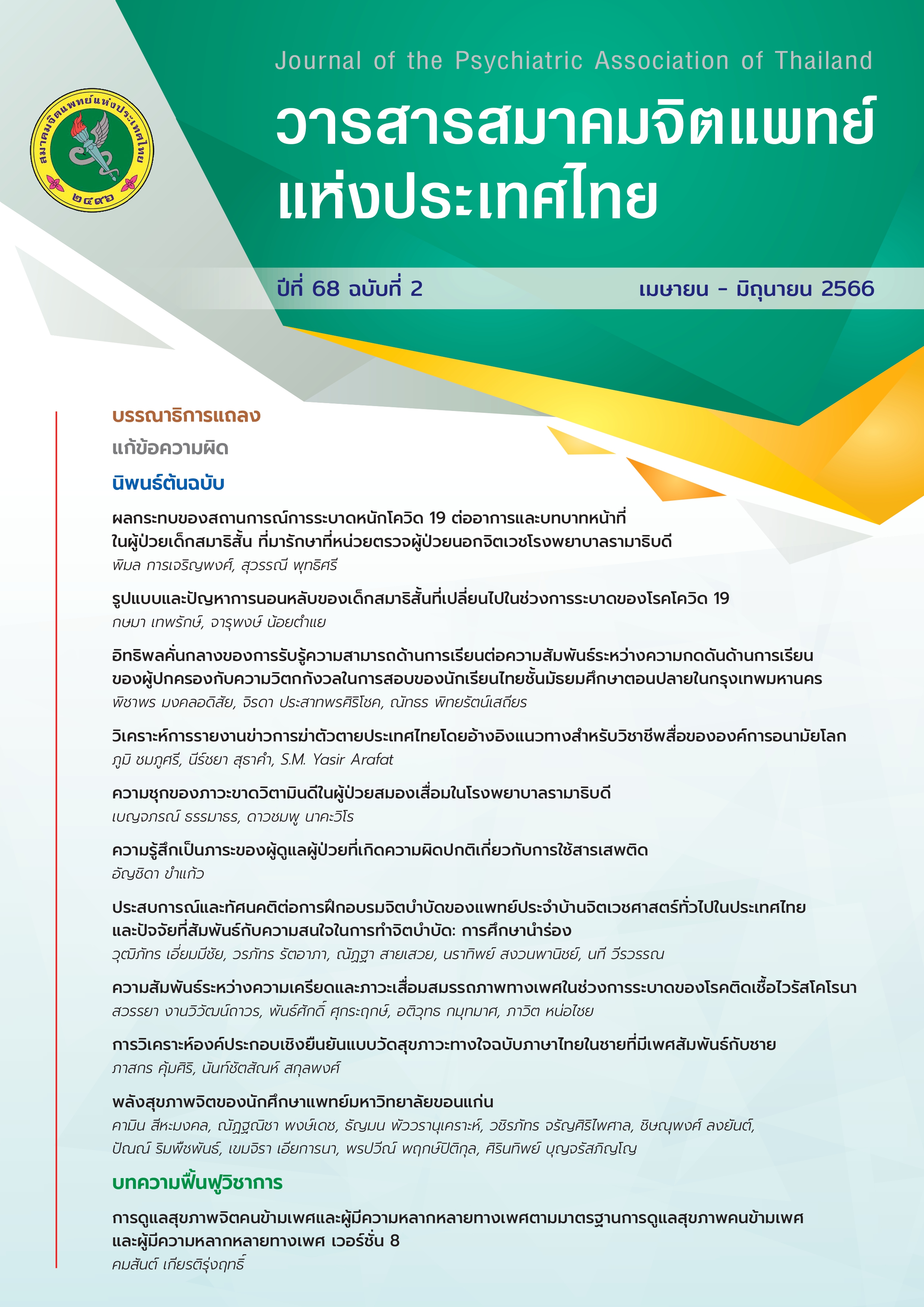
รูปแบบและปัญหาการนอนหลับของเด็กสมาธิสั้นที่เปลี่ยนไปในช่วงการระบาดของโรคโควิด 19
Article Sidebar
Main Article Content
บทคัดย่อ
วัตถุประสงค์ เพื่อศึกษารูปแบบและปัญหาการนอนหลับในเด็กสมาธิสั้นที่เปลี่ยนไปในช่วงการระบาดของโรคโควิด 19
วิธีการศึกษา การศึกษาแบบสังเกตและเก็บข้อมูลไปข้างหน้า ในกลุ่มเด็กสมาธิสั้นอายุ 4 - 10 ปี ที่มารับการรักษาที่โรงพยาบาลพิจิตร ด้วยการเก็บข้อมูล 2 ครั้ง คือ ครั้งที่ 1 ก่อนการระบาดของเชื้อโควิด19 ระลอกสองที่จังหวัดสมุทรสาคร (1 ตุลาคม - 17 ธันวาคม 2563) ครั้งที่ 2 ช่วงระหว่างการระบาดช่วงเดือนตุลาคม 2564 - มีนาคม 2565 โดยใช้แบบสอบถามซึ่งผู้ปกครองเป็นผู้ให้ข้อมูล ประกอบด้วยข้อมูลทั่วไป รูปแบบการนอนหลับ และแบบสอบถามปัญหาการนอนของเด็กฉบับภาษาไทย (CSHQ-Thai) และวิเคราะห์ข้อมูลโดยใช้ Pearson Chi-square test, Pair t test, Causation analysis, Diagnostic analysis และ Cluster analysis
ผลการศึกษา เด็กสมาธิสั้นเข้าร่วมวิจัย จำนวน 80 ราย พบว่าในช่วงการระบาดของโรคโควิด 19 จำนวนของเด็กนอนดึกมากขึ้นกว่าเดิมประมาณ 1 - 1.5 เท่า และตื่นช้าขึ้นประมาณ 30 นาที ถึง 1 ชั่วโมง เมื่อทำการจัดกลุ่มข้อมูลด้วยวิธีทางสถิติพบว่า เด็กซึ่งเคยตื่นนอนเวลา 6.14 น. เปลี่ยนมาตื่นเวลา 8.21 น. ซึ่งเพิ่มขึ้นกว่า 6 เท่า ทั้งยังมีจำนวนชั่วโมงการนอนหลับลดลงเมื่อเทียบกับช่วงก่อนการระบาด นอกจากนี้แบบสอบถามปัญหาการนอนหลับยังแสดงให้เห็นว่า เด็กสมาธิสั้นมีปัญหาภาวะหายใจผิดปกติจากการนอนหลับ (Sleep disorder breathing) เพิ่มมากขึ้นในช่วงการระบาดของโรคโควิด 19 อีกด้วย
สรุป เด็กสมาธิสั้นในช่วงวัยเรียนมีรูปแบบและปัญหาการนอนหลับที่เปลี่ยนแปลงไปอย่างมากในช่วงการระบาดของโรคโควิด19
Article Details

อนุญาตภายใต้เงื่อนไข Creative Commons Attribution-NonCommercial-NoDerivatives 4.0 International License.
บทความที่ส่งมาเพื่อพิจารณา ต้องไม่เคยตีพิมพ์หรือได้รับการตอบรับให้ตีพิมพ์ในวารสารฉบับอื่น และต้องไม่อยู่ระหว่างการส่งไปพิจารณาในวารสารอื่น
เอกสารอ้างอิง
Vindegaard N, Benros ME. COVID-19 pandemic and mental health consequences: systematic review of the current evidence. Brain Behav Immun 2020;89:531–42.
Sun Y, Wu Y, Fan S, Dal Santo T, Li L, Jiang X, et al. Comparison of mental health symptoms before and during the covid-19 pandemic: evidence from a systematic review and meta-analysis of 134 cohorts. BMJ 2023;380:e074224.
Meherali S, Punjani N, Louie-Poon S, Abdul Rahim K, Das JK, Salam RA, et al. Mental health of children and adolescents amidst COVID-19 and past pandemics: A rapid systematic review. Int J Environ Res Public Health 2021;18(7):3432.
Sholihah IF, Nurmala I, Sulistyowati M, Devy SR. The impact physical distancing during the COVID-19 pandemic on mental health among adolescents: a systematic literature review. Int J Public Health Sci (IJPHS) 2022;11(1):69.
Panda PK, Gupta J, Chowdhury SR, Kumar R, Meena AK, Madaan P, et al. Psychological and behavioral impact of lockdown and quarantine measures for COVID-19 pandemic on children, adolescents and caregivers: A systematic review and meta-analysis. J Trop Pediatr 2021;67(1): fmaa122.
Hongsanguansri S.,Limsuwan N. Psychological development. In Psychiatry Ramathibodi. 4th ed. Bangkok:2015.p.1-20.
Wormald A, McGlinchey E, D’Eath M, Leroi I, Lawlor B, McCallion P, et al. Impact of COVID-19 pandemic on caregivers of people with an intellectual disability, in comparison to carers of those with other disabilities and with mental health issues: A multicountry study. Int J Environ Res Public Health 2023;20(4): 3256.
Kim H, Park KJ, Shin YW, Lee JS, Chung S, Lee T, et al. Psychological impact of quarantine on caregivers at a children’s hospital for contact with case of COVID-19. J Korean Med Sci 2020;35(28):e255.
Sadeh A, Raviv A, Gruber R. Sleep patterns and sleep disruptions in school-age children. Dev Psychol 2000;36(3):291–301
Belmon LS, van Stralen MM, Busch V, Harmsen IA, Chinapaw MJM. What are the determinants of children’s sleep behavior? A systematic review of longitudinal studies. Sleep Med Rev 2019;43:60–70
Jiang Y, Feng Y, Wei Z, Zhang Y, You B, Hu Mingdong, et al. Clinical and immunological characteristics of coronavirus disease 2019 patients with redetectable viral RNA post-discharge during the quarantine period. Blood Genom 2022;6(2):125–32.
Sharma M, Aggarwal S, Madaan P, Saini L, Bhutani M. Impact of COVID-19 pandemic on sleep in children and adolescents: a systematic review and meta-analysis. Sleep Med 2021;84:259-67.
Bruni O, Giallonardo M, Sacco R, Ferri R, Melegari MG. The impact of lockdown on sleep patterns of children and adolescents with ADHD. J Clin Sleep Med 2021;17(9):1759-65.
Sciberras E, Patel P, Stokes MA, Coghill D, Middeldorp CM, Bellgrove MA, et al. Physical health, media use, and mental health in children and adolescents with ADHD during the COVID-19 pandemic in Australia. J Atten Disord 2022;26(4):549-62.
Wayne WD. Introductory statistics with aplication. Boston: Hougton Miffin Co; 1977.
Hosiri T, Punyapas S, Sawangsri W. The Prevalence and Patterns of Sleep Problem in Children with ADHD. J Med Assoc Thai 2018;101:S34-40.
Cortese S, Brown TE, Corkum P, Gruber R, O’Brien LM, Stein M, Weiss M, et al. Assessment and management of sleep problems in youths with attention-deficit/hyperactivity disorder. J Am Acad Child Adolesc Psychiatry 2013;52(8):784-96.
Disayawanwat P, Pityaratstian N. Development of children’s sleep habit questionnaire Thai version. Chula Med J 2016;60(3):297-312.
Gruber R. Sleep characteristics of children and adolescents with attention deficit-hyperactivity disorder. Child Adolesc Psychiatr Clin N Am 2009;18(4):863-76.
De Crescenzo F, Licchelli S, Ciabattini M, Menghini D, Armando M, Alfieri P, et al. The use of actigraphy in the monitoring of sleep and activity in ADHD: A meta-analysis. Sleep Med Rev 2016;26:9–20.
Bruni O, Malorgio E, Doria M, Finotti E, Spruyt K, Melegari MG, et al. Changes in sleep patterns and disturbances in children and adolescents in Italy during the Covid-19 outbreak. Sleep Med 2022;91:166–74.
Cellini N, Canale N, Mioni G, Costa S. Changes in sleep pattern, sense of time and digital media use during COVID-19 lockdown in Italy. J Sleep Res 2020;29(4):e13074.
Guan H, Okely AD, Aguilar-Farias N, Del Pozo Cruz B, Draper CE, El Hamdouchi A, et al. Promoting healthy movement behaviours among children during the COVID-19 pandemic. Lancet Child Adolesc Health 2020;4(6):416–8.
Xiang M, Zhang Z, Kuwahara K. Impact of COVID-19 pandemic on children and adolescents’ lifestyle behavior larger than expected. Prog Cardiovasc Dis. 2020;63(4):531–2.
Becker SP, Dvorsky MR, Breaux R, Cusick CN, Taylor KP, Langberg JM. Prospective examination of adolescent sleep patterns and behaviors before and during COVID-19. Sleep 2021;44(8).
Hirshkowitz M, Whiton K, Albert SM, Alessi C, Bruni O, DonCarlos L, et al. National Sleep Foundation’s sleep time duration recommendations: methodology and results summary. Sleep Health 2015;1(1):40–3.
