
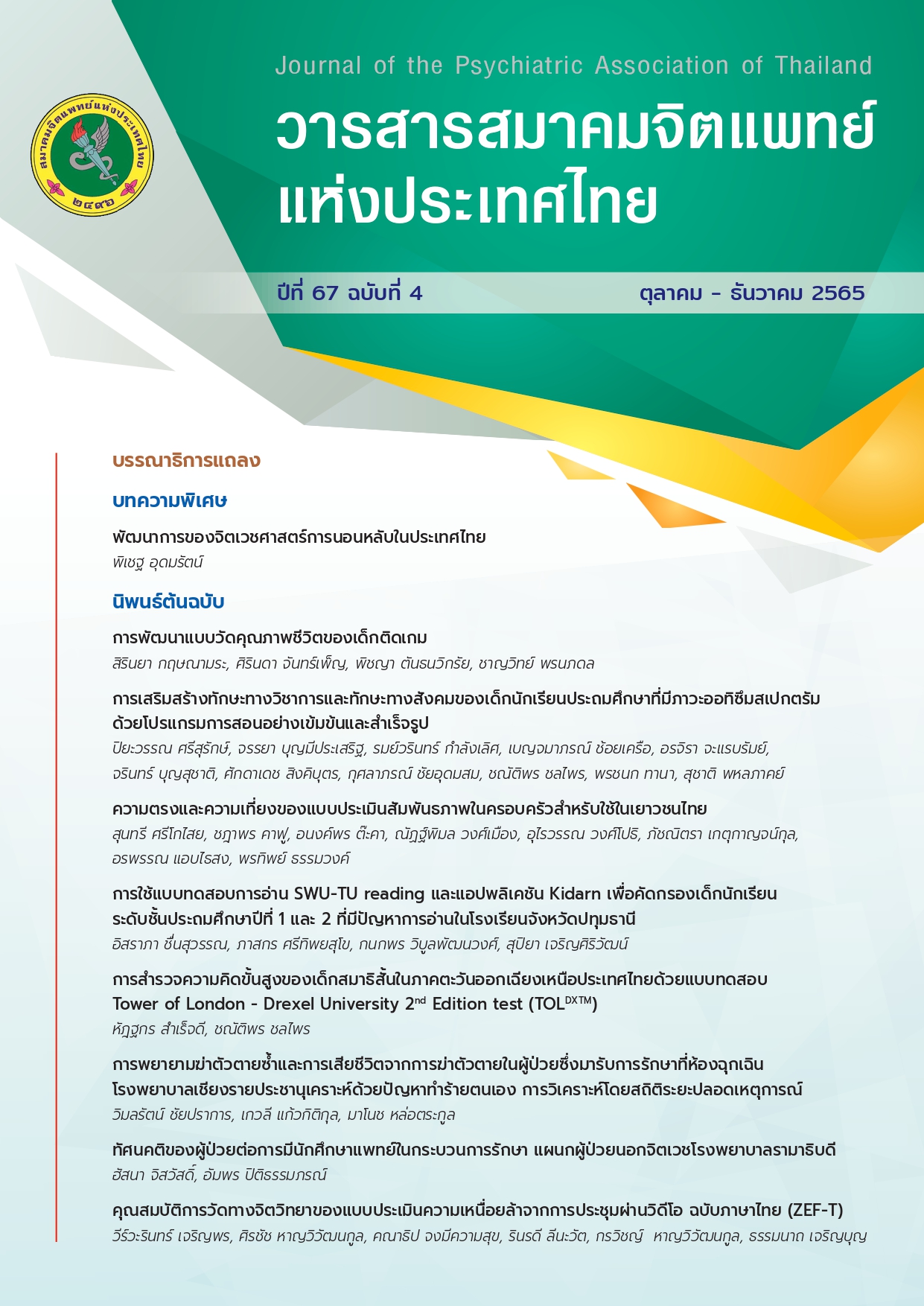
การสำรวจความคิดขั้นสูงของเด็กสมาธิสั้นในภาคตะวันออกเฉียงเหนือประเทศไทยด้วย แบบทดสอบ Tower of London – Drexel University 2nd Edition test (TOLDXTM)
Article Sidebar
Main Article Content
บทคัดย่อ
วัตถุประสงค์: เพื่อศึกษาการคิดขั้นสูงของเด็กสมาธิสั้นในภาคตะวันออกเฉียงเหนือประเทศไทย โดยเปรียบเทียบระหว่างกลุ่มอายุ 7 - 10 ปี และ 11 - 15 ปี และกลุ่มเด็กสมาธิสั้นที่ไม่ได้กินยาสมาธิก่อนการทดสอบ และกินยาสมาธิก่อนการทดสอบ
วิธีการศึกษา: การศึกษาภาคตัดขวาง เก็บข้อมูลที่แผนกจิตเวช โรงพยาบาลศรีนครินทร์ สังกัดคณะแพทยศาสตร์ มหาวิทยาลัยขอนแก่น ระหว่างวันที่ 1 ธันวาคม 2564 ถึง 30 กรกฎาคม 2565 ของเด็กที่ได้รับการวินิจฉัยโรคสมาธิสั้น อายุระหว่าง 7 - 10 ปี และ 11 - 15 ปี จำนวน 83 ราย และประเมินการคิดขั้นสูงด้วยแบบทดสอบ Tower of London - Drexel University 2nd Edition test (TOLDXTM) วิเคราะห์ข้อมูลด้วยค่าเฉลี่ย และเปรียบเทียบค่าเฉลี่ยสองกลุ่มอิสระด้วยสถิติ Independent t-test
ผลการศึกษา: คะแนนเฉลี่ย total move score เท่ากับ 88.41 (SD=16.80) total correct score เท่ากับ 87.52 (SD=13.11) total rule violation เท่ากับ 94.05 (SD=16.82) total initiation time เท่ากับ 96.14 (SD=12.63) total execution time เท่ากับ 95.11 (SD=15.59) และ total problem-solving time เท่ากับ 96.84 (SD=15.65) และกลุ่มเด็กอายุ 7 - 10 ปี เคลื่อนย้ายลูกปัดเฉลี่ยมากกว่ากลุ่มอายุ 11 - 15 ปีอย่างมีนัยสำคัญทางสถิติ (p-value=0.003)
สรุป: การคิดขั้นสูงของเด็กสมาธิสั้นในภาคตะวันออกเฉียงเหนือประเทศไทยอยู่ในระดับต่ำกว่าเกณฑ์ปกติ
Article Details

อนุญาตภายใต้เงื่อนไข Creative Commons Attribution-NonCommercial-NoDerivatives 4.0 International License.
บทความที่ส่งมาเพื่อพิจารณา ต้องไม่เคยตีพิมพ์หรือได้รับการตอบรับให้ตีพิมพ์ในวารสารฉบับอื่น และต้องไม่อยู่ระหว่างการส่งไปพิจารณาในวารสารอื่น
เอกสารอ้างอิง
American Psychiatric Association. Diagnostic and statistical manual of mental disorders (DSM-5®). American Psychiatric Pub; 2013.
Castellanos FX, Proal E. Large-scale brain systems in ADHD: beyond the prefrontal–striatal model. Trends Cogn Sci 2012; 16(1) :17–26.
Liston C, Matalon S, Hare TA, Davidson MC, Casey BJ. Anterior cingulate and posterior parietal cortices are sensitive to dissociable forms of conflict in a task-switching paradigm. Neuron 2006; 50(4): 643–53.
Rubia K. ADHD brain function. Oxford Textb Atten Deficit Hyperact Disord 2018; 64.
Roman-Urrestarazu A, Lindholm P, Moilanen I, Kiviniemi V, Miettunen J, Jääskeläinen E, et al. Brain structural deficits and working memory fMRI dysfunction in young adults who were diagnosed with ADHD in adolescence. Eur Child Adolesc Psychiatry 2016; 25(5): 529–38.
Bock J, Breuer S, Poeggel G, Braun K. Early life stress induces attention-deficit hyperactivity disorder (ADHD)-like behavioral and brain metabolic dysfunctions: functional imaging of methylphenidate treatment in a novel rodent model. Brain Struct Funct 2017; 222(2): 765–80.
Doyle AE. Executive functions in attention-deficit/hyperactivity disorder. J Clin Psychiatry [Internet] 2006; 67 Suppl 8:21–6. Available from: http://europepmc.org/abstract/MED/16961426
Brown TE. Attention deficit disorder: The unfocused mind in children and adults. Yale University Press; 2005.
Brown TE. Executive functions and attention deficit hyperactivity disorder: Implications of two conflicting views. Int J Disabil Dev Educ 2006; 53(1): 35–46.
Diamond A. Executive functions. Annu Rev Psychol 2013; 64: 135–68.
Rosen AC, Gur RC. Ethical considerations for neuropsychologists as functional magnetic imagers. Brain Cogn 2002; 50(3): 469–81.
Zakzanis KK, Mraz R, Graham SJ. An fMRI study of the Trail Making Test. Neuropsychologia 2005; 43(13): 1878–86.
Binder JR, Sabsevitz DS, Swanson SJ, Hammeke TA, Raghavan M, Mueller WM. Use of preoperative functional MRI to predict verbal memory decline after temporal lobe epilepsy surgery. Epilepsia 2008; 49(8): 1377–94.
Barkley RA. Neuropsychological testing is not useful in the diagnosis of ADHD: Stop it (or prove it)! ADHD Rep 2019; 27(2): 1–8.
Jullagate S, Wisessathorn M, Patcharoros N. The comparative study of executive function between children with ADHD and healthy children. J Psychiatr Assoc Thai 2019; 64(2): 187–96.
Culbertson WC, Zillmer EA. The Tower of London(DX): a standardized approach to assessing executive functioning in children. Arch Clin Neuropsychol 1998; 13(3): 285–301.
Culbertson WC. Tower of London - Drexel University (TOL - DX) : technical manual. Second edition. Zillmer EA, editor. Toronto: MHS; 2005.
Culbertson WC, Zillmer EA. The construct validity of the Tower of London DX as a measure of the executive functioning of ADHD children. Assessment 1998; 5(3): 215–26.
Chaimaha N, Sriphetcharawut S, Lersilp S, Chinchai S. Effectiveness of therapeutic programs for students with ADHD with executive function deficits. J Occup Ther Sch Early Interv 2017; 10(4): 436–56.
Chirawatkul A. Statistic for health science research. 4th ed. Bangkok: Witthayaphat Co.,Ltd; 2558.
Romine CB, Reynolds CR. A model of the development of frontal lobe functioning: Findings from a meta-analysis. Appl Neuropsychol 2005; 12(4): 190–201.
Yasumura A, Omori M, Fukuda A, Takahashi J, Yasumura Y, Nakagawa E, et al. Age-related differences in frontal lobe function in children with ADHD. Brain Dev 2019; 41(7): 577–86.
Lumsdaine E, Lumsdaine M. Creative problem solving. IEEE Potentials 1994; 13(5): 4–9.
Kaufman JC, Baer J. Creativity and reason in cognitive development. Cambridge University Press; 2006.
Mechler K, Banaschewski T, Hohmann S, Häge A. Evidence-based pharmacological treatment options for ADHD in children and adolescents. Pharmacol Ther 2022; 230: 107940.
Hernández GGC, Selva JPS. Medication and creativity in attention deficit hyperactivity disorder (ADHD). Psicothema 2016; 28(1): 20–5.
