
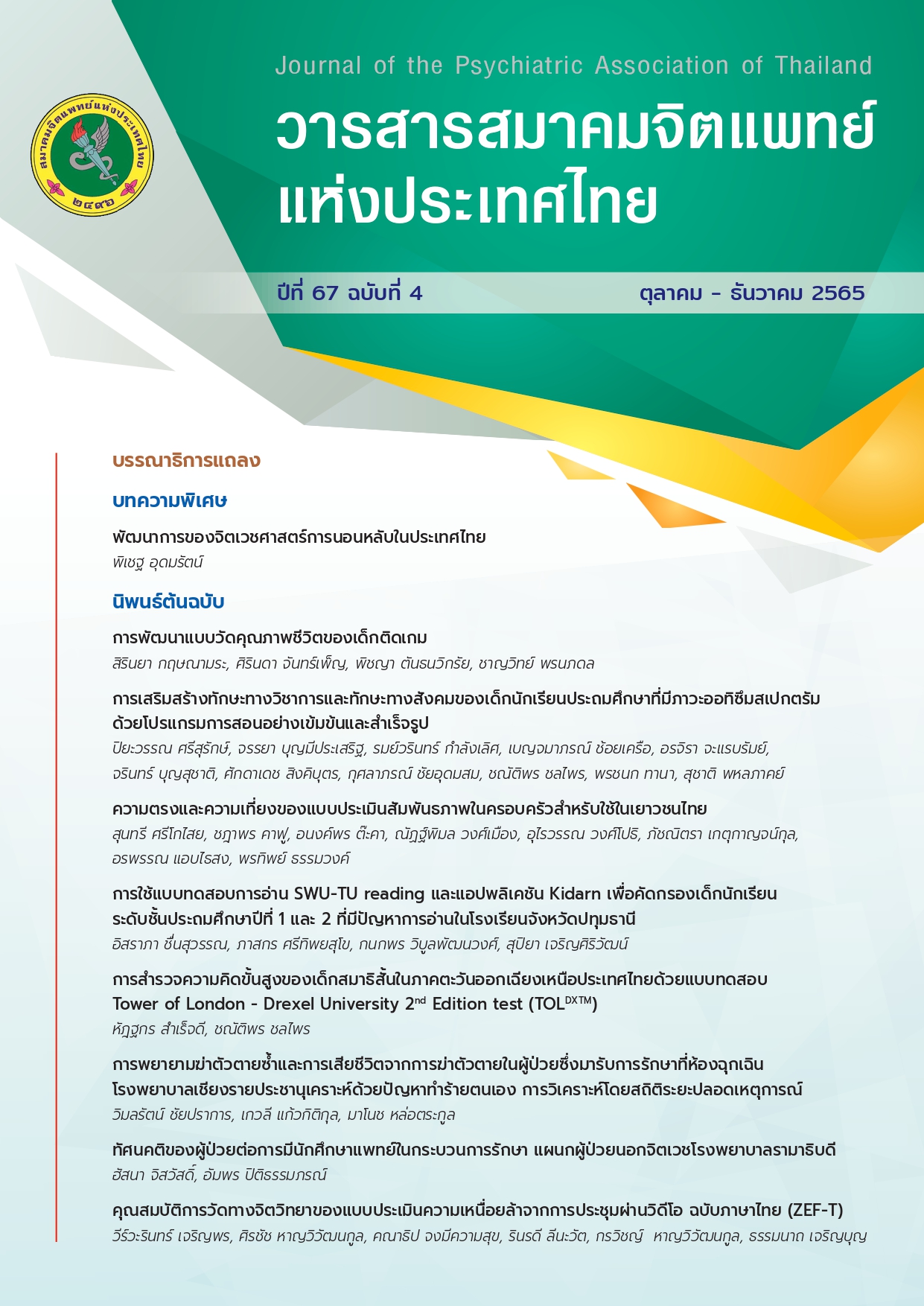
การเสริมสร้างทักษะทางวิชาการและทักษะทางสังคมของเด็กนักเรียนประถมศึกษาที่มีภาวะออทิซึมสเปกตรัมด้วยโปรแกรมการสอนอย่างเข้มข้นและสำเร็จรูป
Article Sidebar
Main Article Content
บทคัดย่อ
วัตถุประสงค์: เพื่อพัฒนาโปรแกรมอย่างเข้มข้นและสำเร็จรูป เพื่อให้ครูนำไปใช้สอนเด็กนักเรียนประถมศึกษาที่เป็นโรค ASD ในห้องเรียนรวม เพื่อเสริมสร้างทักษะทางวิชาการและทักษะทางสังคมให้แก่เด็กและเพื่อศึกษาผลการสอนด้วยโปรแกรมเข้มข้นและสำเร็จรูป
วิธีการศึกษา: เลือกกลุ่มเป้าหมายในการวิจัยอย่างเจาะจงประกอบด้วยครูและนักเรียนประถมศึกษาที่เป็นโรค ASD ที่ครูคนนั้นสอนในห้องเรียนรวมจากโรงเรียนในจังหวัดขอนแก่น จำนวนกลุ่มละ 15 คน เด็กทุกคนได้รับการวินิจฉัยจากจิตแพทย์เด็กและวัยรุ่นว่าเป็นโรค ASD ความรุนแรงอยู่ในระดับ 1 ตามเกณฑ์ DSM-5 เครื่องมือที่ใช้ในการวิจัยได้แก่ 1) โปรแกรมเข้มข้นและสำเร็จรูปเพื่อให้ความรู้แก่ครูเกี่ยวกับโรค ASD และวิธีการสอนเพื่อเสริมสร้างทักษะทางวิชาการและทักษะทางสังคมแก่นักเรียนประถมศึกษาที่เป็นโรค ASD พร้อมแบบประเมินความรู้ของครูก่อนและหลังการอบรม 2) โปรแกรมเข้มข้นและสำเร็จรูปเพื่อให้ครูนำไปใช้สอนเพื่อเสริมสร้างทักษะทางวิชาการและทักษะทางสังคมให้นักเรียนประถมศึกษาที่เป็นโรค ASD สอน 10 ครั้ง ครั้งละ 3 ชั่วโมง สอนตามโครงสร้างที่โครงการวิจัยกำหนดไว้ สื่อที่ใช้ในการสอนมีแผ่นภาพ นิทานเล่า เพลง การละเล่น คณะผู้นิพนธ์จะอบรมเชิงปฏิบัติการการใช้โปรแกรมสำเร็จรูปให้แก่ครูจนครูแสดงการสอนด้วยโปรแกรมเข้มข้นและสำเร็จรูปได้ถูกต้อง ต่อไปครูจะนำโปรแกรมเข้มข้นและสำเร็จรูปไปสอนด้วยตนเอง 3) แบบประเมินสำหรับการประเมินทักษะทางวิชาการและทักษะทางสังคมของนักเรียนที่เป็นโรค ASD ที่เข้าร่วมกับโครงการวิจัย ประเมินก่อนและหลังเสร็จการเรียนด้วยโปรแกรมเข้มข้นและสำเร็จรูป โปรแกรมเข้มข้นและสำเร็จรูปทั้งสองโปรแกรมพร้อมกับแบบประเมินประจำแต่ละโปรแกรมคณะผู้นิพนธ์ทุกคนได้ช่วยกันพัฒนาขึ้นมาและได้รับการตรวจปรับแก้โดยผู้เชี่ยวชาญในหลักสูตรการสอนเด็กนักเรียน ASD จำนวน 3 คน จนผู้เชี่ยวชาญทั้ง 3 คน มีความเห็นพ้องกันว่าเหมาะสมและใช้ในการวิจัยได้ วิเคราะห์ข้อมูลด้วยสถิติพรรณนา และสถิติวิเคราะห์ด้วยโปรแกรม SPSS version 26
ผลการศึกษา ผลการวิจัยพบว่าภายหลังการอบรม ครูมีคะแนนเฉลี่ยของความรู้เกี่ยวกับโรค ASD และวิธีการสอนทักษะทางวิชาการและทักษะทางสังคมแก่นักเรียนประถมศึกษาที่เป็นโรค ASD เพิ่มขึ้น แต่ไม่มีนัยสำคัญทางสถิติ (ค่า p = 0.13) การสอนด้วยโปรแกรมเข้มข้นและสำเร็จรูปทำให้นักเรียนที่เป็นโรค ASD มีคะแนนเฉลี่ยของทักษะทางสังคมด้านการแสดงอารมณ์ การผูกมิตร การเปลี่ยนผ่านและทักษะทางวิชาการเพิ่มขึ้น 3.33 2.27 2.94 และ 3.00 คะแนน คะแนนเต็มแต่ละด้านคือ 18 12 15 และ 12 ตามลำดับ คะแนนเพิ่มขึ้นอย่างมีนัยสำคัญทางสถิติ ค่า p Paired T-Test = 0.007, 0.013, 0.028 และ 0.003 ตามลำดับ
สรุป: โปรแกรมการสอนทั้งทักษะทางวิชาการและทักษะทางสังคมพร้อมๆ กันที่มีความเข้มข้นและสำเร็จรูปสามารถเสริมสร้างทักษะทั้งทางวิชาการและทักษะทางสังคมแก่เด็กนักเรียนประถมศึกษาที่ภาวะออทิซึมสเปกตรัมให้เพิ่มขึ้น
Article Details

อนุญาตภายใต้เงื่อนไข Creative Commons Attribution-NonCommercial-NoDerivatives 4.0 International License.
บทความที่ส่งมาเพื่อพิจารณา ต้องไม่เคยตีพิมพ์หรือได้รับการตอบรับให้ตีพิมพ์ในวารสารฉบับอื่น และต้องไม่อยู่ระหว่างการส่งไปพิจารณาในวารสารอื่น
เอกสารอ้างอิง
Maenner MJ, Shaw KA, Bakian AV, Bilder DA, Durkin MS, Esler A, et al. Prevalence and characteristics of autism spectrum disorder among children aged 8 years - Autism and Developmental Disabilities Monitoring Network, 11 Sites, United States, 2018. MMWR Surveill Summ 2021;70:1-16.
American Psychiatric Association. Neurodevelopmental disorder. In: American Psychiatric Association, editor. Diagnostic and statistical manual of mental disorders. 5th ed. American Psychiatric Association; Washington, DC. p. 31-86.
Koegel LK, Singh AK, Koegel RL. Improving motivation for academics in children with autism. J Autism Dev Disord 2010;40:1057-66.
Sanchack KE, Thomas CA. Autism spectrum disorder: primary care principles. Am Fam Physician 2016;94:972-9.
Bravo A, Schwartz I. Teaching imitation to young children with autism spectrum disorder using discrete trial training and contingent imitation. J Dev Phys Disabil 2021;6:1-18.
Dionne M, Martini R. Floor time play with a child with autism: a single-subject study. Can J Occup Ther 2011;78:196-203.
Rao SM, Gagie B. Learning through seeing and doing: visual supports for children with autism. TEACHING Exceptional Children 2006;38:26-33. doi:10.1177/004005990603800604
Kurth JA, Mastergeorge AM. Academic and cognitive profiles of students with autism: implications for classroom practice and placement. Int J Spec Educ 2010;25:8-14
Arick JR, Loos L, Falco R, Krug DA. Strategies for teaching based on autism research: STAR. TX: ProEd, 2004.
Autism Spectrum Teacher. Autism for Teachers. Available from: https://www.autismforteachers.com/p/autism-for-teachers.access [Accessed 06 June 2022].
Walton KM, Ingersoll BR. The influence of maternal language responsiveness on the expressive speech production of children with autism spectrum disorders: a microanalysis of mother-child play interactions. Autism 2015;19:421-32.
Bordini D, Paula CS, Cunha GR, Caetano SC, Bagaiolo LF, Ribeiro TC, et al. A randomized clinical pilot trial to test the effectiveness of parent training with video modeling to improve functioning and symptoms in children with autism spectrum disorders and intellectual disability. J Intellect Disabil Res 2020;64:629-43
Magiati I, Moss J, Yates R, Charman T, Howlin P. Is the Autism Treatment Evaluation Checklist a useful tool for monitoring progress in children with autism spectrum disorders? J Intellect Disabil Res 2011;55:302-12.
Biggs EE. Strengthening professional networks to serve students with autism who have communication needs. Intervention in School and Clinic. 2022. 0(0). https://doi.org/10.1177/10534512221081250
Mayo clinic. Autism spectrum disorder - Diagnosis and treatment. Available from: https://www.mayoclinic.org/diseases-conditions/autism-spectrum-disorder/diagnosis-treatment/drc-20352934 [Access 13 March 2022].
Kember D, Kwan K-R. Lecturers’ approaches to teaching and their relationship to conceptions of good teaching. Instr Sci 2000;28:469–90.
Warren JL. Does service-learning increase student learning?: a meta-analysis. MJCSL 2012;18: 56-61.
Arthur-KM, Sigafoos J, Green V, Mathisen B, Arthur-Kelly R. Issues in the use of visual supports to promote communication in individuals with autism spectrum disorder. Disabil Rehabil 2009;31:1474-86.
Cihon JH, Ferguson JL, Leaf JB, Milne CM, Leaf R, McEachin J. A randomized clinical trial of three prompting systems to teach tact relations. J Appl Behav Anal 2020;53:727-43.
Meadan H, Ostrosky MM, Triplett B, Michna A, Fettig A. Using visual supports with young children with autism spectrum disorder. Teach Except Child 2011;43:28–35.
Jung S, Sainato DM. Teaching play skills to young children with autism. J Intellect Dev Disabil 2013;38:74-90.
Alvares GA, Chen NTM, Notebaert L, Granich J, Mitchell C, Whitehouse AJO. Brief social attention bias modification for children with autism spectrum disorder. Autism Res 2019;12:527-35.
Sheehy E, Moore K, Tsamtsouris A. Augmentative communication for the non-speaking child. J Clin Pediatr Dent 1993;17:261-4.
Thompson GA, Abel LA. Fostering spontaneous visual attention in children on the autism spectrum: a proof-of-concept study comparing singing and speech. Autism Res 2018;11:732-7.
Müller E, Cannon LR, Kornblum C, Clark J, Powers M. Description and preliminary evaluation of a curriculum for teaching conversational skills to children with high-functioning autism and other social cognition challenges. Lang Speech Hear Serv Sch 2016;47:191-208.
Kotsopoulos SI, Karaivazoglou K, Florou IS, Gyftogianni MI, Papadaki EJ, Kotsopoulou A. Systematic intervention for children with autism spectrum disorder and integration in regular school classes: A naturalistic study. Glob Pediatr Health 2021;8:2333794X211012988.
Russell L, Wendy M, Mark OR, Jeff S, Mandy R, Karrie S, et al. Review of interventions to increase functional and symbolic play in children with autism. Educ Train Autism Dev Disabil 2009;44:481-92.
Zhao M, Chen S. The effects of structured physical activity program on social interaction and communication for children with autism. BioMed Res 2018;2018:1825046.
Roane HS, Fisher WW, Carr JE. Applied behavior analysis as treatment for autism spectrum disorder. J Pediatr 2016;175:27-32
Smith T. Discrete trial training in the treatment of autism. Focus on Autism and Other Developmental Disabilities. 2001;16:86-92.
Center for Autism Middle Town. Differentiating the curriculum - best practice resource (middletownautism.com), NI: Center for Autism Middle Town. Available from: https://best-practice.middletownautism.com/approaches-of-intervention/differentiating-the-curriculum [access 23 Jun 2022].
Tachibana Y, Miyazaki C, Ota E, Mori R, Hwang Y, Kobayashi E, et al. A systematic review and meta-analysis of comprehensive interventions for pre-school children with autism spectrum disorder (ASD). PLoS One 2018;13(5):e0196272.
Whalon KJ, Conroy MA, Martinez JR, Werch BL. School-based peer-related social competence interventions for children with autism spectrum disorder: a meta-analysis and descriptive review of single case research design studies J Autism Dev Disord 2015;45:1513-31.
