
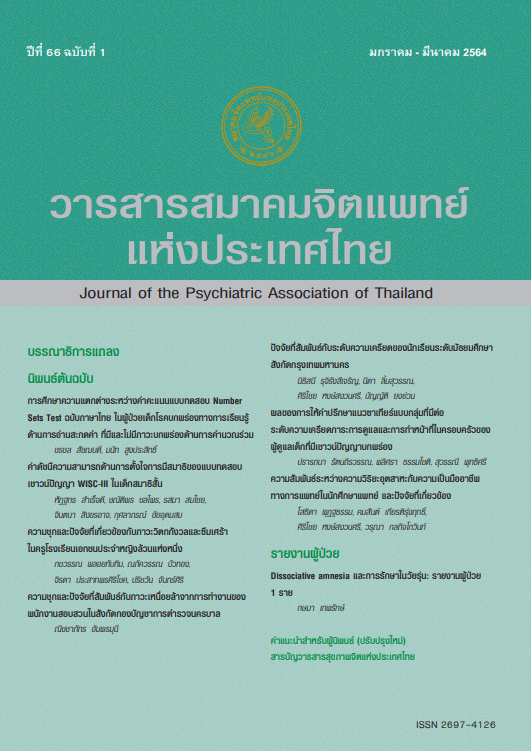
การศึกษาความแตกต่างระหว่างค่าคะแนนแบบทดสอบ Number Sets Test ฉบับภาษาไทย ในผู้ป่วยเด็ก โรคบกพร่องทางการเรียนรู้ด้านการอ่านสะกดค�ำ ที่มีและไม่มีภาวะบกพร่องด้านการค�ำนวณร่วม
Article Sidebar
Main Article Content
บทคัดย่อ
วัตถุประสงค์เพื่อศึกษาความแตกต่างของคะแนนแบบทดสอบ Number Sets Test ฉบับภาษาไทย ในผู้ป่วย
เด็กโรคบกพร่องทางการเรียนรู้ด้านการอ่านสะกดคำ ที่มีและไม่มีภาวะบกพร่องด้านการคำนวณร่วมด้วย
วิธีการศึกษา ทำการศึกษาโดยเก็บข้อมูลในผู้ป่วยเด็กโรคบกพร่องทางการเรียนรู้ ซึ่งกำลังศึกษาในระดับ
ชั้นประถมศึกษาปีที่ 3-4 ที่มารับการรักษาในช่วงเดือนมิถุนายน-ธันวาคม 2562 ณ แผนกผู้ป่วยนอก
จิตเวชเด็กและวัยรุ่นโรงพยาบาลรามาธิบดี จำนวน 56 ราย แบ่งศึกษา 2 กลุ่ม กลุ่มละ 28 ราย คือ
1. ผู้ป่วยเด็กโรคบกพร่องทางการเรียนรู้ด้านการอ่าน (Reading disability; RD) 2. ผู้ป่วยเด็กโรคบกพร่อง
ทางการเรียนรู้ด้านการอ่านร่วมกับด้านการคำนวณ (Reading disability with Mathematics disability;
RD/MD) โดยจัดกลุ่มจากผลการตรวจวัดระดับเชาวน์ปัญญา และผลสัมฤทธิ์ทางการเรียนด้วยวิธี
มาตรฐาน คือ Wechsler Intelligence Scale for Children (WISC), Wide Range Achievement
Test-Thai (WRAT-Thai) จากนั้นให้ทั้งสองกลุ่มมาทำแบบทดสอบ Number Sets Test ฉบับภาษาไทย
ซึ่งได้รับอนุญาตจากผู้พัฒนาแบบทดสอบ และนำมาแปลเป็นภาษาไทยตามระเบียบงานวิจัย จากนั้น
จึงนำข้อมูลที่ได้มาวิเคราะห์ทางสถิติ
ผลการศึกษา ประชากร 2 กลุ่ม มีผลคะแนนรวมของแบบทดสอบ Number Sets Test ฉบับภาษาไทย
ต่างกันอย่างมีนัยสำคัญ โดยคะแนนเฉลี่ยของกลุ่มผู้ป่วยเด็กโรคบกพร่องทางการเรียนรู้ด้านการอ่าน
เท่ากับ 57.81 คะแนน (ระดับประถมศึกษาปีที่ 3 และ 4 เท่ากับ 54.04 และ 60.65 คะแนน ตามลำดับ)
และกลุ่มที่มีโรคบกพร่องทางการเรียนรู้ด้านการคำนวณร่วมด้วย เท่ากับ 35.11 คะแนน (ระดับประถม
ศึกษาปีที่ 3 และ 4 เท่ากับ 32.13 และ 38.54 คะแนน ตามลำดับ)
สรุป แบบทดสอบ Number Sets Test ฉบับภาษาไทย มีคะแนนรวมเฉลี่ยที่สามารถจำแนกการมีหรือ
ไม่มีโรคบกพร่องทางการเรียนรู้ด้านการคำนวณร่วมในกลุ่มประชากรเด็กที่เป็นโรคบกพร่องทางการเรียนรู้
ด้านการอ่านได้ โดยใช้จุดตัดคะแนน เท่ากับ 47.5 คะแนน
Article Details
บทความที่ส่งมาเพื่อพิจารณา ต้องไม่เคยตีพิมพ์หรือได้รับการตอบรับให้ตีพิมพ์ในวารสารฉบับอื่น และต้องไม่อยู่ระหว่างการส่งไปพิจารณาในวารสารอื่น
เอกสารอ้างอิง
2. Piyasil V, Wangtan S. Learning Disorders and Comorbidity. Journal of the Psychiatrist Association of Thailand 2015; 60(4):287-296
3. Gersten R, Jordan NC, Flojo JR. Early identification and interventions for students with mathematics difficulties. J Learn Disabil 2005;38(4):293-304.
4. Geary DC. Mathematics and Learning Disabilities. J Learn Disabil 2004;37(1): 4-15.
5. Mazzocco MM, Feigenson L, Halberda J. Impaired acuity of the approximate number system underlies mathematical learning disability (dyscalculia). Child Dev 2011;82(4): 1224-1237.
6. Mol K, Göbel SM, Snowling MJ. Basic number processing in children with specific learning disorders: Comorbidity of reading and mathematics disorders. Child Neuropsychol 2015;21(3):399-417
7. Geary DC, Bailey DH, Hoard MK. Predicting Mathematical Achievement and Mathematical Learning Disability With a Simple Screening Tool: The Number Sets Test. J Psychoeduc Assess 2009;27(3): 265–279.
8. Geary DC, Hoard M, Nugent L. Mathematical Cognition Deficits in Children With Learning Disabilities and Persistent Low Achievement: A Five-Year Prospective Study. J Educ Psychol 2012;104(1): 206-223.
9. Cirino PT, Fuchs LS, Elias JT. Cognitive and mathematical profiles for different forms of learning difficulties. J Learn Disabil 2015;48(2): 156-175.
10. Raddatz J, Kuhn JT, Holling H, Moll K. Comorbidity of Arithmetic and Reading Disorder. J Learn Disabil 2017;50(3): 298-308.
11. Andersson, U. Mathematical competencies in children with different types of learning difficulties. J Educ Psychol 2008;100(1): 48-66.
12. Jordan NC, Glutting J, Ramineni C. The Importance of Number Sense to Mathematics Achievement in First and Third Grades. Learn Individ Differ 2010;20(2):82-88.
13. Swanson HL, Jerman O, zheng X. Math Disabilities and Reading Disabilities: Can They be Separated. J Psychoeduc Assess 2009; 27(3):175-196.
14. Dowker A. Individual differences in normal arithmetical development. In: Donlan, C (ed.) Studies in developmental psychology The development of mathematical skills. : Psychology Press/Taylor & Francis (UK); 1998: 275-302.
15. Pittalis M. The development of student’s early number sense. CERME 9 - Ninth Congress of the European Society for Research in Mathematics Education. Prague: Charles University in Prague, Faculty of Education; 2015:446-452.
16. González-castro, P, Rodríguez C, Cueli M. Math Competence and Executive Control Skills in Students with Attention Deficit/Hyperactivity Disorder and Mathematics Learning Disabilities. Rev de Psicodidactica 2013;19(1):125-143.
17. Kuhn JT, Ise E, Raddatz J. Basic numerical processing, calculation, and working memory in children with dyscalculia and/or ADHD symptoms. Z Kinder Jugendpsychiatr Psychother2016;44(5):365-375.
18. Rubinsten O. Methylphenidate has Differential Effects on Numerical Abilities in ADHD Children with and without Co-Morbid Mathematical Difficulties. Open Psychol J 2008;1(1):11-17.
19. Tonizzi I, Traverso L, Usai MC. Fostering number sense in low SES children: a comparison between low- and high-intensity interventions. Math Educ Res J 2020; doi.org/10.1007/s13394-019-00307-9
20. National Academies of Sciences, Engineering, and Medicine. Mental Disorders and Disabilities Among Low-income Children. 1st ed. Washington, DC: The National Academies Press; 2015
