
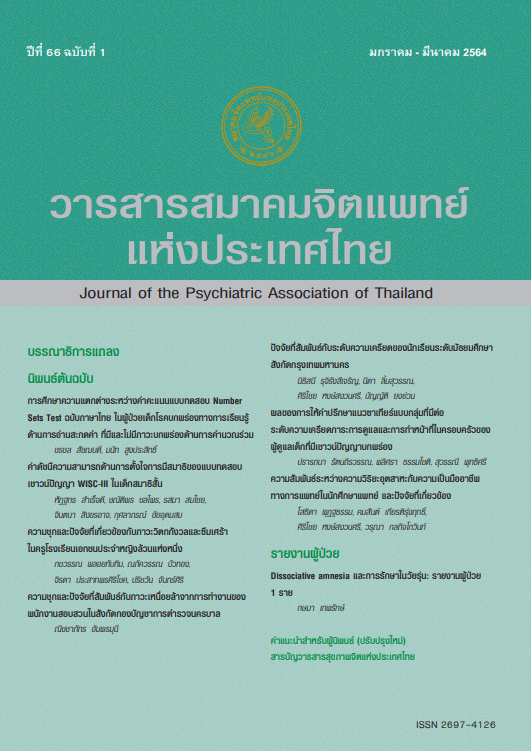
ค่าดัชนีความสามารถด้านการตั้งใจการมีสมาธิของแบบทดสอบเชาวน์ปัญญา WISC-III ในเด็กสมาธิสั้น
Article Sidebar
Main Article Content
บทคัดย่อ
บทคัดย่อ
วัตถุประสงค์ เพื่อทดสอบค่าเฉลี่ยดัชนีการตั้งใจการมีสมาธิ (Freedom from distractibility Index; FDI) ของแบบทดสอบเชาวน์ปัญญา WISC-III ในเด็กสมาธิสั้น
วิธีการศึกษา การศึกษาแบบภาคตัดขวาง (Cross-sectional study) ทบทวนรายงานผลการทดสอบทางจิตวิทยา โรงพยาบาลศรีนครินทร์ สังกัดคณะแพทยศาสตร์ มหาวิทยาลัยขอนแก่น ย้อนหลังระหว่างวันที่ 1 มกราคม 2556 ถึง 30 กรกฎาคม 2563 ของผู้ป่วยอายุ 6 - 16 ปี จำนวน 125 คน ซึ่งได้รับการวินิจฉัยจากจิตแพทย์ตามเกณฑ์ DSM-5 และประเมินเชาวน์ปัญญาโดยนักจิตวิทยาคลินิกด้วยแบบทดสอบวัดความสามารถทางสติปัญญา WISC-III ฉบับภาษาไทย ทดสอบค่าเฉลี่ยด้วยสถิติ One sample t-test ทดสอบสมมติฐานโดยกำหนดให้ค่าดัชนีการตั้งใจการมีสมาธิ (FDI) อยู่ระหว่าง 90 ถึง 109 คะแนน
ผลการศึกษา คะแนนเฉลี่ย FDI อยู่ในช่วง 90 – 109 คะแนน อย่างมีนัยสำคัญทางสถิติ (p-value <0.0001)
สรุป คะแนน FDI ของเด็กสมาธิสั้นอยู่ในเกณฑ์ปกติ แต่เป็นค่าที่ต่ำที่สุดเมื่อเปรียบเทียบกับเชาวน์ปัญญาและค่าดัชนีความสามารถด้านอื่นๆ
คำสำคัญ ค่าดัชนีการตั้งใจการมีสมาธิ, แบบทดสอบเชาวน์ปัญญา, สมาธิสั้น
Article Details
บทความที่ส่งมาเพื่อพิจารณา ต้องไม่เคยตีพิมพ์หรือได้รับการตอบรับให้ตีพิมพ์ในวารสารฉบับอื่น และต้องไม่อยู่ระหว่างการส่งไปพิจารณาในวารสารอื่น
เอกสารอ้างอิง
1. Chaiudomsom K, Paholpak P, Vadhanavikkit P, Paholpak P. Psychiatry. Khon kaen: Klungnana Vitthaya Press; 2559.
2. Association AP. Diagnostic and statistical manual of mental disorders (DSM-5®). American Psychiatric Pub; 2013.
3. Rajanukul Institute Department of Mental Health Ministry of Public Health. Teacher Manual: Student Care System for Special Children with Learning Disabilities. Bangkok: Beyond Publishing Company Limited; 2555. 9 p.
4. Apinuntavech S. Treating ADHD with medications And psychosocial therapy in Thailand. Siriraj Med Bull. 2019;9(3):175–81.
5. Dangnumkoo D. Parenting stress in caretakers of children with ADHD. Chulalongkorn University; 2006.
6. Vitola ES, Bau CHD, Salum GA, Horta BL, Quevedo L, Barros FC, et al. Exploring DSM-5 ADHD criteria beyond young adulthood: phenomenology, psychometric properties and prevalence in a large three-decade birth cohort. Psychol Med. 2017;47(4):744.
7. Voort JL Vande, He J-P, Jameson ND, Merikangas KR. Impact of the DSM-5 attention-deficit/hyperactivity disorder age-of-onset criterion in the US adolescent population. J Am Acad Child Adolesc Psychiatry. 2014;53(7):736–44.
8. Aboul-ata MA, Amin FA. The prevalence of ADHD in Fayoum City (Egypt) among school-age children: depending on a DSM-5-based rating scale. J Atten Disord. 2018;22(2):127–33.
9. Matte B, Anselmi L, Salum GA, Kieling C, Gonçalves H, Menezes A, et al. ADHD in DSM-5: a field trial in a large, representative sample of 18-to 19-year-old adults. Psychol Med. 2015;45(2):361–73.
10. Visanuyothin T, Pavasuthipaisit C, Wachiradilok P, Arunruang P, Buranasuksakul T. The prevalence of attention deficit/hyperactivity disorder in Thailand. J Ment Heal Thail. 2013;21(2):66–75.
11. Boon-yasidhi V. Attention Deficit Hyperactivity Disorder: Diagnosis and Management. J Psychiatr Assoc Thail. 2012;57(4):379.
12. Thongthammarat Y. The Study of Intelligence Quotient of the 6-16 years olds Children with ADHD Tested with WISC-III [Internet]. 2552. Available from: http://www.jvkk.go.th/researchnew/qrresearch.asp?code=0102897
13. Schwean VL, Saklofske DH. 5 - Wisc-III Assessment of Children with Attention Deficit/Hyperactivity Disorder. In: Prifitera A, Saklofske DHBT-W-ICU and I, editors. Practical Resources for the Mental Health Professional [Internet]. San Diego: Academic Press; 1998. p. 91–118. Available from: http://www.sciencedirect.com/science/article/pii/B9780125649308500061
14. Dickerson Mayes S, Calhoun SL, Crowell EW. WISC-III freedom from distractibility as a measure of attention in children with and without attention deficit hyperactivity disorder. J Atten Disord. 1998;2(4):217–27.
15. Krane E, Tannock R. WISC-III third factor indexes learning problems but not Attention Deficit/Hyperactivity Disorder. J Atten Disord [Internet]. 2001 Sep 1;5(2):69–78. Available from: https://doi.org/10.1177/108705470100500201
16. Mayes SD, Calhoun SL. WISC-IV and WISC-III profiles in children with ADHD. J Atten Disord. 2006;9(3):486–93.
17. Daniel WW, Cross CL. Biostatistics: a foundation for analysis in the health sciences. Wiley; 2018. 190 p.
18. Thawong S. The Developmental of the Short Form of Wechsler Intelligence Scale for Children - Third Edition for Children suspected to Attention Deficit and Hyperactive Disorders. Chang Mai Rajabhat University; 2553.
19. Flynn JR. What is intelligence?: Beyond the Flynn effect. Cambridge University Press; 2007.
20. Antshel KM, Faraone S V, Stallone K, Nave A, Kaufmann FA, Doyle A, et al. Is attention deficit hyperactivity disorder a valid diagnosis in the presence of high IQ? Results from the MGH Longitudinal Family Studies of ADHD. J Child Psychol Psychiatry. 2007;48(7):687–94.
21. Healey D, Rucklidge JJ. An investigation into the relationship among ADHD symptomatology, creativity, and neuropsychological functioning in children. Child Neuropsychol. 2006;12(6):421–38.
22. Mahone EM, Hagelthorn KM, Cutting LE, Schuerholz LJ, Pelletier SF, Rawlins C, et al. Effects of IQ on executive function measures in children with ADHD. Child Neuropsychol. 2002;8(1):52–65.
23. Walg M, Hapfelmeier G, El-Wahsch D, Prior H. The faster internal clock in ADHD is related to lower processing speed: WISC-IV profile analyses and time estimation tasks facilitate the distinction between real ADHD and pseudo-ADHD. Eur Child Adolesc Psychiatry. 2017;26(10):1177–86.
24. Kramer E, Koo B, Restrepo A, Koyama M, Neuhaus R, Pugh K, et al. Diagnostic Associations of processing Speed in a transdiagnostic, pediatric Sample. Sci Rep. 2020;10(1):1–11.
