
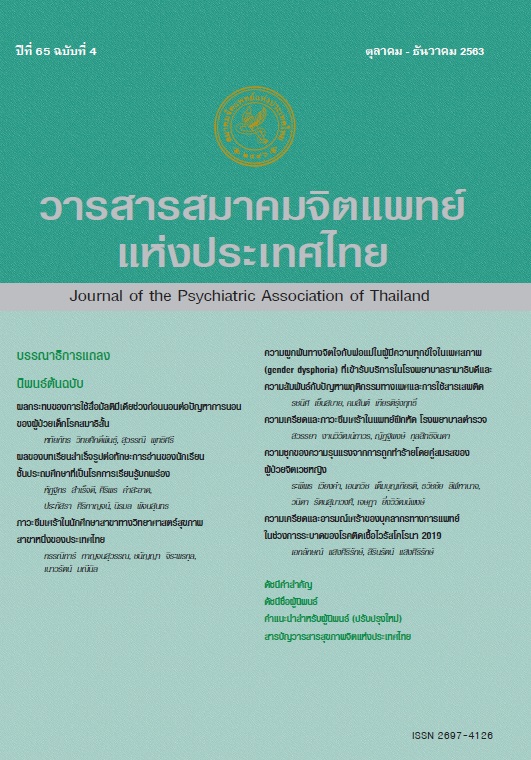
Effects of programed instruction on reading skill among primary school students with learning disorder.
Article Sidebar
Main Article Content
บทคัดย่อ
บทคัดย่อ
วัตถุประสงค์ เพื่อเปรียบเทียบคะแนนการอ่านและคะแนนภาวะซึมเศร้าของนักเรียนชั้นประถมศึกษาที่เป็นโรคการเรียนรู้บกพร่องก่อน และหลังจากได้รับการฝึกด้วยบทเรียนสำเร็จรูปครบ 4 ครั้ง และ 8 ครั้ง
วิธีการศึกษา การวิจัยกึ่งทดลอง มีอาสาสมัครทั้งหมด 23 ราย อายุ 7-11 ปี ได้รับการวินิจฉัยจากจิตแพทย์ว่าเป็นโรคการเรียนรู้บกพร่อง ทำการฝึกการอ่านเด็กทั้งหมดด้วยบทเรียนสำเร็จรูปจำนวน 8 ครั้ง ครั้งละ 30-40 นาที ฝึกทุก 2 สัปดาห์ โดยก่อนฝึกมีการวัดทักษะการอ่านด้วย Wide Range Achievement Test – Thai version และ ภาวะซึมเศร้าวัดด้วยแบบคัดกรองภาวะซึมเศร้าในเด็ก และวัดซ้ำหลังฝึกครบ 4 ครั้ง และ ครบ 8 ครั้ง จากนั้นทำการวิเคราะห์เพื่อเปรียบเทียบคะแนนการอ่านและคะแนนภาวะซึมเศร้าระหว่างการวัดซ้ำ 3 ครั้ง ด้วยการวิเคราะห์ความแปรปรวนแบบวัดซ้ำ
ผลการศึกษา เมื่อเปรียบเทียบก่อนฝึก หลังฝึกครบ 4 ครั้ง และ 8 ครั้ง ค่าเฉลี่ยคะแนนการอ่านได้ถูกต้องมีความแตกต่างกันอย่างมีนัยสำคัญทางสถิติ (p-value <0.001) รวมถึงความคล่องของการอ่าน (p-value <0.001) และคะแนนภาวะซึมเศร้า (p-value = 0.049)
สรุป บทเรียนสำเร็จรูปสามารถทำให้เด็กที่มีการเรียนรู้บกพร่องสามารถอ่านได้อย่างถูกต้องดีขึ้นอย่างมาก แต่ความคล่องของการอ่านและภาวะซึมเศร้าดีขึ้นไม่มาก
Article Details
บทความที่ส่งมาเพื่อพิจารณา ต้องไม่เคยตีพิมพ์หรือได้รับการตอบรับให้ตีพิมพ์ในวารสารฉบับอื่น และต้องไม่อยู่ระหว่างการส่งไปพิจารณาในวารสารอื่น
เอกสารอ้างอิง
1. Chaisudomsom K, Phahonphak P, Wattanawikit P, Phahonphak P. Citwechṣ̄ās̄tr̒ Psychiatry.
Nana Witthaya Printing House; 2559.
2. Association AP. Diagnostic and statistical manual of mental disorders (DSM-5®). American Psychiatric Pub; 2013.
3. Maughan B, Rowe R, Loeber R, Stouthamer-Loeber M. Reading problems and depressed mood. J Abnorm Child Psychol. 2003;31(2):219–29.
4. Görker I. The Prevalence and Gender Differences in Specific Learning Disorder. In: Learning Disabilities. IntechOpen; 2019.
5. Patjanasoontorn N, Singkhorn-ard J, Unphrai P, Srisawat W, Udomsin C, Kittisiriwattanakul O. Learning and Behavioral problems in a Demonstration school children , Education level 1 ( Grade 1-3 ) in Khon Kaen Province. J Psychiatr Assoc Thail. 2011;56(4):345–51.
6. Piyasil V, Wangtan S. Learning Disorders and Comorbidity. J Psychiatr Assoc Thail. 2015;60(4):287–96.
7. Panturee W, Prachanban, Chamnan Panawong P. The Development of Individualized Education Program (IEP) for Students with Learning Disability (LD) Primary Level. Soc Sci Res Acad J. 2556;8(Ld):135–49.
8. Charach A, Fernandez R. Enhancing ADHD medication adherence: challenges and opportunities. Curr Psychiatry Rep. 2013;15(7):371.
9. Khammanee T. 14Wiṭhī s̄xn s̄ảh̄rạb khrū mụ̄x xāchīph. 11th ed. Bangkok: Chulalongkorn University Press; 2555. 99-104 p.
10. Arayawinu P. R I T Krabwnkār s̄xn næw h̄ım̀ (RtI: Response to Instruction). Nakhon Pathom: I.Q.
Book center; 2554.
11. Mercer CD, Campbell KU, Miller MD, Mercer KD, Lane HB. Effects of a reading fluency intervention for middle schoolers with specific learning disabilities. Learn Disabil Res Pract. 2000;15(4):179–89.
12. Scammacca NK, Roberts G, Vaughn S, Stuebing KK. A Meta-Analysis of Interventions for Struggling Readers in Grades 4-12: 1980-2011. J Learn Disabil [Internet]. 2013/10/03. 2015 Jul;48(4):369–90. Available from: https://www.ncbi.nlm.nih.gov/pubmed/24092916
13. Kaewkangwan C, Singhasiwanon P. Tảrā kār wicạy thāng khlinik. Bangkok: Amarin Printing & Publishing Public Co., Ltd.; 2554.
14. Orme DR, Johnstone B, Hanks R, Novack T. The WRAT-3 Reading Subtest as a Measure of Premorbid Intelligence Among Persons With Brain Injury. Rehabil Psychol. 2004;49(3):250.
15. Wiphawee S, Pranduangduen S, Panichsudarat S. Peid mum mxng WRAT-Thai. Journal of Clinical Psychology. 2556;44:1–4.
16. Trangkasombat U, Likanapichitkul D. The Children’s Depression Inventory as a screen for depression in Thai children. J Med Assoc Thai. 1997 Aug;80(8):491–9.
17. Armstrong RA. Recommendations for analysis of repeated‐measures designs: testing and correcting for sphericity and use of manova and mixed model analysis. Ophthalmic Physiol Opt. 2017;37(5):585–93.
18. Songkram N. Kār xxkbæb læa phạtʹhnā mạltimīdeīy pheụ̄̀x kār reīyn rū̂ (MULTIMEDIA FOR LEAMING: DESIGN & DEVELOPMENT). 3rd ed. Bangkok: Publisher of Chulalongkorn University; 2557.
19. Kruakeaw P, Areepong A, Udom P. The Development of Programmed Lessons on Rhetorical Writing for Prathomsuksa 6 Students. Princess Naradhiwas Univ J Humanit Soc Sci. 2018;1:1–10.
20. Honhuan K. The development of programmed instruction on Thai words formation for matthayomsuksa 1 students. Naresuan University; 2010.
21. Yimthanom U. The development of programmed instruction on word compounding in Thai language for matthayomsuksa 3 students. Silpakorn University; 2010. p. 74.
22. Boden A, Archwamety T, McFarland M. Programmed Instruction in Secondary Education: A Meta-Analysis of the Impact of Class Size on Its Effectiveness. 2000;
23. Thanasirikun, A. Effects of using Thai word spelling applications with learning center instruction on Thai word spelling abilities of first grades with reading difficulties. Chulalongkorn University; 2016.
24. Lengjeh A, Chewpattanakul P, Benkarn P. A study of reading ability of students with learning disabilities using rhymes. Research and Special Education Journal. 2560;2:51–64.
25. Hasbrouck J, Glaser DR. Reading fluency: Understanding and teaching this complex skill. Austin, TX: Gibson Hasbrouck & Associates; 2012.
26. Brent DA, Maalouf FT. Pediatric depression: is there evidence to improve evidence‐based treatments? J Child Psychol Psychiatry. 2009;50(1‐2):143–52.
