
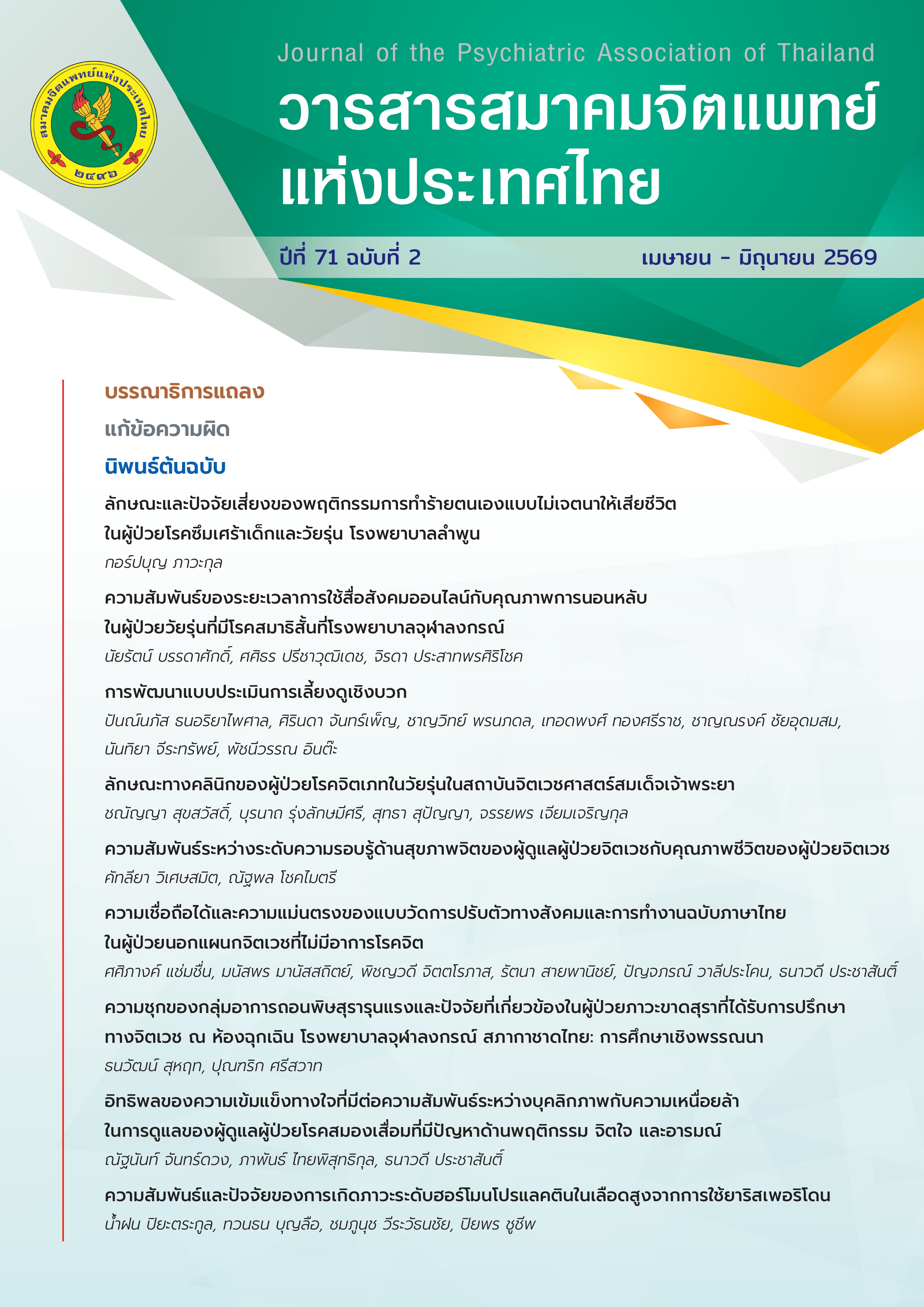
The Association between Caregivers’ Mental Health Literacy Levels and the Quality of Life of Psychiatric Patients
Article Sidebar
Main Article Content
Abstract
Objective: In Thailand, mental health literacy has been emphasized in national policy to improve recognition, help-seeking behavior, and treatment adherence. However, evidence regarding mental health literacy among caregivers of psychiatric patients remains limited. Therefore, this study aimed to assess mental health literacy among caregivers of psychiatric patients, identify associated factors, and examine its association with patients’ quality of life.
Methods: A cross-sectional study was conducted at the psychiatric outpatient department of Phramongkutklao Hospital between January and June 2025. Thirty patient–caregiver dyads were enrolled. Eligible patients were adults aged 18 - 60 years receiving continuous psychiatric treatment for at least six months, and caregivers had provided care for at least six months. Data were collected using the Thai Mental Health Literacy Scale, the WHOQOL-BREF Thai version, the Barthel Activities of Daily Living Index and medical records. Descriptive statistics and logistic regression analyses were performed.
Results: Most caregivers demonstrated a high level of mental health literacy (73.3%). Higher caregiver mental health literacy was significantly associated with caring for patients diagnosed with depression (aOR = 15.84; 95% CI = 1.17 - 214.97; p = 0.038) and with the presence of hallucinations (aOR = 24.82; 95% CI = 1.12 - 551.65; p = 0.042). Most patients reported a moderate level of quality of life (66.7%). In multivariate analysis, the presence of multiple caregivers was the only independent factor associated with better quality of life (aOR = 21.13; 95% CI = 1.44 - 310.94; p = 0.026) No significant association was found between caregiver mental health literacy and patients’ quality of life.
Conclusion: Caregiver mental health literacy was associated with patients’ diagnostic characteristics but was not directly associated with patients’ quality of life. Social support, reflected by having multiple caregivers, appeared to play a more important role in influencing quality of life. Further studies with larger sample sizes are needed to confirm these findings.
Article Details

This work is licensed under a Creative Commons Attribution-NonCommercial-NoDerivatives 4.0 International License.
Articles submitted for consideration must not have been previously published or accepted for publication in any other journal, and must not be under review by any other journal.
References
World Health Organization. Mental disorders [Internet]. Geneva: WHO; 2022 [cited 2024 Mar 4]. Available from: https://www.who.int/news-room/fact-sheets/detail/mental-disorders
Chan SKW, Tse S, Sit HLT, Hui CLM, Lee EHM, Chang WC, et al. Web-based psychoeducation program for caregivers of first-episode psychosis: an experience of the Chinese population in Hong Kong. Front Psychol 2016;7:2006.
Jorm AF. The concept of mental health literacy. In: Orkan O, Ullrich B, Levin-Zamir D, Pinheiro P, Sørensen K, editors. International handbook of health literacy. Bristol (UK): Policy Press; 2019.
Jorm AF. Mental health literacy: public knowledge and beliefs about mental disorders. Br J Psychiatry 2000; 177: 396-401.
Ababu H, Kassaw C, Temesgen K, Sileshy B, Negash M. Mental health literacy and associated factors among residents living in Dilla town, Gedeo zone, Ethiopia, 2022. Res Sq 2022.
Fahmy F, Fayad E, Khedr M. Mental health literacy among psychiatric patients’ family caregivers. Alexandria Sci Nurs J 2023; 25: 118-28.
O'Connor M, Casey L. The Mental Health Literacy Scale (MHLS): a new scale-based measure of mental health literacy. Psychiatry Res 2015; 229: 511-6.
Sittironnarit G, Sri R, Phatharayuttawat S. Psychometric properties of the Thai Mental Health Literacy Scale in sixth-year medical students. J Ment Health 2021; 30: 649-55.
Phongkasem Khaimuk. Policy of the Department of Mental Health, B.E. 2567 [Internet]. Bangkok: Ministry of Public Health; 2023 [cited 2024 Jul 7]. Available from: https://dmh.go.th/intranet/p2567 /policyDMH2567.pdf
Salloum A, Ismail S. Factors associated with mental health literacy among international postgraduate students. Int J Public Health Clin Sci 2020; 7: 14-27.
Singh S, Zaki RA, Farid NDN, Kaur K. The determinants of mental health literacy among young adolescents in Malaysia. Int J Environ Res Public Health 2022; 19: 3242.
Tariku Seboka B, Hailegebreal S, Negash M, Mamo TT, Ali Ewune H, Gilano G, et al. Predictors of mental health literacy and information seeking behavior toward mental health among university students in resource-limited settings. Int J Gen Med 2022; 15: 8159-72.
Phoa PK, Ab Razak A, Kuay HS, Ghazali AK, Ab Rahman A, Husain M, et al. Predictors of mental health literacy among parents, guardians, and teachers of adolescents in West Malaysia. Int J Environ Res Public Health 2023; 20: 825.
Bjørnsen HN, Espnes GA, Eilertsen MB, Ringdal R, Moksnes UK. The relationship between positive mental health literacy and mental well-being among adolescents. J Sch Nurs 2019; 35: 107-16.
Jafari A, Nejatian M, Momeniyan V, Ramezani Barsalani F, Tehrani H. Mental health literacy and quality of life in Iran: a cross-sectional study. BMC Psychiatry 2021; 21: 499.
Zhang Z, Chen S, Wang X, Liu J, Zhang Y, Mei Y, et al. The relationship between mental health literacy and subjective well-being of young and middle-aged residents: the mediating role of social support. Int J Ment Health Promot 2023; 25: 471-83.
Boonpichachan P, Panuthai S, Tamdee D. Mental health literacy and psychological well-being among dependent elders. Nurs J CMU 2022; 49: 186-99.
Yao ZY, Wang T, Yu YK, Li R, Sang X, Fu YN, et al. Mental health literacy and suicidal ideation among Chinese college students: the mediating role of depressive symptoms and anxiety symptoms. J Affect Disord 2023;339:293-301
Ediriweera HW, Fernando SM, Pai NB. Mental health literacy survey among Sri Lankan carers of schizophrenia and depression. Asian J Psychiatr 2012; 5: 246-50.
Mohamad MS, Putit Z, Ibrahim F, Sar N. Mental health literacy among family caregivers of schizophrenia patients. Asian Soc Sci 2012; 8: 74-82.
Phosai W, Boonchu R, Watradul D, Makkaphonlanon K, Thangkathok P. Mental health literacy and quality of life among stroke patients. Chiang Mai Med J 2021; 60: 63-74.
Thongduang K, Boonchieng W, Chautrakarn S, Ong-Artborirak P. Influence of family caregiver knowledge and behavior on elderly diabetic patients' quality of life in Northern Thailand. Int J Environ Res Public Health 2022; 19: 10216.
Dong M, Lu L, Zhang L, Zhang YS, Ng CH, Ungvari GS, et al. Quality of life in schizophrenia: a meta-analysis of comparative studies. Psychiatr Q 2019; 90: 519-32.
Petrovic AD, Barjaktarevic AM, Kostic OZ, Dimitrijevic JM, Mijailovic SS, Gogic AD, et al. Evaluation of quality of life in patients with schizophrenia: an inpatient social welfare institution-based cross-sectional study. Open Med 2024;19: 20240947.
Mahatnirunkul S. WHOQOL-BREF Thai version [Internet]. Bangkok: Department of Mental Health; [cited 2024 Jul 1]. Available from: https://dmh.go.th/test/whoqol/
Ministry of Public Health. Barthel Index ADL assessment form [Internet]. Bangkok: Ministry of Public Health; [cited 2024 Jul 1]. Available from: http://203.157.185.18/download/hosxp/
Jorm AF. Mental health literacy: empowering the community to take action. Am Psychol 2012; 67: 231-43.
Poreddi V, Thimmaiah R, Math SB. Mental health literacy among caregivers of persons with mental illness. J Neurosci Rural Pract 2015; 6: 355-60.
Reavley NJ, Jorm AF. Young people’s recognition of mental disorders and beliefs about treatment. Aust N Z J Psychiatry 2011; 45: 890-8.
Furnham A, Swami V. Mental health literacy: a review of what it is and why it matters. Int Perspect Psychol 2018; 7: 240-57.
Tough H, Brinkhof MW, Siegrist J, Fekete C. Untangling the role of social relationships in caregiver burden and health. BMC Public Health 2022; 22:14127.
Almulla H, Aljaloud O, Almulla H, Nasser S. Caregiver burden, perceived stress, and social support among parents of chronically ill children in Saudi Arabia.BMC Nurs 2024;23:811.
Cohen S, Wills TA. Stress, social support, and the buffering hypothesis. Psychol Bull 1985; 98: 310-57.
Chappell NL, Reid RC. Burden and well-being among caregivers. Gerontologist 2002; 42: 772-80.
Pearlin LI, Mullan JT, Semple SJ, Skaff MM. Caregiving and the stress process. Gerontologist 1990; 30:583-94.
Gellert P, Häusler A, Suhr R, Mösch E, Hütter P, Werle J, et al. Testing the stress-buffering hypothesis in couples coping with early-stage dementia. PLoS One 2018; 13: e0189849.
Norman RM, Malla AK, Verdi MB, Hassall LD, Fazekas C. Understanding delay in treatment for first-episode psychosis. Psychol Med 2004; 34: 255-66.
Toohey MJ, Muralidharan A, Medoff D, Lucksted A, Dixon L. Caregiver positive and negative appraisals: effects of the National Alliance on Mental Illness Family-to-Family intervention. J Nerv Ment Dis 2016; 204: 156-9.
