
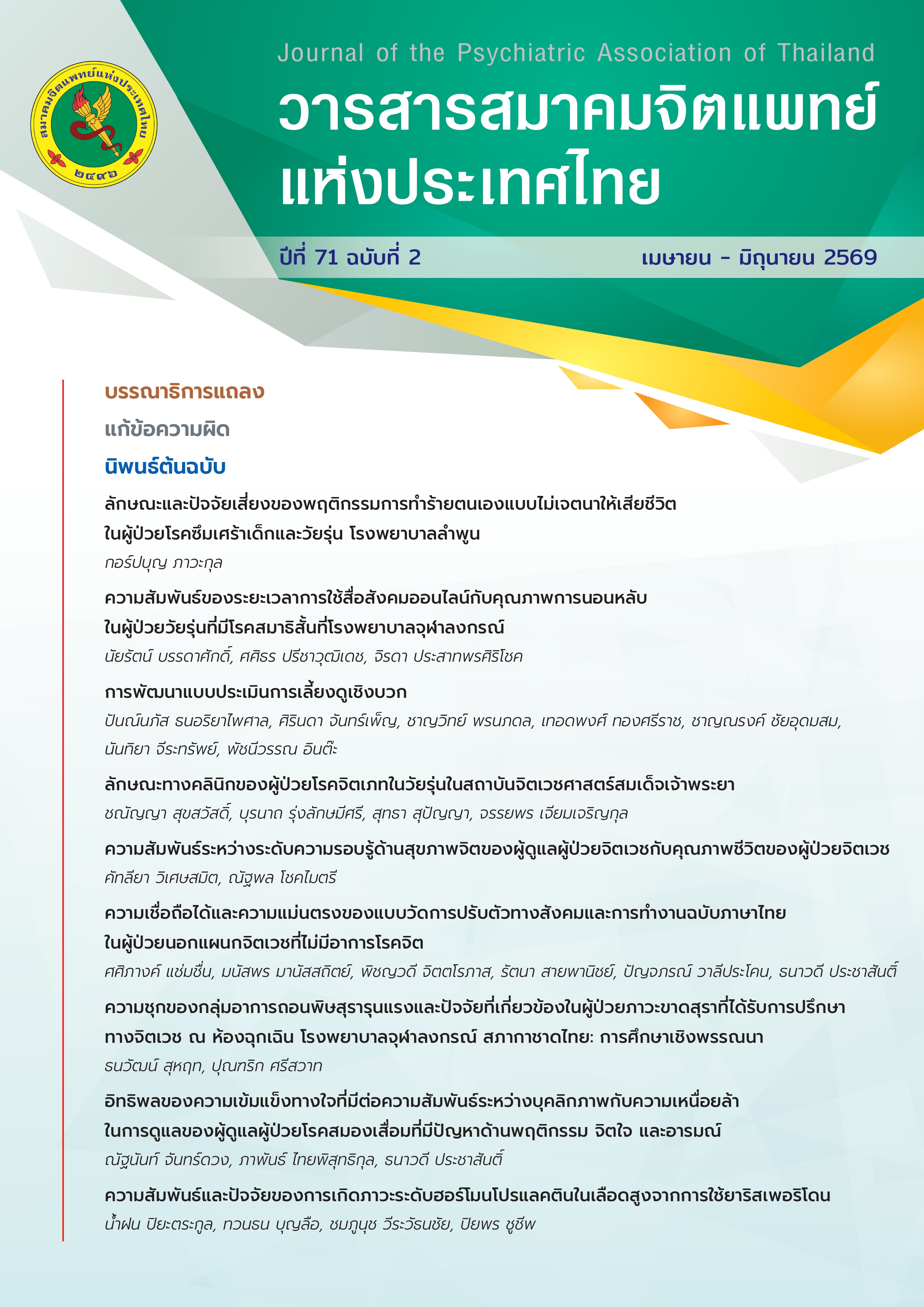
Prevalence of Severe Alcohol Withdrawal Syndrome and Its Associated Factors among Alcohol Withdrawal Syndrome Patients Receiving Psychiatric Consultation at The Emergency Department at King Chulalongkorn Memorial Hospital: A Descriptive Study
Article Sidebar
Main Article Content
Abstract
Objective: To determine the prevalence of severe alcohol withdrawal syndrome and identify factors associated with alcohol withdrawal in patients presenting to the emergency department of a tertiary hospital.
Methods: This retrospective descriptive study included 179 patients diagnosed with Alcohol Withdrawal Syndrome (AWS) at the Emergency Department, King Chulalongkorn Memorial Hospital. Severe AWS was defined by an AWS score >15, delirium tremens, withdrawal seizures, or physician diagnosis. Clinical history and laboratory data were analyzed using univariate analysis and multivariate analysis using Generalized Linear Model (GLM) with a Hierarchical approach to identify factors associated with severe alcohol withdrawal syndrome.
Results: The prevalence of severe AWS among patients receiving psychiatric consultation was 73.7% (n = 132 of 179). Multivariate analysis identified history of alcohol withdrawal seizures as the strongest factor associated with severe AWS (Adjusted Odds Ratio [AOR], 5.50; 95% CI, 1.75 - 24.76). Additionally, significantly inverse associations were identified for bicarbonate levels (AOR, 0.31 per 10 mmol/L increase; 95% CI, 0.13 - 0.69) and Platelets count (AOR, 0.58 per 100,000/μL increase; 95% CI, 0.38 - 0.87), indicating that lower levels of these markers were associated with severe AWS.
Conclusion: The prevalence of severe AWS in this cohort of patients receiving psychiatric consultation was high. History of alcohol withdrawal seizures, bicarbonate levels, and Platelets count were statistically significant factors associated with severe AWS. However, due to the retrospective cross-sectional design, these factors cannot be directly applied as predictors. Prospective studies are needed to confirm the direction of these associations and evaluate their predictive capability.
Article Details

This work is licensed under a Creative Commons Attribution-NonCommercial-NoDerivatives 4.0 International License.
Articles submitted for consideration must not have been previously published or accepted for publication in any other journal, and must not be under review by any other journal.
References
Alcohol Control Committee Office, Department of Disease Control, Ministry of Public Health. The second national action plan on alcohol control (B.E. 2565-2570). Nonthaburi: Department of Disease Control, Ministry of Public Health; 2022.
Kittirattanapaiboon P, Tantirangsee N, Chutha W, Tanaree A, Kwansanit P, Assanangkornchai S. The 2013 national mental health survey of Thailand: methods and procedures. J Ment Health Thai 2016;24(1):1-14.
Suen L, Makam A, Snyder H, Repplinger D, Kushel M, Martin M, et al. National prevalence of alcohol and other substance use disorders among emergency department visits and hospitalizations: NHAMCS 2014-2018. J Gen Intern Med 2022;37(10):2420-8.
Livne O, Finn RS, Knox J, Hartwell EE, Gelernter J, Hasin DS, et al. Alcohol withdrawal in past-year drinkers with unhealthy alcohol use: prevalence, characteristics, and correlates in a national epidemiologic survey. Alcohol Clin Exp Res 2022;46(3):422-33.
Perry EC. Inpatient management of acute alcohol withdrawal syndrome. CNS Drugs 2014;28(5):401-10.
Lalitanantpong D. Alcohol withdrawal: syndrome and treatment. Chula Med J 2010;54(1):67-79.
Jesse S, Bråthen G, Ferrara M, Keindl M, Ben-Menachem E, Tanasescu R, et al. Alcohol withdrawal syndrome: mechanisms, manifestations, and management. Acta Neurol Scand 2017;135(1):4-16.
Pribék IK, Kovács I, Kádár BK, Kovács CS, Richman MJ, Janka Z, et al. Evaluation of the course and treatment of alcohol withdrawal syndrome with the Clinical Institute Withdrawal Assessment for Alcohol-Revised: a systematic review-based meta-analysis. Drug Alcohol Depend 2021;220:108536.
Holleck JL, Merchant N, Gunderson CG. Symptom-triggered therapy for alcohol withdrawal syndrome: a systematic review and meta-analysis of randomized controlled trials. J Gen Intern Med 2019;34(6):1018-24.
Daeppen JB, Gache P, Landry U, Sekera E, Schweizer V, Gloor S, et al. Symptom-triggered vs fixed-schedule doses of benzodiazepine for alcohol withdrawal. Arch Intern Med 2002;162(10):1117-23.
Jitthitikulchai T. Area-based health service networking to alleviate personnel shortage. J Health Syst Res 2020;14(3):243-73.
Shu JE, Lin A, Chang G. Alcohol withdrawal treatment in the medically hospitalized patient: a pilot study assessing predictors for medical or psychiatric complications. Psychosomatics 2015;56(5):547-55.
Reoux JP, Malte CA, Kivlahan DR, Saxon AJ. The Alcohol Use Disorders Identification Test (AUDIT) predicts alcohol withdrawal symptoms during inpatient detoxification. J Addict Dis 2002;21(4):81-91.
Monte R, Rabuñal R, Casariego E, Bal M, Pértega S. Risk factors for delirium tremens in patients with alcohol withdrawal syndrome in a hospital setting. Eur J Intern Med 2009;20(7):690-4.
Sarkar S, Choudhury S, Ezhumalai G, Konthoujam J. Risk factors for the development of delirium in alcohol dependence syndrome: clinical and neurobiological implications. Indian J Psychiatry 2017;59(3):300-5.
Benson G, McCallum J, Roberts NJ. Risk factors for severe alcohol withdrawal syndrome in an acute hospital population. J Addict Nurs 2019;30(3):159-68.
Berggren U, Fahlke C, Berglund KJ, Blennow K, Zetterberg H, Balldin J. Thrombocytopenia in early alcohol withdrawal is associated with development of delirium tremens or seizures. Alcohol Alcohol 2009;44(4):382-6.
Kim DW, Kim HK, Bae EK, Park SH, Kim KK. Clinical predictors for delirium tremens in patients with alcohol withdrawal seizures. Am J Emerg Med 2015;33(5):701-4.
Yıldırım YE, Umut G, Evren C, Yeral E, Secerli H. Neutrophil-lymphocyte ratio as a predictor of delirium tremens in hospitalized patients with alcohol withdrawal. Alcohol 2023;109:43-8.
Rosoff DB, Charlet K, Jung J, Lee J, Muench C, Luo A, et al. Lipid profile dysregulation predicts alcohol withdrawal symptom severity in individuals with alcohol use disorder. Alcohol 2020;86:93-101.
Wood E, Albarqouni L, Tkachuk S, Green CJ, Ahamad K, Nolan S, et al. Will this hospitalized patient develop severe alcohol withdrawal syndrome?: the rational clinical examination systematic review. JAMA 2018;320(8):825-33.
Mirijello A, D'Angelo C, Ferrulli A, Vassallo G, Antonelli M, Caputo F, et al. Identification and management of alcohol withdrawal syndrome. Drugs 2015;75(4):353-65.
Prakash R, Gupta D, Jose NA, Bhardwaj A. Risk factors for delirium tremens among individuals with alcohol use disorder in a tertiary care hospital. Int J Sci Res 2023;12(5):47-51.
Shukla A, Saurabh, Shukla A, Kukreti P, Kataria D. Assessing financial status, legal status, employment status and social relationships in patients with complicated and uncomplicated alcohol withdrawal. Indian J Psychiatry 2022;64(Suppl 3):S658.
Eyer F, Schuster T, Felgenhauer N, Pfab R, Strubel T, Saugel B, et al. Risk assessment of moderate to severe alcohol withdrawal-predictors for seizures and delirium tremens in the course of withdrawal. Alcohol Alcohol 2011;46(4):427-33.
Monte-Secades R, Blanco-Soto M, Díaz-Peromingo JA. Epidemiological and sociodemographic factors associated with complicated alcohol withdrawal syndrome. Rev Clin Esp (Barc) 2017;217(7):381-6.
Chien NH, Thi Thuy An L, Viet Chung N. Associated factors for the development of alcohol withdrawal delirium. VNU J Sci Med Pharm Sci 2022;38(3):1-8.
Saravithi J. Prevalence and associated factors of alcohol withdrawal delirium in trauma patients at a tertiary care hospital in lower northeastern Thailand. J Psychiatr Assoc Thailand 2025;70(3):407-29.
Teeratanatorn S, Ratta-apha W, Wansrisuthon W, Puangtai S, Sa-nguanpanich N. Factors associated with alcohol withdrawal or alcohol-withdrawal delirium among inpatients with alcohol use in a general hospital setting: a comparison before and during the COVID-19 pandemic. Addicta 2024;11(3):357-65.
Burapakajornpong N, Maneeton B, Srisurapanont M. Pattern and risk factors of alcohol withdrawal delirium. J Med Assoc Thai 2011;94(8):991-7.
Teetharatkul T, Vittayanont A. Delirium tremens in psychiatric ward at Songklanagarind Hospital. J Health Sci Med Res 2018;36(3):213-22.
Kalayasiri R, Sareedenchai P. Associated factors of delirium tremens in the inpatients receiving psychiatric consultation-liaison service for alcohol-related problems. Chula Med J 2022;66(1):57-64.
Ukranun W. Risk factors for alcohol withdrawal delirium in patient with alcohol dependence of Thanyarak Maehongson Hospital. J Dept Med Serv 2019;44(6):39-45.
Patrakorn A, Tippayawong T, Renuwattananon A, Rattanasang P, Lakkhanaphichonchat W, editors. Clinical practice guideline of alcohol withdrawal patient for multidisciplinary team. 2nd ed. Pathum Thani: Princess Mother National Institute on Drug Abuse Treatment; 2015.
Steel TL, Matson TE, Hallgren KA, Luce C, Achtmeyer CE, Bradley KA. Incidence of hospitalizations involving alcohol withdrawal syndrome in a primary care population. JAMA Netw Open 2024;7(10):e2438128.
Simel DL. Severe alcohol withdrawal syndrome. In: Simel DL, Rennie D, editors. The rational clinical examination: evidence-based clinical diagnosis. New York: McGraw-Hill Education; 2009. p. 649-58.
Maldonado JR, Sher Y, Ashouri JF, Hills-Evans K, Swendsen H, Lolak S, et al. The "Prediction of Alcohol Withdrawal Severity Scale" (PAWSS): systematic literature review and pilot study of a new scale for the prediction of complicated alcohol withdrawal syndrome. Alcohol 2014;48(4):375-90.
Hosmer DW Jr, Lemeshow S, Sturdivant RX. Applied logistic regression. 3rd ed. Hoboken (NJ): John Wiley & Sons; 2013.
Westreich D. Berkson's bias, selection bias, and missing data. Epidemiology 2012;23(1):159-64.
Brown ME, Anton RF, Malcolm R, Ballenger JC. Alcohol detoxification and withdrawal seizures: clinical support for a kindling hypothesis. Biol Psychiatry 1988;23(5):507-14.
