
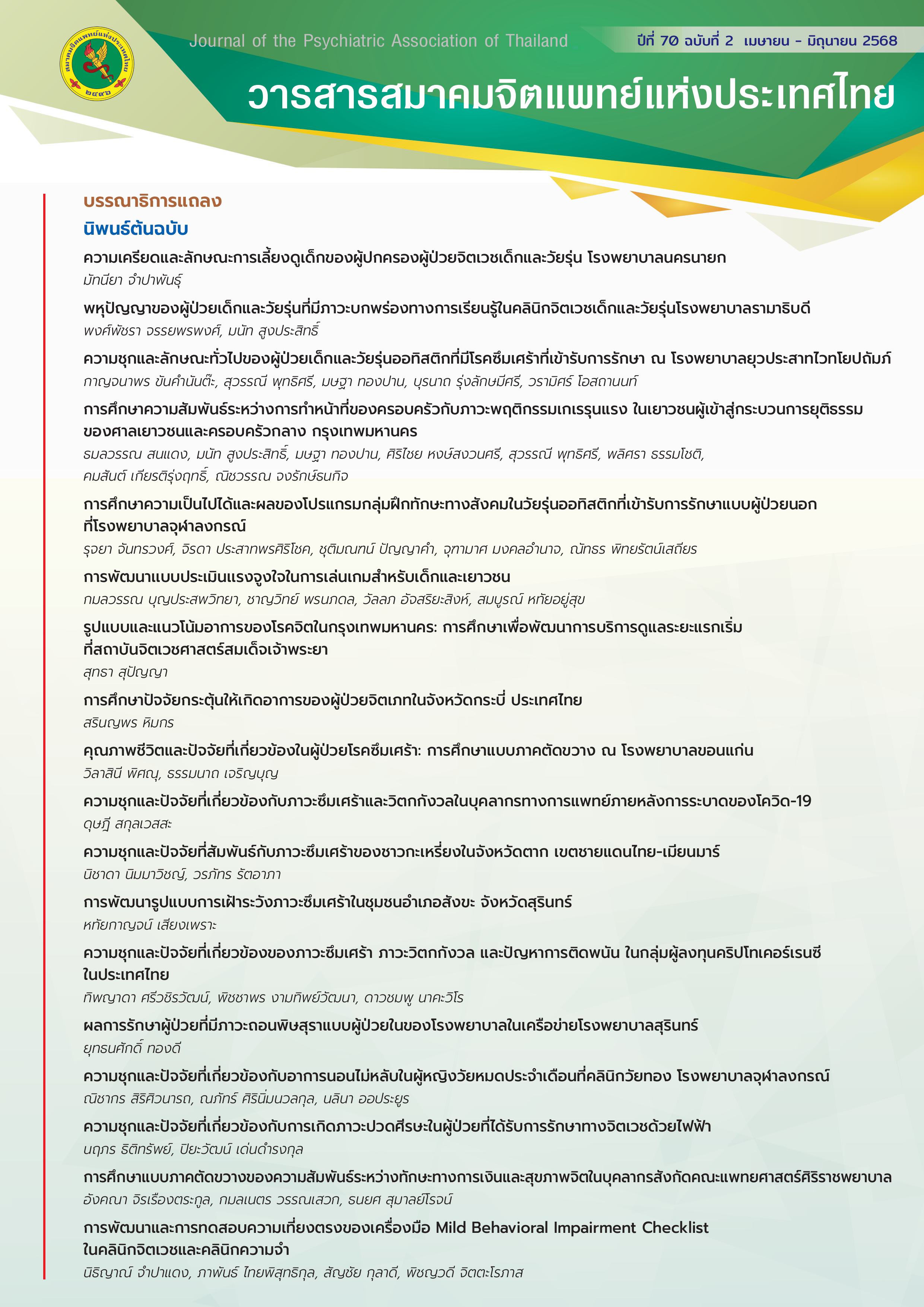
The Cross-Sectional Study of the Relationship between Financial Literacy and Mental Health among Employees and Eealth Professionals in the Faculty of Medicine Siriraj Hospital
Article Sidebar
Main Article Content
Abstract
Objectives: To examine the relationship between financial literacy in terms of financial knowledge, financial attitudes, financial behavior, and mental health among employees and health professionals in the Faculty of Medicine Siriraj hospital. It also aimed to assess the levels of financial knowledge, financial attitudes, financial behavior, and mental health of the employees and health professionals, as well as to investigate the personal factors affecting financial literacy and mental health.
Methods: This research was a cross-sectional study involving a sample of 164 individuals aged 20-60 years. A set of questionnaires were administered including a personal information questionnaire, the Depression, Anxiety, and Stress Scale (DASS-21), and a financial literacy questionnaire. The relationships between variables were analyzed using Pearson's or Spearman's correlation coefficients for quantitative variables.
Results: Among 164 employees and health professionals at the Faculty of Medicine Siriraj Hospital, a significant weak negative correlation was found between financial literacy and both anxiety (rs = -0.210, p = 0.007) and depression (rs = -0.240, p = 0.002). Additionally, most participants had financial literacy scores, financial knowledge, financial attitudes, and financial behaviors in the expected range: 89.0%, 84.8%, 89.0%, and 87.8% respectively. Moreover, more than half of participants had normal mental health scores in terms of stress, anxiety, and depression, with 65.9%, 53.0%, and 56.7%, respectively. From the multiple logistic regression analysis (Nagelkerke R2=0.252), it was found that depression and some personal factors such as the number of children and average monthly income significantly affected financial literacy (p < 0.05). Depression was associated with an 80% lower chance of having better financial literacy (OR = 0.20, 95% CI 0.06 - 0.68, p = 0.010). An increase in the number of children was associated with a 44% lower chance of having better financial literacy (OR = 0.56, 95% CI 0.34 - 0.92, p = 0.021). Higher average monthly income was associated with a 2.93 times higher chance of having better financial literacy (OR = 2.93, 95% CI 1.03 - 8.34, p = 0.044).
Conclusion: The financial literacy of most employees and health professionals at the Faculty of Medicine Siriraj Hospital-as measured by their financial knowledge, attitudes, and behaviors-fell within the expected range. More than half of them had normal levels of stress, anxiety, and depression. Lower financial literacy was significantly correlated with higher levels of anxiety and depression. Depression and personal factors such as the number of children and average monthly income were found to significantly affect financial literacy.
Article Details

This work is licensed under a Creative Commons Attribution-NonCommercial-NoDerivatives 4.0 International License.
Articles submitted for consideration must not have been previously published or accepted for publication in any other journal, and must not be under review by any other journal.
References
Sachin K, Hengudomsub P, Vatanasin D Factors influencing mental health status of professional nurses in a private hospital. J Health Nurs Res 2019;35: 98-111.
Guan N, Guariglia A, Moore P, Xu F, Al-Janabi H. Financial stress and depression in adults: A systematic review. PLoS One 2022;17(2): 1-20.
Inlakorn S. An Analysis of financial literacy of students at Kasetsart University Si Racha Campus. Interdisciplinary Sripatum Chonburi J 2020;6(2): 78-90.
Ansong A. Level of knowledge in personal finance by university freshmen business students. J Bus Manag 2011;5(22): 8933-40.
Chen H, Volpe RP. An analysis of personal financial literacy among college students. Financ Serv Rev 1998;7(2): 107-28.
Chen H, Volpe RP. Gender differences in personal financial literacy among college students. Financ Serv Rev 2002;11(3): 289-307.
Khan F, Siddiqui MA, Imtiaz S, Shaikh SA, Chen C-L, Wu C-M. Determinants of mental and financial health during COVID-19: Evidence from data of a developing country. Front Public Health 2022;10: 1-8.
Mulsrisuk S, Dharmakulsakti P, Keha C, Ratta-apha W, Saisavoey N, Lortrakul J. Stress and factors associated with stress in frontline healthcare workers during the COVID-19 pandemic in Thailand. Vajira Nurs J 2023;25: 15-25.
Ahakwa I, Yang J, Tackie EA, Atingabili S. The influence of employee engagement, work environment and job satisfaction on organizational commitment and performance of employees: a sampling weights in PLS path modelling. SEISENSE J Manag 2021;4(3): 34-62.
Bank of Thailand. Thai financial literacy survey 2016 [Internet]: Bank of Thailand; 2016 [cited 2025 Feb 27]. Available from: https://www.bot.or.th/content/dam/bot/image/research-and-publications/2559ThaiFLsurvey.pdf.
Samit A. Organizational commitment among employees working for Nikompattana sub-district administrative organization, Rayong province. [Internet]: Samit A; 2015 [cited 2025 Feb 26]. Available from: https://buuir.buu.ac.th/bitstream/1234567890/10852/1/Fulltext.pdf.
Lestari SD, Muhdaliha E, Firdaus PM, Suhendra ES, Brabo NA. Financial Literacy at Work: enhancing organizational performance through employee training investments. Jurnal Ilmiah Akuntansi 2024;7(1):721-41.
Oei TPS, Sawang, S, Goh YW, Mukhtar F. Using the depression anxiety stress scale 21 (DASS-21) across cultures. Int J Psychol 2013;48(6): 1018-29.
Morero JA, Esteves RB, Vieira MV, Park T, Hegadoren KM, Cardoso L. Systematic review of the use of Depression Anxiety Stress scale 21 (DASS-21) in the elderly: Practical applicability across countries. Res Soc Dev 2024;13(2): 1-14.
Bank of Thailand. Thailand financial literacy survey report 2022 [Internet] Bangkok: Bank of Thailand; 2022 [cited 2024 Nov 6]. Available from: https://www.bot.or.th/content/dam/bot/image/research-and-publications/2565ThaiFLsurvey.pdf.
OECD. OECD/INFE 2020 international survey of adult financial literacy [Internet]. Paris: Organisation for Economic Co-operation and Development; 2020 [cited 2024 Nov 6]. Available from: https://www.oecd-ilibrary.org/docserver/145f5607-en.pdf?expires=1730867003&id=id&accname=guest&checksum=50A9A3F5958AFD269BC9B47D7508D450.
Elbay RY, Kurtulmuş A, Arpacıoğlu S, Karadere E. Depression, anxiety, stress levels of physicians and associated factors in Covid-19 pandemics. Psychiatry Res 2020;290: 1-5.
Vittengl JR. Low household income, financial literacy, or financial health: Which is the strongest risk factor and outcome of depressive symptomatology? J Health Psychol 2024;29(4): 455-68.
FinHealth Network. Financial health frontiers: households under financial pressure [Internet]. 2024 [cited 2024 Dec 15]. Available from: https://finhealthnetwork.org/wp-content/uploads/2024/09/Financial-Health-Frontiers-Households-Under-Financial-Pressure.pdf.
Guiso L, Pistaferri L, Schivardi F. Lifetime income and current income inequality [Internet]. Cambridge (MA): National Bureau of Economic Research; 2019 [cited 2024 Dec 15]. Available from: https://www.nber.org/system/files/working_papers/w25597/w25597.pdf.
Lusardi A, Mitchell OS. The economic importance of financial literacy: Theory and evidence. Journal of Economic Literature. 2014;52(1): 5-44.
