
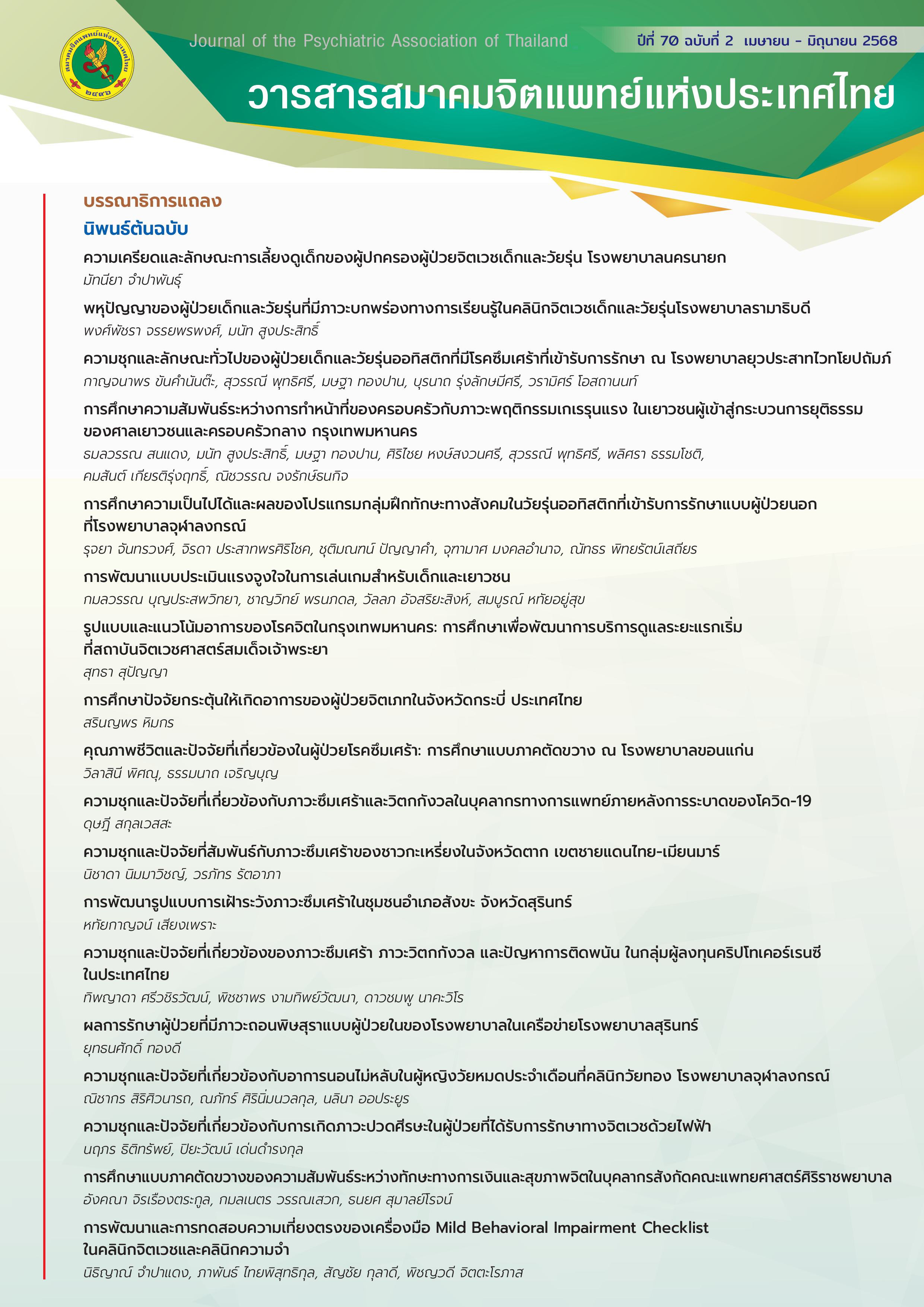
Multiple Intelligences of Children and Adolescents with Specific Learning Disorders at the Child and Adolescent Psychiatry Clinic, Ramathibodi Hospital
Article Sidebar
Main Article Content
Abstract
Objective: This study aimed to explore the different types of multiple intelligences in individuals with specific learning disorders and to examine the relationship between factors related to comorbid conditions, intelligence quotient (IQ) scores, the severity level and types of specific learning disorders, and the multiple intelligences in different areas.
Methods: A cross-sectional study was conducted, collecting data from 101 patients with specific learning disorders at the Child and Adolescent Psychiatry Clinic, Ramathibodi Hospital. Multiple intelligences were assessed using the Multiple Intelligences Screening and Development Manual from the Office of the Education Council, Ministry of Education, with parents as respondents.
Results: The study found that the most prominent types of intelligence in individuals with specific learning disorders were bodilykinesthetic (53.5%) and naturalistic intelligence (47.5%). The least prominent type of intelligence was musical intelligence (18.8%). A significant relationship was found between verballinguistic intelligence and a co-occurring diagnosis of depression (p = 0.013). No significant correlation was found between type of specific learning disorders, severity of specific learning disorders, intelligence quotient (IQ), demographic characteristics, and the different types of multiple intelligences.
Conclusion: The study found that bodilykinesthetic and naturalistic intelligences were the most pronounced in individuals with specific learning disorders, while musical intelligence was the least. A relationship was observed between verballinguistic intelligence and co-occurring depression. No significant correlation was found between IQ scores and multiple intelligences.
Article Details

This work is licensed under a Creative Commons Attribution-NonCommercial-NoDerivatives 4.0 International License.
Articles submitted for consideration must not have been previously published or accepted for publication in any other journal, and must not be under review by any other journal.
References
Commodari E, Rosa VLL, Sagone E, Indiana ML. Interpersonal adaptation, self-efficacy, and metacognitive skills in Italian adolescents with specific learning disorders: a cross-sectional study. Eur J Investig Health Psychol Educ 2022; 12: 1034–49.
Kasani SR, Tafti MA, Mahdi SM, Farahi M, Ebrahimabad MJA. Visual working memory performance based on fixations and saccades in children with and without specific learning disorder: an eye-tracking study. Cogn Brain Behav 2018; 22: 233-45.
Nemati S, Pourtaleb N, BadriGargari R, Hashemi T, Deetjen R, Shojaeian N. The effectiveness of acceptance and commitment training program on the level of academic stress and academic burnout in students with specific learning disability. Adv Neurodev Disord 2023; 7: 502-11.
Suvarnakich K, Rohitsuk W, Phattharayuttawat S, Ariyanuchitkul S, Patoommas P. Academic problems in primary schools in Bangkok. J Psychiatr Assoc Thailand 1999; 44: 55-64.
Ajmal M, Hussain J. Comparative analysis of literacy skills, writing and numeracy attained by the students of formal and non-formal schools at primary level in Islamabad capital territory. BER 2022; 44: 23-38.
Apinuntavech S, Seree P, Yongyuan B. Mental health problem in grade 4th- 6th students with a different academic achievement in school mental health project of Bangkok metropolitan area. SWU Education Journals 2017; 1: 46-58.
Nisu S, Konganan W, Arsan C, Roekwiang A, Piampuech R. Quality of life and self-esteem in children with specific learning disorder after receiving treatment. J Med Assoc Thai 2022; 105: 87-93.
lbayrak ZS, Kadak MT, Hatice, Gurbuz HGA, Dogangun B. Emotion recognition skill in specific learning disorder and attention-deficit hyperactivity disorder. Alpha Psychiatry 2022; 23: 268-73.
Hearne D, Stone S. Multiple intelligences and underachievement: lessons from Individuals with learning disabilities. J Learn Disabil 1995; 28: 439-48.
Chanpleng P, Wisuttranukul A, Khwanrat J, Poopan S, Pattrawiwat K, Kijtorntham W, et al. Development of the multiple intelligences promotion model for Thai learners. EU-JER 2023; 12: 663–71.
Furnham A, Fukomoto S. Japanese parents’ estimates of their own and their children’s multiple intelligences: cultural modesty and moderate differentiation. JPA 2008; 50: 63–76.
Hasanuddin, Dewi SS, Siregar ES, Tarigan K. Exploration of the description and relationship of each learning style and multiple intelligences of high school students. JPSP 2022; 6: 1439-48.
Shearer CB, Karanian JM. The neuroscience of intelligence: empirical support for the theory of multiple intelligences. Trends Neurosci Educ 2017; 6: 211-23.
Makkonen T, Lavonen J, Tirri K. Self-evaluated multiple intelligences of gifted upper-secondary-school physics students in Finland. Roeper Rev 2022; 44: 19–34.
Sener S, Cokcaliskan A. An investigation between multiple intelligences and learning styles. JETS 2018; 6: 125-32.
Hernandez-Torrano D, Ferrandiz C, Ferrando M, Prieto L, Fernandez MDC. The theory of multiple intelligences in the identification of high-ability students. Annals of Psychology 2014; 30: 192–200.
Jaina S, Kotharib S, Kumar RH, Jaine C. The relationship between auditory and cognitive processing abilities in children with specific learning disorders. ASHA 2024; 33: 824-36.
Flaugnacco E, Lopez L, Terribili C, Zoia S, Buda S, Tilli S, et al. Rhythm perception and production predict reading abilities in developmental dyslexia. fnhum 2014; 8: 1-14.
Books: Kaplan HI, Sadock BJ, Ruitz P. Synopsis of psychiatry: behavioral sciences, clinical psychiatry. 11th ed. Baltimore: Wolters & Kluwer; 2015.
Alessandra P, Enrico G. Specific learning disorders in vocational music training: screening tools and qualitative study among students of AFAM institutes. PSICOL CLIN SVILUPP 2023; 27: 205-25.
Cancer A, Bonacina S, Lorusso ML, Lanzi PL, Antonietti A. Rhythmic reading training (RRT) a computer-assisted intervention program for dyslexia. CCIS 2016; 604: 249–58.
Penney AM, Miedema VC, Mazmanian D. Intelligence and emotional disorders: Is the worrying and ruminating mind a more intelligent mind. ISSID 2015; 74: 90-3.
You Z, You R, Zheng J, Wang X, Zhang F, Li X, et al. The role of sense of control and rumination in the association between childhood trauma and depression. Curr Psychol 2024; 43: 27875–85.
Bonifacci P, Tobia V, Marra V, Desideri L, Baiocco R, Ottaviani C. Rumination and emotional profile in children with specific learning disorders and their parents. Int J Environ Res Public Health 2020; 17: 1-14.
Najafi M, Akouchekian S, Ghaderi A, Mahaki B, Rezaei M. Multiple intelligences profiles of children with attention deficit and hyperactivity disorder in comparison with nonattention deficit and hyperactivity disorder. Adv Biomed Res 2017;6:148-55.
Feraco T, Meneghetti C. Sport practice, fluid reasoning, and soft skills in 10- to 18-year-olds. Front Hum Neurosci 2022; 16: 1-8.
Bazalo B, Morales-Sanchez V, Pérez-Romero N, Contreras-Osorio F, Campos-Jara C, Hernandez-Mendo A, et al. Associations between fluid intelligence and physical fitness in school children. Healthcare 2024; 12: 1-10.
Garcia-Botero L, Aguilar-Barreto AJ, Rincon-Alvarez GA. Relationship between multiple intelligences and gender. Mundo Fesc 2021; 11: 366-74.
Rodriguez-Manasse GA, Aguilar-Barreto AJ, Rincon-Alvarez GA. Multiple intelligences in students from vulnerable socioeconomic contexts. Perspectivas 2022; 7: 220-8.
